On the decidability of semigroup freeness
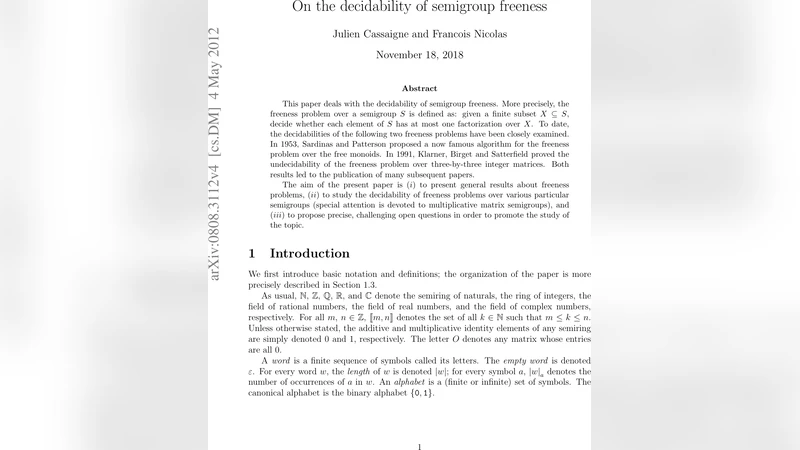
This paper deals with the decidability of semigroup freeness. More precisely, the freeness problem over a semigroup S is defined as: given a finite subset X of S, decide whether each element of S has at most one factorization over X. To date, the decidabilities of two freeness problems have been closely examined. In 1953, Sardinas and Patterson proposed a now famous algorithm for the freeness problem over the free monoid. In 1991, Klarner, Birget and Satterfield proved the undecidability of the freeness problem over three-by-three integer matrices. Both results led to the publication of many subsequent papers. The aim of the present paper is three-fold: (i) to present general results concerning freeness problems, (ii) to study the decidability of freeness problems over various particular semigroups (special attention is devoted to multiplicative matrix semigroups), and (iii) to propose precise, challenging open questions in order to promote the study of the topic.
💡 Research Summary
The paper investigates the decidability of the freeness problem for semigroups. Given a finite subset X of a semigroup S, the problem asks whether every element of S has at most one factorisation over X. The authors begin by formalising this notion and by reviewing two landmark results: the Sardinas‑Patterson algorithm (1953), which decides freeness for the free monoid, and the Klarner‑Birget‑Satterfield theorem (1991), which proves undecidability for the semigroup of 3 × 3 integer matrices. Building on these, the paper develops a general framework that isolates the algebraic conditions under which a finite‑state procedure can decide freeness. A key insight is that if a semigroup is left‑ (or right‑) cancellative, the set of “prefix‑suffix overlaps” generated from X is guaranteed to be finite, allowing a systematic enumeration akin to the Sardinas‑Patterson construction.
The authors then apply the framework to several concrete families. For commutative semigroups, the overlap condition collapses to a simple congruence test, yielding a polynomial‑time decision algorithm. In the matrix setting, they distinguish dimensions. For 2 × 2 integer matrices, both the determinant‑nonzero case and the singular case admit decidable procedures; special subclasses such as upper‑triangular or 0‑1 matrices are treated in detail, with explicit algorithms that terminate after finitely many steps. By contrast, for dimension three and higher, the paper reproduces the Klarner‑Birget‑Satterfield reduction, showing that the freeness problem encodes the halting problem and is therefore undecidable in general.
A further contribution concerns product constructions. The paper proves that the free product of semigroups preserves freeness: if each component semigroup admits a unique‑factorisation property for its own generating set, then the combined free product also does. Conversely, the direct product does not enjoy this preservation; the authors construct examples where one factor is non‑cancellative (e.g., a matrix semigroup) and the resulting product admits multiple distinct factorizations, thereby violating freeness.
The final section compiles a comprehensive table of known decidability and undecidability results, and it poses several open problems designed to stimulate further research. Among these are questions about the exact complexity class of freeness for non‑commutative, but still cancellative, semigroups; the impact of imposing finiteness on certain sub‑semigroups; and whether additional algebraic constraints (such as being aperiodic or having a bounded exponent) can render the problem decidable in higher dimensions. By bridging classic results with new structural insights, the paper advances our understanding of how algebraic properties of semigroups influence the algorithmic tractability of the freeness problem.
Comments & Academic Discussion
Loading comments...
Leave a Comment