Breaking the Blazar Sequence: A New View of Radio Loud AGN Unification
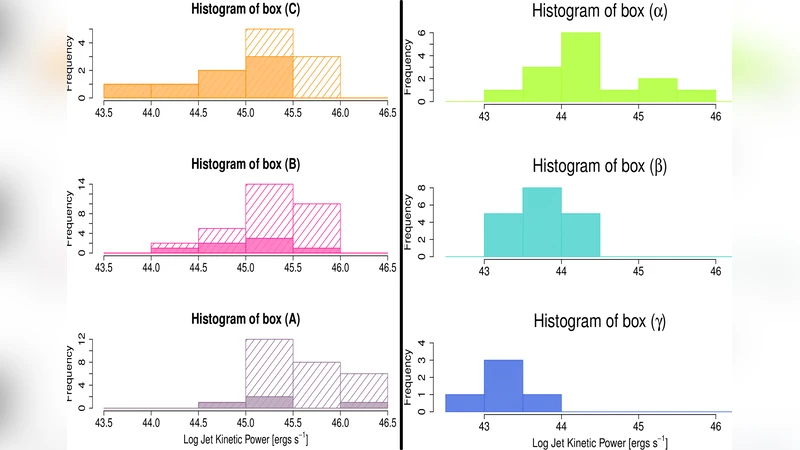
In recent work, we have identified two sub-populations of radio-loud AGN which appear to be distinguished by jet structure, where low-efficiency accreting systems produce weak' jets which decelerate more rapidly than the strong’ jets of black holes accreting near the Eddington limit. The two classes are comprised of: (1) The weak jet sources, corresponding to FR I radio galaxies, having a decelerating or spine-sheath jet with velocity gradients, and (2) The strong jet sources, having fast, collimated jets, and typically displaying strong emission lines. The dichotomy in the \nu_peak-L_peak plane can be understood as a `broken power sequence’ in which jets exist on one branch or the other based on the particular accretion mode. We suggest that the intrinsic kinetic power (as measured by low-frequency, isotropic radio emission), the orientation, and the accretion rate of the SMBH system are the the fundamental axes needed for unification of radio-loud AGN by studying a well-characterized sample of several hundred Fermi-detected jets. Finally, we present very recent findings that the most powerful strong jets produce gamma-rays by external Compton rather than SSC emission, placing the dissipation region in these strong jets at a radius inside the BLR and/or molecular torus.
💡 Research Summary
The authors present a revised unification scheme for radio‑loud active galactic nuclei (AGN) based on a large, well‑characterized sample of several hundred Fermi‑detected jets. They argue that the traditional “blazar sequence” – a single continuous relation between synchrotron peak frequency (ν_peak) and peak luminosity (L_peak) – cannot accommodate the full diversity of radio‑loud AGN. Instead, they identify two distinct sub‑populations that are fundamentally separated by the accretion mode of the super‑massive black hole (SMBH).
-
Weak‑jet sources – These correspond to low‑efficiency accretors (ṁ ≲ 10⁻³ Eddington) that host radiatively inefficient accretion flows (RIAFs/ADAFs). Their jets are decelerating, often exhibiting a spine‑sheath velocity gradient. Because the external photon fields are weak, the high‑energy emission is dominated by synchrotron self‑Compton (SSC). The resulting synchrotron peaks lie at low frequencies and the peak luminosities are modest. This class includes FR I radio galaxies and most BL Lac objects.
-
Strong‑jet sources – These are high‑efficiency accretors (ṁ ≈ Eddington) with standard thin disks that generate intense broad‑line region (BLR) and dusty torus photon fields. Their jets remain highly collimated and relativistic over large distances. The dominant γ‑ray production mechanism is external Compton (EC) scattering of BLR/torus photons, which yields much higher L_peak for a given ν_peak. This group comprises FR II radio galaxies, powerful quasars, and many flat‑spectrum radio quasars (FSRQs).
When plotted in the ν_peak‑L_peak plane, the two groups form a “broken power‑law” rather than a single smooth curve. The authors demonstrate that the intrinsic kinetic power of the jet (Q), estimated from low‑frequency isotropic radio emission (e.g., 151 MHz), correlates differently with L_peak for the two branches. Weak jets show a shallow Q–L_peak relation, whereas strong jets display a steep rise, reflecting the increasing efficiency of EC as Q grows.
A third axis—orientation (θ)—modulates the observed luminosities through relativistic beaming, but does not erase the fundamental bifurcation caused by accretion mode. By combining Q, θ, and ṁ, the authors propose a three‑dimensional unification framework that can simultaneously explain the observed distribution of synchrotron peaks, the diversity of γ‑ray spectra, and the morphological differences between FR I and FR II radio galaxies.
A key new result is that the most powerful strong‑jet sources appear to produce γ‑rays inside the BLR or torus (r ≈ 0.1–1 pc). This places the dissipation region well within the traditional “far‑downstream” zone assumed for SSC‑dominated blazars, implying that external photon fields play a decisive role in shaping the high‑energy output of the most luminous AGN jets.
Overall, the paper offers a coherent, physically motivated picture that unifies radio‑loud AGN across the full range of jet powers, orientations, and accretion states, and it sets the stage for future high‑resolution VLBI and multi‑wavelength campaigns to test the proposed three‑axis scheme.