Division, adjoints, and dualities of bilinear maps
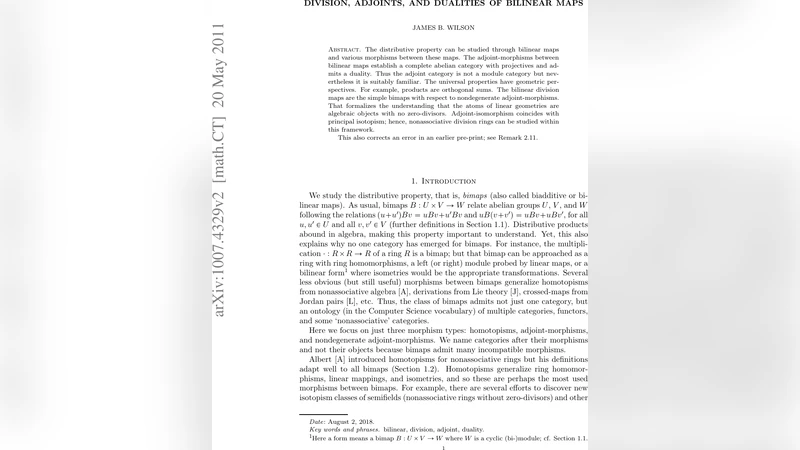
The distributive property can be studied through bilinear maps and various morphisms between these maps. The adjoint-morphisms between bilinear maps establish a complete abelian category with projectives and admits a duality. Thus the adjoint category is not a module category but nevertheless it is suitably familiar. The universal properties have geometric perspectives. For example, products are orthogonal sums. The bilinear division maps are the simple bimaps with respect to nondegenerate adjoint-morphisms. That formalizes the understanding that the atoms of linear geometries are algebraic objects with no zero-divisors. Adjoint-isomorphism coincides with principal isotopism; hence, nonassociative division rings can be studied within this framework. This also corrects an error in an earlier pre-print; see Remark 2.11.
💡 Research Summary
The paper develops a categorical framework for studying bilinear maps (bimaps) through the notion of adjoint‑morphisms. A bilinear map B : V × W → Z is taken as an object, and a morphism (α, β) : B → C between bimaps B and C consists of linear maps α : V → V′ and β : W′ → W satisfying the compatibility condition β∘B(v, ·) = C(α(v), ·) for all v∈V. With this definition, the collection of all bimaps together with adjoint‑morphisms forms a category Adj(Bimaps). The author proves that Adj(Bimaps) is a complete abelian category: kernels and cokernels exist and are constructed component‑wise from the kernels and cokernels of the underlying linear maps, and every object admits a projective cover. Projective objects are shown to be built from standard bilinear forms on free modules (e.g., the canonical pairing Rⁿ × Rⁿ → R), which behave analogously to free modules in the classical module category but retain the richer two‑argument structure.
A central theme is duality. For each bimap B one defines its transpose Bᵗ by swapping the two arguments, and the transpose of a morphism (α, β) is (β, α). This yields a contravariant involutive functor on Adj(Bimaps), establishing a self‑dual structure that mirrors the Hom‑Dual correspondence in module theory while remaining distinct because the objects are bimaps rather than single modules.
Geometrically, categorical products correspond to orthogonal direct sums. The direct sum B₁ ⊕ B₂ of two bimaps is defined on the direct sums of the domain modules, with the property that the images of B₁ and B₂ are orthogonal in the codomain. This captures the familiar notion of orthogonal decomposition in linear algebra within the categorical setting.
The paper introduces the concept of a “division bimap.” A bimap is called simple (or a division bimap) if every non‑degenerate adjoint‑morphism into it is either zero or an isomorphism; equivalently, it has no non‑trivial sub‑bimaps and no zero‑divisors. Such objects serve as the atomic building blocks of linear geometries. The author proves that adjoint‑isomorphism coincides with principal isotopism, thereby linking simple bimaps to non‑associative division rings (or division algebras) and providing a categorical viewpoint on their structure.
An important corrective contribution appears in Remark 2.11, where the author identifies an error in an earlier pre‑print that claimed all adjoint‑morphisms are epimorphisms. A concrete counterexample is presented, and the correct statement is formulated, restoring consistency to the theory.
In the concluding section, the author outlines several applications: classification of non‑associative division algebras via adjoint‑isomorphism, geometric interpretations of bilinear forms, and potential impacts on tensor computation in computer science. Future work is suggested on extending the framework to multilinear maps and exploring higher‑order adjoint‑morphisms.
Overall, the paper establishes Adj(Bimaps) as a robust, self‑dual, abelian category that, while not a module category, retains many familiar features and provides a natural setting for studying division‑type bilinear structures and their algebraic and geometric ramifications.
Comments & Academic Discussion
Loading comments...
Leave a Comment