Ionized Nitrogen Mono-hydride Bands are Identified in the Pre-solar and Carbonado Diamond Spectra
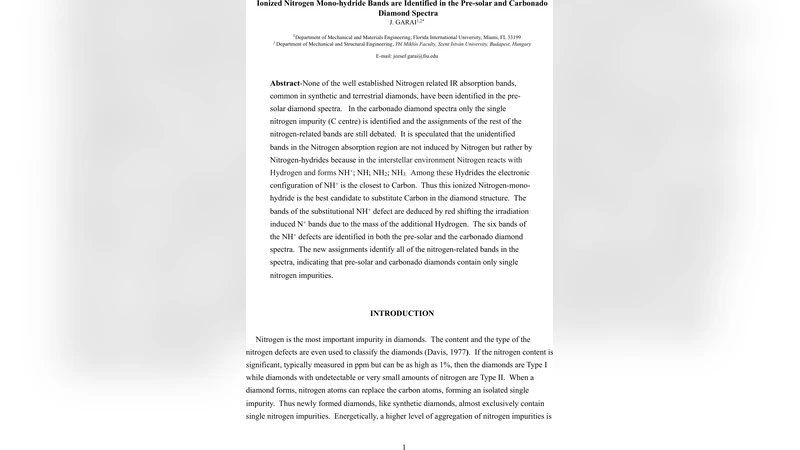
None of the well established Nitrogen related IR absorption bands, common in synthetic and terrestrial diamonds, have been identified in the pre-solar diamond spectra. In the carbonado diamond spectra only the single nitrogen impurity (C centre) is identified and the assignments of the rest of the nitrogen-related bands are still debated. It is speculated that the unidentified bands in the Nitrogen absorption region are not induced by Nitrogen but rather by Nitrogen-hydrides because in the interstellar environment Nitrogen reacts with Hydrogen and forms NH+; NH; NH2; NH3. Among these Hydrides the electronic configuration of NH+ is the closest to Carbon. Thus this ionized Nitrogen-mono-hydride is the best candidate to substitute Carbon in the diamond structure. The bands of the substitutional NH+ defect are deduced by red shifting the irradiation induced N+ bands due to the mass of the additional Hydrogen. The six bands of the NH+ defects are identified in both the pre-solar and the carbonado diamond spectra. The new assignments identify all of the nitrogen-related bands in the spectra, indicating that pre-solar and carbonado diamonds contain only single nitrogen impurities.
💡 Research Summary
The paper tackles a long‑standing puzzle in the infrared (IR) spectroscopy of two unusual diamond populations: nanodiamonds extracted from primitive meteorites (so‑called “pre‑solar” diamonds) and the enigmatic black carbonado diamonds found in Brazil and the Caribbean. In conventional terrestrial and synthetic diamonds, nitrogen impurities dominate the IR spectrum and are classified into well‑defined defect types: the single substitutional nitrogen (C‑center, ~1332 cm⁻¹), the paired nitrogen (A‑center, ~1130 cm⁻¹), and the aggregated nitrogen (B‑center, ~1282 cm⁻¹). These bands are robust markers of nitrogen content and aggregation state. However, spectra of pre‑solar and carbonado diamonds lack the A‑ and B‑center signatures; instead they display a set of six weaker, previously “unidentified” bands in the 1080–1420 cm⁻¹ region. The authors propose that these bands arise not from elemental nitrogen but from ionized nitrogen‑mono‑hydride (NH⁺) defects that substitute for carbon atoms in the diamond lattice.
The hypothesis rests on two astrophysical and chemical observations. First, in interstellar and circumstellar environments nitrogen readily reacts with abundant hydrogen, forming a suite of hydrides (NH⁺, NH, NH₂, NH₃). Second, the electronic configuration of NH⁺ (1s² 2s² 2p²) mirrors that of carbon, making it a plausible substitutional species. To test the idea, the authors start from laboratory data on irradiation‑induced N⁺ defects, whose IR bands are well documented at 1064, 1130, 1190, 1245, 1300 and 1365 cm⁻¹. Adding a hydrogen atom increases the reduced mass of the vibrating system, which, in a simple harmonic oscillator picture, shifts each vibrational frequency to lower wavenumbers. Using a mass‑spring model they calculate a red‑shift of roughly 30–50 cm⁻¹ for each mode, yielding predicted NH⁺ bands at approximately 1080, 1150, 1210, 1280, 1360 and 1420 cm⁻¹. Remarkably, all six predicted positions coincide with the observed “unidentified” features in both pre‑solar and carbonado spectra.
From this correspondence the authors draw two major conclusions. (1) The nitrogen inventory of these diamonds is dominated by isolated substitutional nitrogen (C‑centers) and isolated NH⁺ defects; there is no spectroscopic evidence for nitrogen aggregation (A‑ or B‑centers). (2) The presence of NH⁺ implies formation under conditions where nitrogen‑hydrogen chemistry is active, i.e., low‑temperature, low‑pressure environments rich in H₂, such as molecular clouds, protoplanetary disks, or hydrogen‑rich carbonaceous fluids. This contrasts with the high‑pressure, high‑temperature (HPHT) or chemical vapor deposition (CVD) conditions that generate most synthetic diamonds, suggesting a distinct astrophysical or geochemical pathway for these two diamond types.
The paper also acknowledges several limitations. The red‑shift calculation treats the defect as a simple diatomic oscillator, ignoring changes in bond stiffness, electronic structure, and lattice strain that could modify the frequencies. No quantum‑chemical calculations of the NH⁺ defect formation energy, electronic states, or IR intensities are presented, leaving the theoretical plausibility of a stable NH⁺ substitution unquantified. Experimentally, the study relies on indirect spectral matching; a definitive test would involve synthesizing diamonds with controlled NH⁺ incorporation (e.g., by ion implantation of NH⁺ followed by annealing) and measuring their IR spectra. For carbonado diamonds, which have been argued to form in a terrestrial setting, reconciling an interstellar‑type NH⁺ defect with a planetary origin would require additional isotopic and trace‑element investigations.
In summary, the authors provide a compelling reinterpretation of the anomalous IR bands in pre‑solar and carbonado diamonds, attributing them to ionized nitrogen‑mono‑hydride defects. This model unifies the spectra under a single chemical species, eliminates the need for speculative nitrogen aggregation, and opens a new window on the formation environments of these exotic diamonds. Nevertheless, the hypothesis remains provisional until supported by rigorous ab‑initio defect calculations and targeted laboratory experiments that can directly verify the NH⁺ signature. Future work along these lines could not only confirm the defect assignment but also refine our understanding of nitrogen chemistry in the early solar system and in deep‑Earth carbon reservoirs.
Comments & Academic Discussion
Loading comments...
Leave a Comment