Upper bounds for centerlines
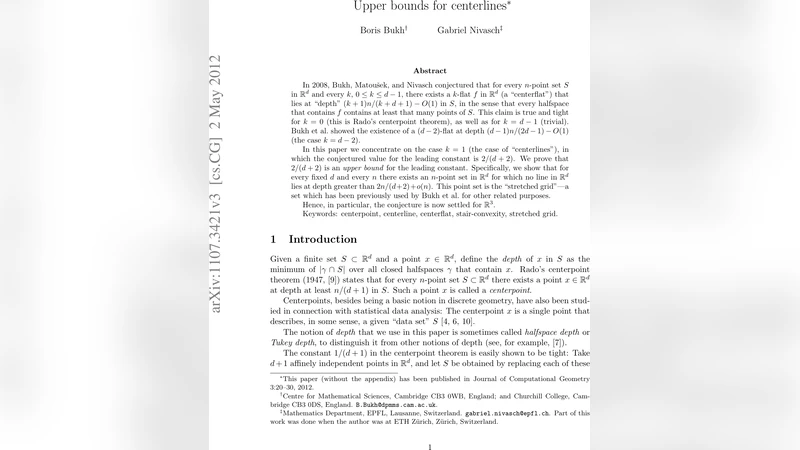
In 2008, Bukh, Matousek, and Nivasch conjectured that for every n-point set S in R^d and every k, 0 <= k <= d-1, there exists a k-flat f in R^d (a “centerflat”) that lies at “depth” (k+1) n / (k+d+1) - O(1) in S, in the sense that every halfspace that contains f contains at least that many points of S. This claim is true and tight for k=0 (this is Rado’s centerpoint theorem), as well as for k = d-1 (trivial). Bukh et al. showed the existence of a (d-2)-flat at depth (d-1) n / (2d-1) - O(1) (the case k = d-2). In this paper we concentrate on the case k=1 (the case of “centerlines”), in which the conjectured value for the leading constant is 2/(d+2). We prove that 2/(d+2) is an upper bound for the leading constant. Specifically, we show that for every fixed d and every n there exists an n-point set in R^d for which no line in R^d lies at depth larger than 2n/(d+2) + o(n). This point set is the “stretched grid”—a set which has been previously used by Bukh et al. for other related purposes. Hence, in particular, the conjecture is now settled for R^3.
💡 Research Summary
The paper addresses the long‑standing conjecture of Bukh, Matoušek, and Nivasch concerning “center k‑flats” in ℝᵈ, focusing on the case k = 1, i.e., centerlines. The conjecture predicts that for any n‑point set S⊂ℝᵈ there exists a line ℓ such that every closed halfspace containing ℓ also contains at least (k + 1)n/(k + d + 1) − O(1) points of S. For k = 1 this translates to a depth of at least 2n/(d + 2) − O(1). While the conjecture is known to be tight for k = 0 (Rado’s centerpoint theorem) and trivial for k = d − 1, the exact constant for k = 1 had remained open.
The authors construct a specific point configuration called the “stretched grid” Gₛ. For a given n and fixed dimension d, they set m = ⌈n^{1/d}⌉ and define a grid of size m in each coordinate. The coordinates are scaled by a rapidly increasing sequence of factors K₁, K₂, …, K_d, where K₁ = 2ᵈ and K_{i+1} = K_i^{,m}. This makes the spacing between successive “layers” in each dimension grow exponentially, so that points that are far apart in the original space become extremely far in the later coordinates, while points that are close remain close after a logarithmic mapping.
A key technical tool is the notion of stair‑convexity and stair‑halfspaces. For a reference point a∈ℝᵈ the space is partitioned into d + 1 regions C₀(a),…,C_d(a) defined by component‑wise inequalities relative to a. A stair‑halfspace is any union of a selected subset of these regions, with a as the “vertex”. Lemma 2.4 shows that for any such stair‑halfspace there exists an ordinary Euclidean halfspace H₀ whose boundary passes through a and which coincides with the stair‑halfspace on all points that are at least one “layer” away from a. Thus stair‑halfspaces can be viewed as limits of Euclidean halfspaces under the exponential scaling.
The central combinatorial result is the “covering lemma” (Lemma 3.1). Given any two points p, q∈ℝᵈ, the authors construct a family ℋ of (d − 1)(d + 2)/2 stair‑halfspaces, each containing both p and q, such that the union of the halfspaces covers ℝᵈ exactly d − 1 times (points on the boundaries may be covered more). The construction proceeds by induction on the dimension. In the base case d = 2, two stair‑halfplanes are sufficient. For higher dimensions, a covering in ℝ^{d‑1} is lifted to ℝᵈ and supplemented by d additional stair‑halfspaces that handle the top and bottom parts of the space.
Applying the covering lemma to the stretched grid yields the main theorem (Theorem 1.1): for any fixed d and any n there exists an n‑point set Gₛ⊂ℝᵈ such that every line ℓ is contained in some halfspace that captures at most 2n/(d + 2) + o(n) points of Gₛ. In other words, no line can achieve depth larger than 2n/(d + 2) + o(n). This proves that the conjectured leading constant 2/(d + 2) is an upper bound, i.e., it cannot be improved.
When d = 3, the result combines with the previously known existence of a (d − 2)‑flat at depth (d − 1)n/(2d − 1) − O(1) to give a tight bound: every 3‑dimensional point set admits a line of depth at least 2n/5 − O(1), and the stretched grid shows that 2/5 is optimal. Hence the centerline conjecture is completely settled in ℝ³.
Beyond settling the conjecture for k = 1, the paper demonstrates the power of the stretched grid and stair‑convexity framework. These tools have already been employed in related problems such as lower bounds for weak ε‑nets and upper bounds for the first selection lemma, and the present work suggests they may be useful for a broader class of high‑dimensional geometric problems.
In summary, the authors provide a clean, constructive counterexample that matches the conjectured depth bound, thereby establishing the optimality of the constant 2/(d + 2) for centerlines. The result closes a gap in the theory of center k‑flats, enriches the toolbox of discrete geometry with stair‑convex constructions, and has potential implications for algorithmic applications that rely on depth‑type guarantees.
Comments & Academic Discussion
Loading comments...
Leave a Comment