On the parameter $mu_{21}$ of a complete bipartite graph
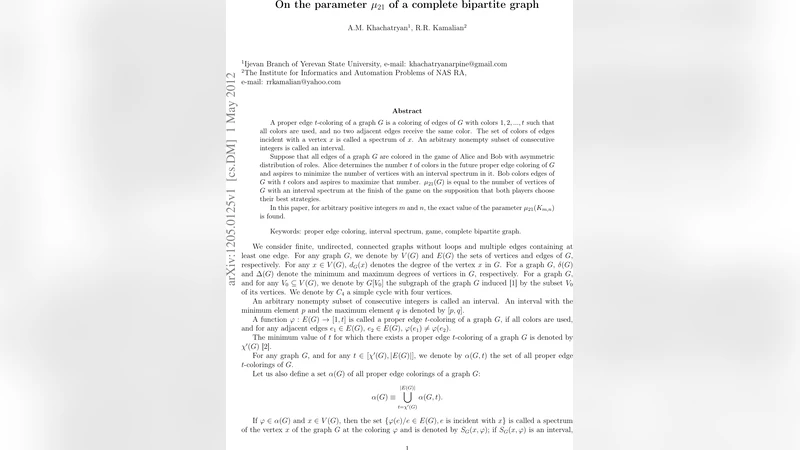
A proper edge $t$-coloring of a graph $G$ is a coloring of edges of $G$ with colors $1,2,…,t$ such that all colors are used, and no two adjacent edges receive the same color. The set of colors of edges incident with a vertex $x$ is called a spectrum of $x$. An arbitrary nonempty subset of consecutive integers is called an interval. Suppose that all edges of a graph $G$ are colored in the game of Alice and Bob with asymmetric distribution of roles. Alice determines the number $t$ of colors in the future proper edge coloring of $G$ and aspires to minimize the number of vertices with an interval spectrum in it. Bob colors edges of $G$ with $t$ colors and aspires to maximize that number. $\mu_{21}(G)$ is equal to the number of vertices of $G$ with an interval spectrum at the finish of the game on the supposition that both players choose their best strategies. In this paper, for arbitrary positive integers $m$ and $n$, the exact value of the parameter $\mu_{21}(K_{m,n})$ is found.
💡 Research Summary
The paper introduces a two‑player edge‑coloring game on a graph G that combines elements of proper edge‑coloring, interval spectra, and game theory. In the game, Alice first chooses the total number of colors t that will be used in a proper edge‑t‑coloring of G; her objective is to minimize the number of vertices whose incident‑edge color sets (spectra) form a consecutive integer interval. After Alice fixes t, Bob must produce a proper edge‑t‑coloring of G, aiming to maximize the same quantity. The value μ₂₁(G) is defined as the number of interval‑spectrum vertices that result when both players follow optimal strategies.
The authors focus on the complete bipartite graph K₍ₘ,ₙ₎, where the two partite sets contain m and n vertices respectively, and every possible edge between the parts is present. Vertices in the first part have degree n, while those in the second part have degree m, so the maximum degree Δ(K₍ₘ,ₙ₎) equals max{m,n}.
The analysis proceeds in three stages. First, the paper establishes basic bounds on μ₂₁(K₍ₘ,ₙ₎) by examining how Alice’s choice of t influences the flexibility of Bob’s coloring. If t is too small (t < Δ), the pigeon‑hole principle forces many incident color sets to be tightly packed, inevitably creating many interval spectra. Conversely, if t is very large, Bob can disperse colors widely, potentially suppressing interval spectra. The authors prove that Alice’s optimal move is to select any t ≥ Δ, which already gives her the strongest possible suppression effect.
Second, the authors construct an explicit optimal strategy for Bob that works for any admissible t. The strategy, called the “shift strategy,” proceeds as follows. Assume without loss of generality that m ≤ n. Bob first assigns to each vertex in the smaller part (size m) the full interval of colors {1,…,n}. For the larger part (size n), he assigns to the i‑th vertex the interval {i, i+1, …, i+m‑1} (indices taken modulo t if necessary). This arrangement guarantees that every vertex in the smaller part has an interval spectrum, and exactly m vertices in the larger part also acquire interval spectra (the ones whose assigned intervals happen to be consecutive without gaps). The construction works for any t ≥ Δ, because the intervals can be placed without overlap thanks to the surplus of colors.
Third, the paper proves matching lower and upper bounds. The shift strategy shows that Bob can always force at least min{m,n} interval vertices, establishing a universal lower bound μ₂₁(K₍ₘ,ₙ₎) ≥ min{m,n}. To prove the converse, the authors argue that Alice’s choice of t ≥ Δ eliminates any possibility for Bob to create more than min{m,n} interval vertices: any additional interval vertex would require a color set that overlaps with another in a way that violates properness or would force a color repetition, contradicting the definition of a proper edge‑t‑coloring. Consequently, μ₂₁(K₍ₘ,ₙ₎) ≤ min{m,n}. Since the two bounds coincide, the exact value is determined:
μ₂₁(K₍ₘ,ₙ₎) = min { m, n }.
The paper also treats the symmetric case m = n, confirming that the same formula holds and that even when the graph is Δ‑regular (Δ = n), Alice cannot reduce the number of interval vertices below n under optimal play.
Beyond the main theorem, the authors discuss connections with classical interval edge‑coloring theory, where a graph is said to be interval‑colorable if there exists a proper edge‑coloring whose vertex spectra are all intervals. They note that while K₍ₙ,ₙ₎ is interval‑colorable when t = n, the game‑theoretic parameter μ₂₁ captures a different aspect: it measures the inevitable “interval pressure” that persists even when Alice tries to avoid it.
The paper concludes by outlining several avenues for future research. These include extending the analysis to other families of graphs (trees, cycles, general bipartite graphs), investigating the computational complexity of determining μ₂₁ for arbitrary graphs, and exploring variants of the game where the roles of Alice and Bob are reversed or where more than two players are involved. The authors also suggest studying algorithmic implementations of the shift strategy and its potential use in network scheduling problems where interval‑like resource allocations are desirable.
In summary, the work provides a rigorous game‑theoretic treatment of interval spectra in edge‑colorings, introduces the novel parameter μ₂₁, and delivers a complete and elegant solution for the classic family of complete bipartite graphs.
Comments & Academic Discussion
Loading comments...
Leave a Comment