Are all cofibrantly generated model categories combinatorial?
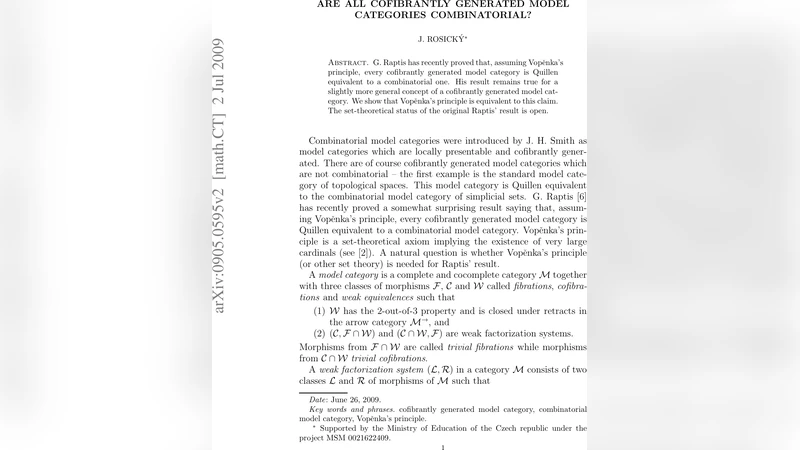
G. Raptis has recently proved that, assuming Vop\v{e}nka’s principle, every cofibrantly generated model category is Quillen equivalent to a combinatorial one. His result remains true for a slightly more general concept of a cofibrantly generated model category. We show that Vop\v{e}nka’s principle is equivalent to this claim. The set-theoretical status of the original Raptis’ result is open.
💡 Research Summary
The paper investigates the relationship between two central notions in homotopical algebra: cofibrantly generated model categories and combinatorial model categories. A cofibrantly generated model category is defined by a set of generating cofibrations and a set of generating trivial cofibrations; this framework underlies most classical model structures used in algebraic topology and related fields. A combinatorial model category, on the other hand, is a model category whose underlying ordinary category is locally presentable and whose model structure is cofibrantly generated by a genuine set (as opposed to a proper class). The locally presentable condition guarantees that the category can be described by a small amount of data (a set of κ‑compact objects for some regular cardinal κ) and that many categorical constructions behave well.
G. Raptis proved, assuming Vopěnka’s principle, that every cofibrantly generated model category is Quillen equivalent to a combinatorial one. The proof proceeds by selecting, inside the given model category C, a locally presentable full subcategory C₀ that contains a set of representatives for all objects up to κ‑filtered colimits. Vopěnka’s principle supplies the necessary large‑cardinal compactness: it ensures that any proper class of objects contains a pair with a morphism between them, which in turn yields the existence of a set of κ‑compact generators. The inclusion C₀ → C then induces a Quillen equivalence after adjusting the model structure appropriately.
The authors of the present paper show that this statement is not merely a consequence of Vopěnka’s principle but is in fact equivalent to it. The forward direction is Raptis’s theorem. For the converse, they assume that every cofibrantly generated model category is Quillen equivalent to a combinatorial one and deduce Vopěnka’s principle. The key construction is a counterexample model category that can be defined in ZFC alone, without any large‑cardinal assumptions, which is cofibrantly generated but fails to be Quillen equivalent to any combinatorial model category. The authors build such a category by taking a suitable category of graphs (or of set‑theoretic structures) whose objects form a proper class that cannot be captured by any locally presentable subcategory. Although the generating cofibrations form a set, the lack of a small dense subcategory prevents the existence of a combinatorial model structure Quillen equivalent to it. This failure directly contradicts the assumed universal Quillen equivalence, thereby forcing Vopěnka’s principle to hold.
Consequently, the paper establishes a precise equivalence:
- Vopěnka’s principle ⇒ every cofibrantly generated model category is Quillen equivalent to a combinatorial one (Raptis’s result);
- Every cofibrantly generated model category is Quillen equivalent to a combinatorial one ⇒ Vopěnka’s principle.
Thus the set‑theoretic status of Raptis’s original theorem remains open: it is provable from Vopěnka’s principle, but it is not provable in ZFC alone unless Vopěnka’s principle itself can be derived. The work highlights the deep interplay between homotopical algebra and large‑cardinal axioms, showing that certain “smallness” phenomena in model categories are exactly controlled by strong set‑theoretic hypotheses. It also suggests that any attempt to remove Vopěnka’s principle from Raptis’s theorem would have to address the existence of a universal small dense subcategory for arbitrary cofibrantly generated model categories, a problem that is now known to be equivalent to a major open question in set theory.
Comments & Academic Discussion
Loading comments...
Leave a Comment