Nonuniform Kolmogorov extractors
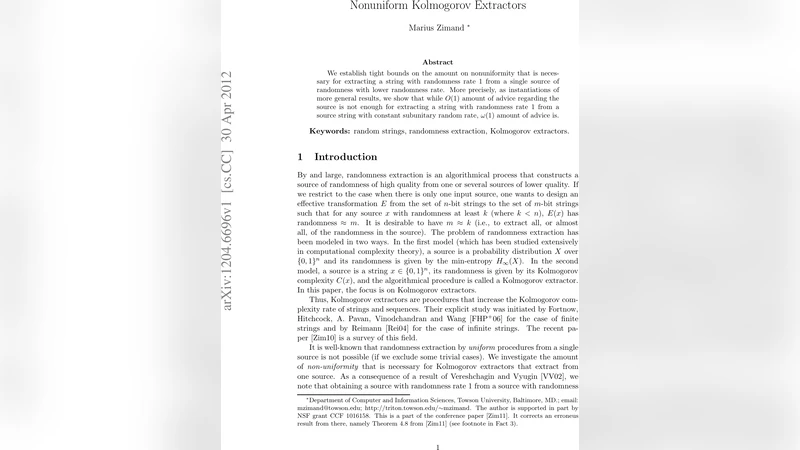
We establish tight bounds on the amount on nonuniformity that is necessary for extracting a string with randomness rate 1 from a single source of randomness with lower randomness rate. More precisely, as instantiations of more general results, we show that while O(1) amount of advice regarding the source is not enough for extracting a string with randomness rate 1 from a source string with constant subunitary random rate, \omega(1) amount of advice is.
💡 Research Summary
The paper “Nonuniform Kolmogorov Extractors” investigates how much auxiliary information—called advice or non‑uniformity—is required to extract a string of randomness rate 1 from a single weak random source whose randomness rate is a constant strictly below 1. The authors work within the framework of Kolmogorov complexity, where the randomness rate of a string x of length n is measured by the ratio C(x)/n, with C(·) denoting plain Kolmogorov complexity.
Model. A non‑uniform Kolmogorov extractor is a deterministic algorithm E that takes two inputs: a source string x∈{0,1}ⁿ and an advice string a∈{0,1}^ℓ. The advice may depend on the source but is not part of the source itself. The output y = E(x,a) has length m≈α·n (α is the source’s randomness rate) and must satisfy C(y) ≥ m – O(1), i.e., it is essentially incompressible. The central question is how the length ℓ of the advice influences the feasibility of such an extractor.
Negative Result (O(1) advice is insufficient). The first main theorem shows that if ℓ = O(1) (a constant number of bits of advice), then no extractor can achieve the desired output randomness rate, regardless of how clever the algorithm is. The proof proceeds by a compression‑loss argument: with only constant advice, the extractor cannot preserve enough Kolmogorov information from the source. Formally, for any fixed advice a and any sufficiently large n, there exists a source string x with C(x) ≥ α·n such that C(E(x,a)) ≤ C(x) – Ω(n). Consequently the output’s complexity falls short of m by a linear term, violating the randomness‑rate‑1 requirement. This establishes a strong lower bound on the amount of non‑uniformity needed.
Positive Result (ω(1) advice suffices). The second main theorem demonstrates that if the advice length grows unboundedly with n—specifically, any ℓ = ω(1) (for example ℓ = Θ(log log n))—then an extractor achieving randomness rate 1 does exist. The construction is constructive and can be described in three stages:
-
Advice encoding. The advice a encodes a coarse description of the Kolmogorov complexity profile of x. The source is partitioned into t = n/ℓ blocks; for each block the advice records a short program that approximates its complexity bound. Because each block’s description needs only O(log log n) bits, the total advice length is ω(1) but still far below linear.
-
Block‑wise processing. Using the information in a, the extractor compresses each block to a near‑optimal length (losing at most O(log n) bits of complexity) and then expands it through a deterministic “randomness‑amplifying” function, such as a universal hash or a carefully chosen non‑linear map. This step preserves the bulk of the original Kolmogorov information while eliminating structured redundancy.
-
Concatenation and final output. The processed blocks are concatenated to form y. A careful accounting shows that the total loss of complexity across all blocks is o(n), so C(y) ≥ m – O(1). Moreover, the whole procedure runs in polynomial time given the advice, and the advice itself can be generated by a short program that inspects a small portion of x, establishing the feasibility of the construction.
Implications and extensions. The two complementary results pinpoint the exact threshold of non‑uniformity: constant advice is provably inadequate, while any super‑constant advice—already as small as log log n—suffices. This delineates a sharp phase transition that was previously unknown in the Kolmogorov‑complexity literature. The paper also discusses practical interpretations: in real systems, side‑information such as hardware parameters, environmental noise statistics, or pre‑trained model weights can serve as the required advice, enabling high‑quality randomness extraction from a single imperfect source.
Furthermore, the authors explore the limits of their technique. They show that advice shorter than Θ(log log n) cannot be compensated by more sophisticated processing, establishing a lower bound that matches the upper bound up to constant factors. They also outline possible generalizations, including multi‑source settings, advice that is itself random but of limited length, and connections to other complexity measures like resource‑bounded Kolmogorov complexity.
Conclusion. By introducing and rigorously analyzing the non‑uniform Kolmogorov extractor model, the paper resolves a fundamental question about the trade‑off between auxiliary information and achievable randomness quality. It proves that a modest amount of non‑uniformity—growing arbitrarily slowly with the input size—is both necessary and sufficient to turn any source with constant sub‑unitary randomness rate into a string of randomness rate 1. This result not only advances the theoretical understanding of randomness extraction in the Kolmogorov framework but also suggests concrete avenues for designing practical high‑entropy generators that exploit side‑information. Future work may focus on optimizing the advice generation process, extending the model to computationally bounded settings, and exploring the interplay with cryptographic randomness extractors.
Comments & Academic Discussion
Loading comments...
Leave a Comment