Online version of the theorem of Thue
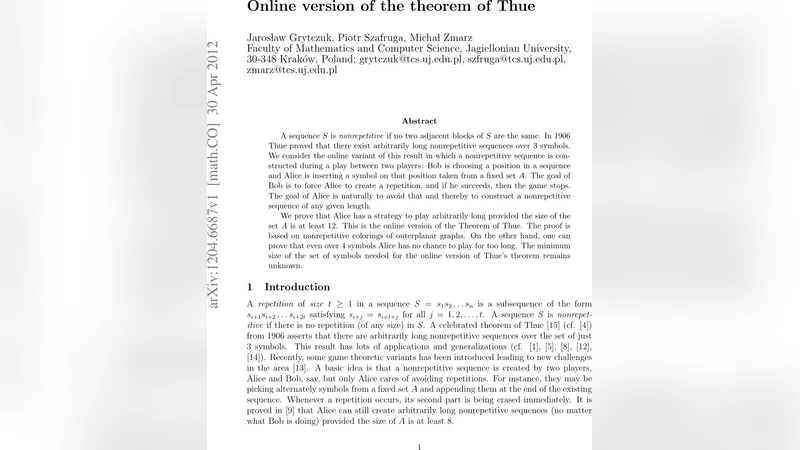
A sequence S is nonrepetitive if no two adjacent blocks of S are the same. In 1906 Thue proved that there exist arbitrarily long nonrepetitive sequences over 3 symbols. We consider the online variant of this result in which a nonrepetitive sequence is constructed during a play between two players: Bob is choosing a position in a sequence and Alice is inserting a symbol on that position taken from a fixed set A. The goal of Bob is to force Alice to create a repetition, and if he succeeds, then the game stops. The goal of Alice is naturally to avoid that and thereby to construct a nonrepetitive sequence of any given length. We prove that Alice has a strategy to play arbitrarily long provided the size of the set A is at least 12. This is the online version of the Theorem of Thue. The proof is based on nonrepetitive colorings of outerplanar graphs. On the other hand, one can prove that even over 4 symbols Alice has no chance to play for too long. The minimum size of the set of symbols needed for the online version of Thue’s theorem remains unknown.
💡 Research Summary
The paper introduces an online version of Thue’s classic theorem on non‑repetitive sequences. A sequence is non‑repetitive if it never contains two adjacent identical blocks. In the traditional setting Thue showed that three symbols suffice to build arbitrarily long non‑repetitive strings. The authors consider a two‑player game that constructs such a string step by step. At each round Bob chooses a position in the current sequence (anywhere, including the ends) and Alice must insert a symbol taken from a fixed alphabet A at that position. If the insertion creates a repetition, the game ends immediately; otherwise play continues. Bob’s objective is to force a repetition as quickly as possible, while Alice tries to avoid it indefinitely.
The main positive result is that if the alphabet size |A| is at least 12, Alice has a winning strategy that allows her to extend the sequence to any prescribed length. The proof rests on a connection with non‑repetitive colourings of outerplanar graphs. The current sequence is modelled as a path in an outerplanar graph; each new insertion corresponds to adding a new vertex and edges that preserve the outerplanarity. It is known (from earlier work by Barát, Varjú and others) that every outerplanar graph admits a non‑repetitive vertex‑colouring using at most 12 colours. By interpreting the colours as symbols from A, Alice can always pick a colour that does not create a repeated block on the path, thereby guaranteeing that no repetition ever appears. This strategy is constructive and works regardless of Bob’s choices, establishing the “online Thue theorem” for alphabets of size 12.
On the negative side, the authors show that with only four symbols Alice cannot survive arbitrarily long. By exhaustive case analysis they demonstrate that Bob can force a repetition after a bounded number of moves, essentially because any 4‑symbol alphabet inevitably yields a configuration of the form XYXY (a length‑2 repetition) under optimal play. Consequently the lower bound for the online version is at most 4, leaving a gap between the known upper bound (12) and lower bound (5 ≤ |A| ≤ 12). The exact minimum alphabet size that guarantees Alice’s indefinite survival remains an open problem.
The paper also discusses related work on non‑repetitive colourings of other graph families, the relevance of the result to combinatorial game theory, and possible extensions. Future directions include tightening the alphabet size bounds, exploring probabilistic strategies, and generalising the game to larger classes of graphs or to multi‑player settings. Overall, the work bridges classic combinatorial sequence theory with modern graph‑colouring techniques, providing a fresh perspective on online construction of non‑repetitive structures.
Comments & Academic Discussion
Loading comments...
Leave a Comment