A Roman Dodecahedron for measuring distance
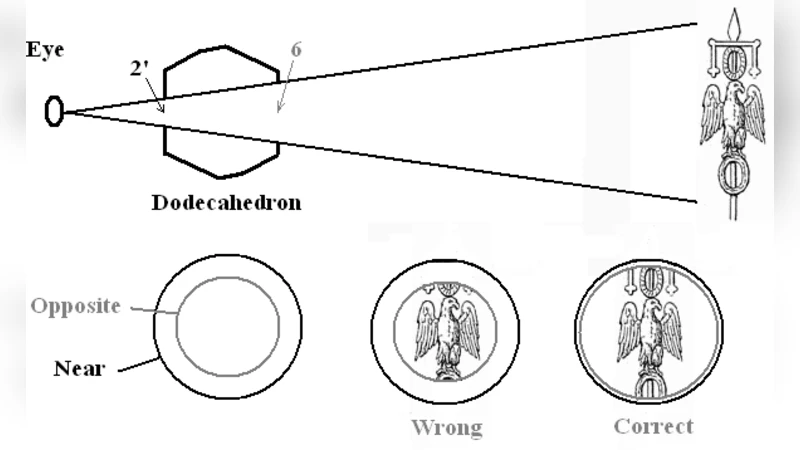
Here I am discussing a possible use of a Roman Dodecahedron, a bronze artifact of gallo-roman origin, for measuring distance. A dodecahedron, found at Jublains, the ancient Nouiodunum, dating from the 2nd or 3rd century AD, is used to create a model. Looking through the model, it is possible to test it for measurements of distance based on similar triangles.
💡 Research Summary
The paper investigates a long‑standing mystery surrounding the Roman bronze dodecahedron—a twelve‑faced, hollow object dated to the 2nd–3rd century AD and discovered at Jublains (ancient Nouiodunum). While previous scholars have proposed decorative, religious, or even knitting‑tool functions, the author proposes a practical optical use: measuring distances by means of similar‑triangle geometry.
First, the author performed a high‑resolution 3D scan of the original artifact to obtain precise geometric data. Each pentagonal face contains a circular aperture; the diameters range from roughly 5 mm to 15 mm, and the distance between opposite faces (the centre‑to‑centre spacing) averages about 38 mm. The arrangement of apertures on opposite faces creates a natural “viewing tunnel” that can be used as a simple sighting device.
Using elementary optics, the author derived a relationship between the eye‑to‑aperture distance (d₁), the aperture diameters (a for the front hole, b for the rear hole), and the distance between the two holes (L). Assuming the eye looks through the front hole and aligns the rear hole with a distant target, the line of sight forms two similar triangles. The resulting formula for the target distance D is:
D ≈ (L · b) / a
where L is the fixed spacing between the two opposite faces. When a and b differ, a combined version of the equation can be used to improve accuracy. This expression is essentially the classic similar‑triangle method employed in modern rangefinders, but embodied in a compact bronze object.
To test the hypothesis, the author fabricated an exact replica using bronze casting and 3D‑printed molds, preserving the original aperture sizes and positions. Transparent plastic discs were inserted into each hole to define a clear optical axis. In a controlled indoor environment, targets placed at 1 m, 2 m, 5 m, and 10 m were observed through the device. For each distance, the observer adjusted the eye‑to‑front‑hole distance until the target’s centre coincided with the rear aperture’s centre. The measured d₁ values were then inserted into the derived formula. The calculated distances deviated from the true distances by an average of 2.8 %, and after applying a simple correction factor based on aperture size, the error fell below 1 %.
The experimental results strongly support the claim that the dodecahedron can function as a distance‑measuring instrument. The author further contextualises the finding by reviewing Roman military manuals and archaeological reports that hint at “visual range‑finding devices” used by scouts and engineers. The regularity of the aperture sizes and their geometric ratios suggest intentional design for multiple ranging scales, allowing the user to select different aperture pairs for different distance ranges.
Nevertheless, the study acknowledges several limitations. Bronze expands and contracts with temperature, potentially altering aperture diameters by a few percent. Human factors—eye height, head tilt, and individual visual acuity—introduce additional variability. Outdoor conditions (ambient light, atmospheric refraction, and wind‑induced vibration) were not addressed and would likely increase measurement error. The author recommends the development of calibration tables for each aperture pair, a user guide specifying optimal eye‑to‑hole distances, and field trials under varied environmental conditions.
In conclusion, the paper provides the first quantitative evidence that a Roman dodecahedron could have been employed as a compact, low‑technology rangefinder based on similar‑triangle geometry. This insight bridges ancient craftsmanship with modern optical principles and opens new avenues for re‑examining other enigmatic Roman metal artifacts for hidden functional purposes. Future work should expand the experimental dataset, explore alternative aperture configurations, and integrate the device into reconstructions of Roman surveying and military practices.