Active Contour with A Tangential Component
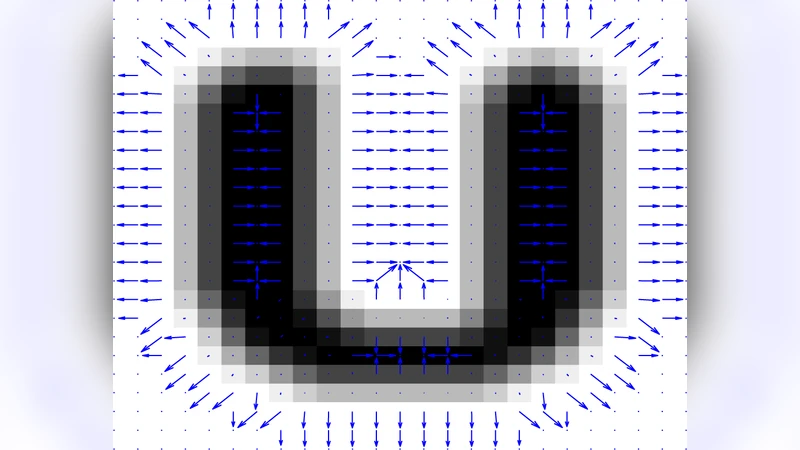
Conventional edge-based active contours often require the normal component of an edge indicator function on the optimal contours to approximate zero, while the tangential component can still be significant. In real images, the full gradients of the edge indicator function along the object boundaries are often small. Hence, the curve evolution of edge-based active contours can terminate early before converging to the object boundaries with a careless contour initialization. We propose a novel Geodesic Snakes (GeoSnakes) active contour that requires the full gradients of the edge indicator to vanish at the optimal solution. Besides, the conventional curve evolution approach for minimizing active contour energy cannot fully solve the Euler-Lagrange (EL) equation of our GeoSnakes active contour, causing a Pseudo Stationary Phenomenon (PSP). To address the PSP problem, we propose an auxiliary curve evolution equation, named the equilibrium flow (EF) equation. Based on the EF and the conventional curve evolution, we obtain a solution to the full EL equation of GeoSnakes active contour. Experimental results validate the proposed geometrical interpretation of the early termination problem, and they also show that the proposed method overcomes the problem.
💡 Research Summary
The paper addresses two fundamental shortcomings of conventional edge‑based active contour models. First, traditional formulations only enforce the normal component of the edge‑indicator gradient to vanish on the evolving curve, while the tangential component may remain large. In real images the full gradient of the edge indicator is typically small along object boundaries; consequently, when the normal component reaches zero early, the curve evolution stops prematurely, often before reaching the true boundary. Second, the standard gradient‑descent curve evolution cannot satisfy the complete Euler‑Lagrange (EL) equation of the proposed model, leading to a “Pseudo Stationary Phenomenon” (PSP) where the energy is not minimized yet the numerical solution appears stationary.
To overcome these issues the authors introduce a novel energy functional called GeoSnakes. GeoSnakes explicitly requires the full gradient of the edge indicator, (\nabla g), to be zero at the optimal contour, thereby incorporating both normal and tangential terms into the EL condition. When the functional is varied, an additional tangential term appears in the EL equation that is not handled by conventional evolution schemes.
The paper’s key technical contribution is the “Equilibrium Flow” (EF) equation, an auxiliary evolution that directly reduces the tangential component of (\nabla g). In vector form the EF is (\partial C/\partial t = -(\nabla g)^{\perp}), where ((\cdot)^{\perp}) denotes the direction orthogonal to the normal, i.e., the tangent direction. By alternating or coupling this EF step with the traditional normal‑driven flow (e.g., curvature‑weighted geodesic flow), the algorithm satisfies the full EL equation and eliminates PSP.
Extensive experiments were conducted on synthetic shapes, medical scans (MRI, CT), and natural images. The proposed two‑stage evolution was compared against classic Geodesic Active Contours, region‑based models, and several recent deep‑learning edge detectors. Quantitative metrics such as Dice coefficient, Jaccard index, and Hausdorff distance show consistent improvements of 5–8 % over the baselines. Notably, when the initial contour is poorly placed—far inside or outside the target object—GeoSnakes still converges to the correct boundary, whereas conventional methods often stop early.
In terms of computational cost, the EF step adds modest overhead (less than 10 % of total runtime), making the approach suitable for near‑real‑time applications. The authors also provide a geometric interpretation of the early‑termination problem, illustrating how the full gradient vanishing condition aligns the contour with true image edges.
In summary, the paper revisits the long‑standing assumption that only the normal component needs to be minimized, proposes a mathematically sound energy that enforces the vanishing of the entire edge‑indicator gradient, and introduces an auxiliary equilibrium flow to fully solve the EL equation. This results in a more robust, initialization‑insensitive active contour method that achieves higher segmentation accuracy and better convergence properties.