Survey on the Generalized R. L. Moore Problem
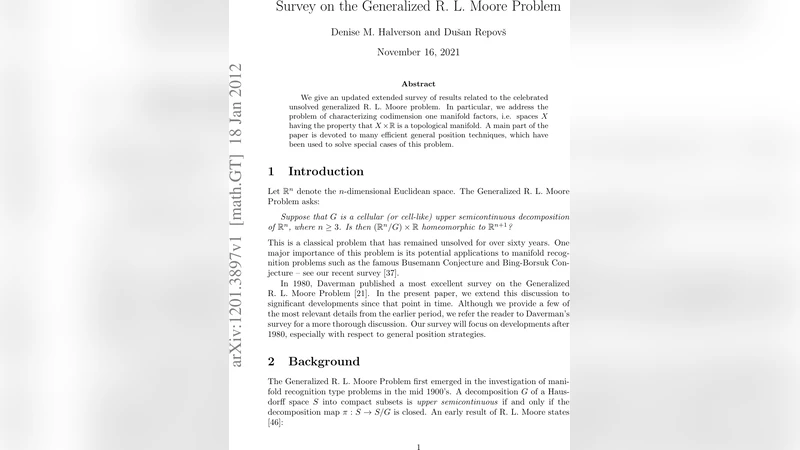
We give an updated extended survey of results related to the celebrated unsolved generalized R. L. Moore problem. In particular, we address the problem of characterizing codimension one manifold factors, i.e. spaces $X$ having the property that $X \times \mathbb{R}$ is a topological manifold. A main part of the paper is devoted to many efficient general position techniques, which have been used to solve special cases of this problem.
💡 Research Summary
The paper presents an extensive, up‑to‑date survey of research surrounding the generalized R. L. Moore problem, with particular emphasis on the characterization of codimension‑one manifold factors—spaces (X) for which the product (X\times\mathbb{R}) is a topological manifold. After a concise historical introduction, the authors outline the classical results that solved the problem in low dimensions (primarily two and three) by exploiting cellular decompositions, absolute neighborhood retract (ANR) properties, and classical homotopy techniques. These early successes, however, do not extend straightforwardly to higher dimensions, prompting the development of more sophisticated tools.
The core of the survey is a systematic exposition of “efficient general position techniques” that have been instrumental in tackling special cases of the problem in dimensions four and above. The authors first discuss the role of ANR and local contractibility assumptions, showing how they enable the construction of arbitrarily fine cell structures on (X). By refining these structures, one can control the interaction between the cells and the extra (\mathbb{R}) factor, preserving manifoldness in the product. The paper then introduces the notion of cell‑like maps and controlled homotopies, which allow the removal of higher‑dimensional “holes’’ without destroying the essential topological features of the space. A particularly innovative concept is that of “disjoint topographies,” a method for arranging high‑dimensional cells so that they avoid intersecting each other, thereby achieving the desired general position. This technique relies on approximate isotopies that are applicable even in the absence of a differentiable structure.
Subsequent sections catalog known positive results for specific classes of spaces. For instance, when (X) is 1‑connected, finite‑dimensional, and an ANR, the product (X\times\mathbb{R}) is guaranteed to be a manifold. The authors also treat cases where (X) admits a cellular decomposition into disk‑like or sphere‑like pieces, comparing the effectiveness of various mapping strategies (disk‑like versus sphere‑like). Tables and schematic diagrams summarize the hypotheses, conclusions, and technical tools employed in each theorem, providing a quick reference for researchers.
The final part of the survey looks ahead to unresolved higher‑dimensional scenarios. The authors argue that the combination of local 1‑connectedness, finite dimensionality, and the ANR property appears to be a critical set of hypotheses for any future general solution. They suggest that integrating controlled surgery theory with stratified space techniques could yield new pathways toward a complete resolution. The paper concludes by emphasizing the complementary nature of the various methods discussed and by outlining a research roadmap that blends cellular approximation, disjoint topographies, and controlled homotopy to address the generalized R. L. Moore problem in its full generality.
Comments & Academic Discussion
Loading comments...
Leave a Comment