The Network of French Legal Codes
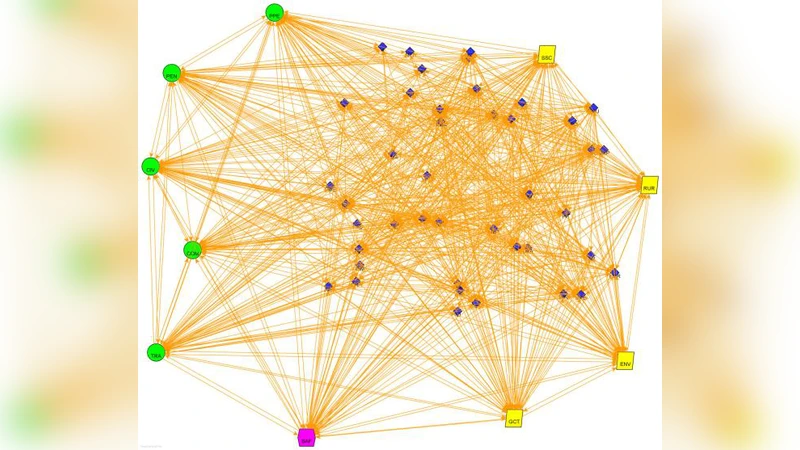
We propose an analysis of the codified Law of France as a structured system. Fifty two legal codes are selected on the basis of explicit legal criteria and considered as vertices with their mutual quotations forming the edges in a network which properties are analyzed relying on graph theory. We find that a group of 10 codes are simultaneously the most citing and the most cited by other codes, and are also strongly connected together so forming a “rich club” sub-graph. Three other code communities are also found that somewhat partition the legal field is distinct thematic sub-domains. The legal interpretation of this partition is opening new untraditional lines of research. We also conjecture that many legal systems are forming such new kind of networks that share some properties in common with small worlds but are far denser. We propose to call “concentrated world”.
💡 Research Summary
The paper presents a pioneering network‑theoretic analysis of the French legal system at the level of codified statutes. The authors selected 52 French legal codes that have been produced under a unified codification policy overseen by the Commission Supérieure de Codification. Each code is represented as a vertex, and a directed edge from code X to code Y is created whenever the text of X cites Y at least once. Self‑citations are ignored, and the number of citations is not weighted; the presence of a citation alone defines an edge. This yields a dense, directed graph that captures the inter‑code referencing structure of French law.
Using standard centrality measures (betweenness, closeness, degree), the authors identify a set of ten codes that are simultaneously the most citing and the most cited. These ten codes include four “general” codes (Local and Regional Authorities, Environmental, Public Health, Social Security, Rural) and six “core” codes (Penal, Civil, Criminal Procedure, Labor, Commerce, Public Health). The ten codes are tightly interconnected, forming a “rich club” sub‑graph that dominates the flow of citations across the whole network.
When the rich‑club vertices are removed, community detection based on the Clauset‑Newman‑Moore algorithm reveals three well‑defined sub‑graphs. The first community (13 codes) clusters around issues of territory, resources, and property; the second (12 codes) groups codes governing social systems and activities; the third (12 codes) gathers codes related to administration and institutional matters. Each community exhibits high internal edge density and relatively sparse connections to the other two, suggesting a functional partition of the French legal field into territorial, social, and administrative domains.
The authors argue that this structure differs from the classic “small‑world” model, which is characterized by short average path lengths and high clustering but relatively low overall density. Instead, the French legal code network is both dense and centrally organized around a rich club. They introduce the term “concentrated world” to describe such networks: dense graphs with a dominant central core that are likely to appear in other national legal systems when examined at the code or statute level.
Methodologically, the data were extracted from the official LEGIFRANCE portal using automated text parsing to locate code references. The resulting adjacency matrix was analyzed in R with the igraph library, and visualizations were produced with yEd Graph Editor. The paper highlights the value of applying quantitative network tools to legal scholarship, offering a new lens for measuring legal complexity, comparing legal systems, and informing codification policy.
In conclusion, the study not only maps the structural topology of French codified law but also proposes a generalizable framework for legal network analysis. By identifying a rich‑club core and three thematic communities, the authors open avenues for interdisciplinary research that bridges law, computer science, and network theory, and they suggest that similar “concentrated world” patterns may be a common feature of complex legal systems worldwide.
Comments & Academic Discussion
Loading comments...
Leave a Comment