Lattice Boltzmann simulations of anisotropic particles at liquid interfaces
Complex colloidal fluids, such as emulsions stabilized by complex shaped particles, play an important role in many industrial applications. However, understanding their physics requires a study at sufficiently large length scales while still resolving the microscopic structure of a large number of particles and of the local hydrodynamics. Due to its high degree of locality, the lattice Boltzmann method, when combined with a molecular dynamics solver and parallelized on modern supercomputers, provides a tool that allows such studies. Still, running simulations on hundreds of thousands of cores is not trivial. We report on our practical experiences when employing large fractions of an IBM Blue Gene/P system for our simulations. Then, we extend our model for spherical particles in multicomponent flows to anisotropic ellipsoidal objects rendering the shape of e.g. clay particles. The model is applied to a number of test cases including the adsorption of single particles at fluid interfaces and the formation and stabilization of Pickering emulsions or bijels.
💡 Research Summary
This paper presents a comprehensive computational framework that couples the lattice Boltzmann (LB) method with molecular dynamics (MD) to simulate multicomponent fluid systems containing anisotropic (ellipsoidal) colloidal particles at liquid–liquid interfaces. The authors begin by motivating the study of particle‑stabilized emulsions and bicontinuous interfacially jammed emulsion gels (bijels), emphasizing that realistic industrial formulations often involve non‑spherical particles such as clays, whose shape and orientation critically affect interfacial stability. Traditional simulation techniques struggle to resolve both the hydrodynamics of multiple fluid components and the detailed particle dynamics at the required length scales, especially when large numbers of particles are present.
The methodological core relies on the Shan‑Chen multicomponent LB model, which introduces a pseudo‑potential force to generate surface tension between two immiscible fluids (denoted red and blue). The LB evolution follows the standard BGK collision operator on a D3Q19 lattice. Colloidal particles are discretized on the lattice and coupled to the fluids via a moving bounce‑back boundary condition that enforces no‑slip at the particle surface. To conserve momentum, an additional corrective force is applied to each particle. For spherical particles, a Hertzian repulsive potential approximates hard‑core interactions; the authors extend this potential to ellipsoids by incorporating the particle orientation vectors and aspect ratios, yielding direction‑dependent interaction parameters (ε and σ) as described in equations (7)–(8).
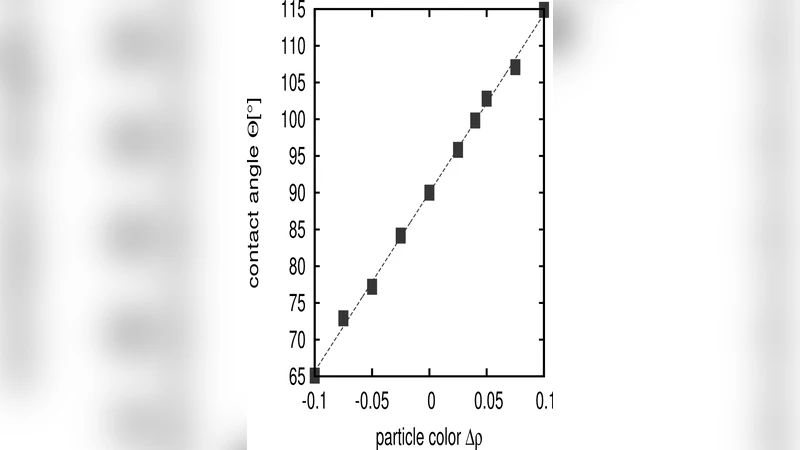
A lubrication correction (equation 9) is added to compensate for insufficient lattice resolution when particles approach each other closely, ensuring realistic hydrodynamic resistance. The wettability of particles is controlled through a “particle colour” parameter Δρ, which modifies the local density of one fluid component near the particle surface. Empirically, the contact angle Θ varies linearly with Δρ (Θ = 243.2 Δρ + 90°), allowing precise tuning of particle affinity for either fluid.
From a computational standpoint, the authors detail the development of the LB3D code, originally created in 1999 for single‑component LB simulations, and its later integration with an asynchronous parallel MD engine in 2008. The code exploits the extreme locality of the LB update and short‑range particle forces to achieve strong scaling on the IBM Blue Gene/P system JUGENE, which comprises up to 294 912 cores. By manually aligning the MPI Cartesian topology with the physical domain decomposition, they mitigate communication bottlenecks inherent to the torus network. Benchmark results show that a 1024 × 2048 lattice with two fluid species and over 4 × 10⁸ spherical particles scales efficiently to 262 144 cores, delivering 8.97 × 10⁹ lattice updates per second (≈3.42 × 10⁴ LUPS per core) and a parallel efficiency of 93 % relative to the 2 048‑core baseline. Profiling indicates that the Shan‑Chen force calculation consumes 41.8 % of runtime, particle‑fluid coupling 29.6 %, and the LB collision step 18.7 %, with the remainder dominated by MPI communication. Parallel HDF5 output enables writing 4.6 GB of fluid density fields in under 30 seconds on the full machine, facilitating frequent checkpointing and data analysis.
Physical results focus first on the adsorption dynamics of a single ellipsoidal particle (aspect ratio m = 2) with a neutral contact angle (Θ = 90°). Starting from a horizontal orientation (φ = 0°), the particle approaches the interface, simultaneously decreasing its center‑to‑interface distance (z) and rotating. The trajectory reveals two equilibrium points: a stable configuration with the particle’s long axis perpendicular to the interface (φ = π/2) and a metastable configuration with the axis parallel (φ = 0). This demonstrates that anisotropy introduces a coupling between translational and rotational degrees of freedom absent for spheres.
The authors then explore many‑particle systems to investigate the transition between Pickering emulsions and bijels. By varying particle concentration, contact angle, and the volume ratio of the two fluids, they reproduce the experimentally observed transition: low particle loadings or moderate wettability yield discrete droplets (Pickering emulsions), whereas higher loadings and near‑neutral wettability produce a bicontinuous jammed structure (bijel). Importantly, increasing the particle aspect ratio reduces the number of particles required to stabilize the interface, and the particles preferentially arrange in tip‑to‑tip configurations, consistent with prior experimental observations on clay‑like particles.
In conclusion, the paper demonstrates that a highly optimized, massively parallel LB‑MD framework can faithfully capture the complex interplay of hydrodynamics, interfacial tension, and anisotropic particle geometry. The methodology scales to hundreds of thousands of cores, enabling simulations that bridge the gap between microscopic particle interactions and macroscopic emulsion behavior. The authors suggest that the approach can be extended to more complex particle shapes, external fields, and realistic industrial formulations, offering a powerful tool for both fundamental research and applied colloid science.
Comments & Academic Discussion
Loading comments...
Leave a Comment