Software Engineering and Complexity in Effective Algebraic Geometry
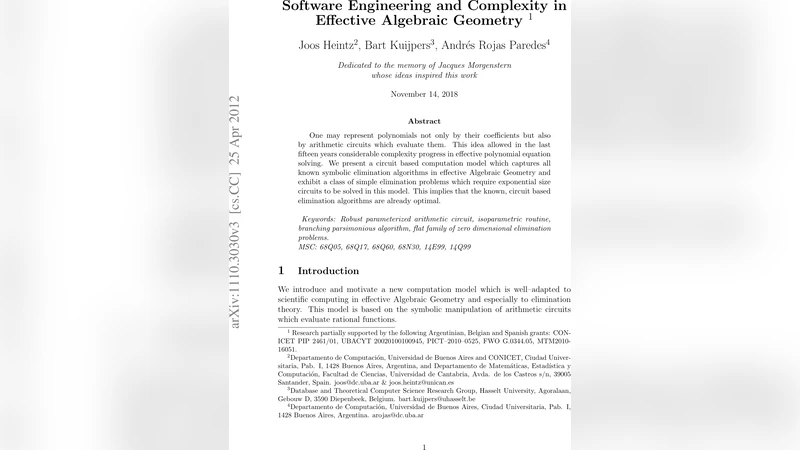
We introduce the notion of a robust parameterized arithmetic circuit for the evaluation of algebraic families of multivariate polynomials. Based on this notion, we present a computation model, adapted to Scientific Computing, which captures all known branching parsimonious symbolic algorithms in effective Algebraic Geometry. We justify this model by arguments from Software Engineering. Finally we exhibit a class of simple elimination problems of effective Algebraic Geometry which require exponential time to be solved by branching parsimonious algorithms of our computation model.
💡 Research Summary
The paper introduces a novel computational framework for effective algebraic geometry based on the representation of multivariate polynomials and rational functions by parameterized arithmetic circuits. A circuit is “parameterized” in the sense that it depends on two distinct kinds of inputs: basic parameters, which are piecewise rational functions, and input variables. The authors define a “robust parameterized arithmetic circuit” as one that satisfies four technical conditions—existence of a dense Zariski‑open domain on which the circuit defines a rational map, Euclidean continuity, boundedness of image sequences, and hereditary extension on constructible subsets. These conditions collectively guarantee topological robustness and algebraic stability across the whole parameter space.
The computational model is built from “elementary routines,” which are branching‑free transformations of circuits. Complex algorithms are obtained by recursively composing elementary routines. A crucial requirement for composition is “isoparametricity”: the intermediate results of two circuits must be linked by a continuous, piecewise‑rational map, ensuring that the parameter structure is preserved. This mirrors software‑engineering concerns such as interface consistency and modularity.
To capture realistic elimination algorithms, the model is extended to allow limited branching, yielding “branching‑parsimonious” algorithms. The authors formalize such algorithms as “procedures,” which consist of a sequence of elementary routines interleaved with controlled branch points. This captures the essence of many known symbolic elimination methods (e.g., resultants, Gröbner‑basis based elimination) while keeping the branching overhead minimal.
The core technical contribution is a series of lower‑bound results. Theorem 10, Proposition 11, and Theorem 12 prove that for a family of zero‑dimensional elimination problems, any algorithm that fits within the robust, branching‑parsimonious model must use circuits whose size grows exponentially in the input size, even though the input description (the original family of polynomials) is only polynomially large. Theorem 13 provides an explicit construction of a family of parameterized Boolean circuits whose standard arithmetization yields the same exponential lower bound. These results demonstrate that the existing circuit‑based elimination algorithms are essentially optimal within the proposed model.
The paper also situates its model within broader complexity frameworks. It discusses connections to the Blum‑Shub‑Smale (BSS) model, interactive protocols, and the notion of geometrically robust constructible maps introduced in earlier work. Geometric robustness is shown to imply hereditary behavior, which in turn corresponds to the software‑engineering concept of “coalescence” (the convergence of problem instances and algorithmic behavior). By grounding the model in software‑engineering quality attributes—robustness, isoparametricity, coalescence—the authors argue that the model is not merely a theoretical abstraction but reflects practical design principles for reliable scientific software.
In summary, the paper delivers a comprehensive theory that (1) formalizes arithmetic‑circuit based computation for algebraic geometry, (2) integrates software‑engineering criteria to justify the model’s naturalness, and (3) establishes exponential lower bounds for a broad class of elimination problems, thereby confirming the optimality of current circuit‑based methods under realistic algorithmic constraints.
Comments & Academic Discussion
Loading comments...
Leave a Comment