Derived Hall algebras for stable homotopy theories
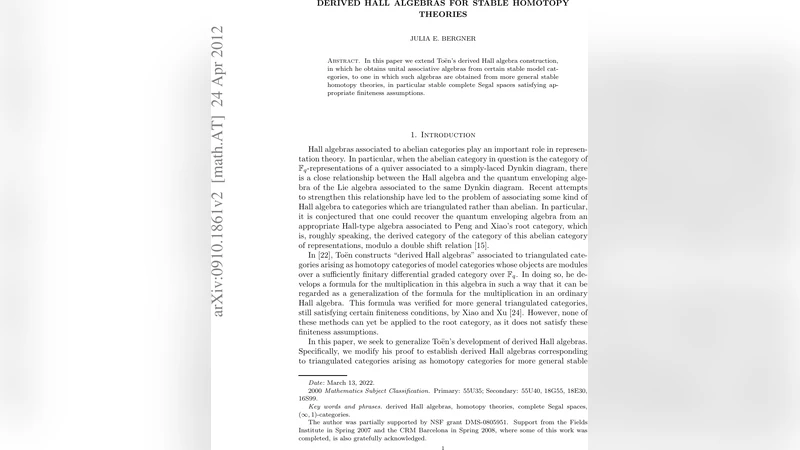
In this paper we extend To"en’s derived Hall algebra construction, in which he obtains unital associative algebras from certain stable model categories, to one in which such algebras are obtained from more general stable homotopy theories, in particular stable complete Segal spaces satisfying appropriate finiteness assumptions.
💡 Research Summary
The paper expands Toën’s construction of derived Hall algebras from the relatively narrow setting of stable model categories to a much broader class of stable homotopy theories, in particular to stable complete Segal spaces that satisfy suitable finiteness conditions. The authors begin by recalling Toën’s original framework, where objects of a finitary stable model category give rise to a Hall algebra whose multiplication counts extensions (short exact sequences) weighted by automorphism groups. They then argue that the model‑category restriction is unnecessary: the essential ingredients—triangulated structure, a shift functor, and a well‑behaved notion of extensions—are already present in the language of ∞‑categories, and stable complete Segal spaces provide a concrete model for such ∞‑categorical stability.
Two finiteness hypotheses are imposed on a stable complete Segal space 𝒮. First, for every object X the graded self‑extension groups Extⁿ(X,X) must be finite‑dimensional (or, more generally, have finite homotopy cardinality). Second, there must exist a set of “core morphisms” that represent each isomorphism class of extensions and allow a well‑defined normalization by automorphism groups. Under these assumptions the authors define the derived Hall algebra 𝓗(𝒮) as follows: the underlying vector space (over a chosen ground field) has a basis indexed by equivalence classes of objects of 𝒮, and the product of basis elements
Comments & Academic Discussion
Loading comments...
Leave a Comment