Whats in an `is about link? Chemical diagrams and the Information Artifact Ontology
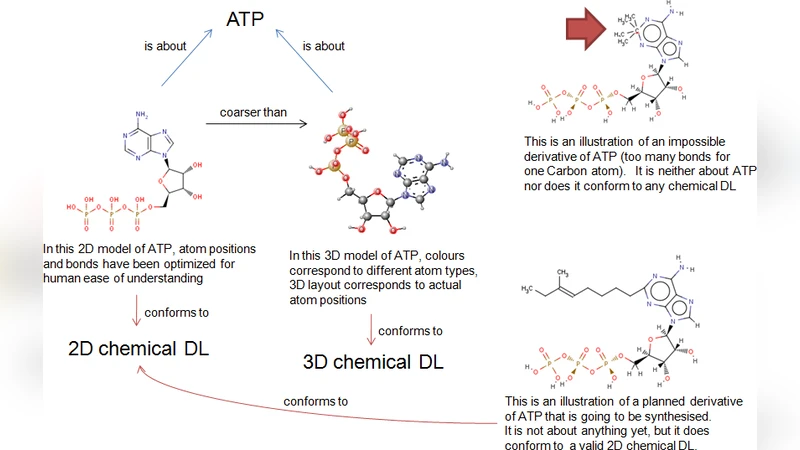
The Information Artifact Ontology is an ontology in the domain of information entities. Core to the definition of what it is to be an information entity is the claim that an information entity must be `about’ something, which is encoded in an axiom expressing that all information entities are about some entity. This axiom comes into conflict with ontological realism, since many information entities seem to be about non-existing entities, such as hypothetical molecules. We discuss this problem in the context of diagrams of molecules, a kind of information entity pervasively used throughout computational chemistry. We then propose a solution that recognizes that information entities such as diagrams are expressions of diagrammatic languages. In so doing, we not only address the problem of classifying diagrams that seem to be about non-existing entities but also allow a more sophisticated categorisation of information entities.
💡 Research Summary
The paper tackles a fundamental tension within the Information Artifact Ontology (IAO), namely the axiom that every information entity must be “about” some entity. While this axiom works well for information that refers to concrete, existent objects, it runs into trouble when the information refers to non‑existent or hypothetical entities. The authors illustrate the problem with a ubiquitous example from computational chemistry: molecular diagrams. Chemists routinely draw structures of molecules that have never been synthesized, that exist only as theoretical constructs, or that are deliberately speculative. According to the strict reading of the IAO “about” axiom, such diagrams would not qualify as legitimate information entities because there is no real-world referent. This apparent inconsistency threatens the realism that underpins many ontological projects.
To resolve the dilemma, the authors propose reframing diagrams (and, by extension, other visual representations) as expressions of diagrammatic languages rather than as direct references to objects. In this view, a diagram is a well‑formed sentence in a visual language, complete with its own syntax, vocabulary, and semantics. The “about” relationship is thus shifted from a direct link to an existent entity to a meta‑level connection between the expression and the language that generated it. In practical terms, the ontology is extended with a new class, DiagrammaticLanguage, and a property expressedInLanguage that ties each diagram instance to the language it belongs to. The traditional about property is retained but re‑interpreted to point at an abstract IntentionalObject class that can subsume both real and hypothetical referents. Additional meta‑attributes such as isHypothetical, isValidated, and hasStatus allow curators to record whether a diagram depicts a proven molecule, a conjectured structure, or a purely illustrative concept.
This reconceptualisation yields several important benefits. First, it legitimises diagrams of non‑existent molecules within IAO without abandoning the “about” axiom; the axiom now captures intentionality rather than ontic existence. Second, it enables a richer taxonomy of visual information: chemical structure diagrams, reaction mechanism schematics, spectral plots, and even non‑chemical visualizations can each be assigned to distinct diagrammatic languages, supporting hierarchical classification, equivalence, and isomorphism reasoning. Third, the approach preserves backward compatibility with existing IAO‑based datasets because the original about triples remain valid; the new properties simply augment the model.
Beyond chemistry, the authors argue that the same strategy applies to any scientific domain where hypothetical models are visualised—protein‑folding cartoons in biology, speculative particle diagrams in physics, or conceptual maps in the social sciences. By treating visual artefacts as language‑bound expressions, ontologies can accommodate both realist and anti‑realist perspectives, thereby widening their applicability and reducing philosophical friction.
In summary, the paper demonstrates that the “about” requirement of IAO need not be a roadblock for representing information about non‑existent entities. By introducing diagrammatic languages and re‑orienting the “about” relation toward intentionality, the authors provide a principled, extensible framework that both resolves the specific issue of chemical diagrams and offers a general solution for visual information across scientific disciplines. This work advances ontology engineering by marrying formal realism with the pragmatic needs of scientific communication.