Nielsen equalizer theory
We extend the Nielsen theory of coincidence sets to equalizer sets, the points where a given set of (more than 2) mappings agree. On manifolds, this theory is interesting only for maps between spaces
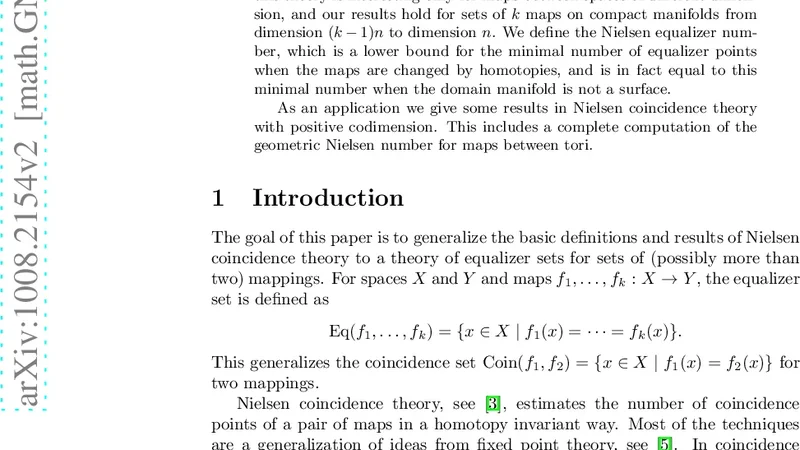
We extend the Nielsen theory of coincidence sets to equalizer sets, the points where a given set of (more than 2) mappings agree. On manifolds, this theory is interesting only for maps between spaces of different dimension, and our results hold for sets of k maps on compact manifolds from dimension (k-1)n to dimension n. We define the Nielsen equalizer number, which is a lower bound for the minimal number of equalizer points when the maps are changed by homotopies, and is in fact equal to this minimal number when the domain manifold is not a surface. As an application we give some results in Nielsen coincidence theory with positive codimension. This includes a complete computation of the geometric Nielsen number for maps between tori.
💡 Research Summary
The paper introduces a genuine extension of Nielsen coincidence theory to the setting of equalizer sets, i.e., the points where more than two maps agree simultaneously. While classical Nielsen coincidence theory deals with two maps f,g : M→N and the set Coinc(f,g) = {x∈M | f(x)=g(x)}, the authors consider a collection of k ≥ 2 maps f₁,…,f_k : M→N where the domain M has dimension (k‑1)n and the target N has dimension n, both compact manifolds. The equalizer set is defined as
E(f₁,…,f_k) = {x∈M | f₁(x)=f₂(x)=…=f_k(x)}.
The central object of study is the Nielsen equalizer number N_eq(f₁,…,f_k), a homotopy invariant that counts the number of essential equalizer classes. An equalizer class is an equivalence class of points in E under the relation that two points can be joined by a path staying inside the equalizer while the induced loops in M are homotopic relative to the maps. Each class carries a Reidemeister–type index (a generalized Lefschetz number) L(α). If L(α)≠0 the class is called essential, and essential classes cannot be eliminated by any homotopies of the maps. Consequently, N_eq is a lower bound for the minimal cardinality of the equalizer set over all homotopic families of maps.
The authors prove two fundamental theorems. First, for any compact manifolds of the prescribed dimensions, N_eq(f₁,…,f_k) ≤ min_{homotopies} |E(f₁’,…,f_k’)|. Second, when the domain M is not a surface (i.e., dim M ≥ 3), the inequality becomes an equality: the Nielsen equalizer number actually realizes the minimal possible number of equalizer points. The proof rests on a careful analysis of normal bordism theory, the construction of a universal covering of the configuration space of k ordered points in N, and the use of transfer maps to relate the Reidemeister index to ordinary homology classes. In the surface case (dim M = 2) extra phenomena appear, mirroring the classical Nielsen coincidence theory where the lower bound may be strict.
A significant part of the paper is devoted to applications in positive codimension, i.e., when dim M > dim N. Classical Nielsen coincidence theory provides little information in this regime because the coincidence set is generically empty. By reinterpreting a coincidence problem as an equalizer problem with k = 2, the authors obtain a non‑trivial Nielsen invariant even in positive codimension. They illustrate the method by a complete computation of the geometric Nielsen number for maps between tori T^m and T^n. Using the standard identification of homotopy classes of maps T^m→T^n with integer matrices A∈Mat_{n×m}(ℤ), they express the equalizer condition as a linear system A x = B x for two matrices A,B. The essential classes correspond to solutions of (A−B) x ≡ 0 modulo ℤ^n, and the Reidemeister index reduces to the absolute value of det(A−B) when m=n, or to the greatest common divisor of the maximal minors of A−B in the general case. This yields an explicit formula for the Nielsen equalizer number and shows that it coincides with the geometric Nielsen number for torus maps.
The paper concludes with a discussion of further directions. The authors suggest extending the equalizer framework to more general fiber bundles, to non‑compact or singular spaces, and to dynamical systems where equalizer points correspond to simultaneous fixed points of several iterates. They also point out the potential for new algebraic invariants arising from the interaction between Reidemeister classes and higher homotopy groups, which could enrich both Nielsen theory and its applications in topological robotics, coincidence detection, and multi‑parameter persistence. Overall, the work provides a robust theoretical foundation for studying simultaneous agreement of multiple maps, broadening the scope of Nielsen theory beyond the traditional two‑map setting and opening new avenues for research in high‑dimensional and positive‑codimension topology.
📜 Original Paper Content
🚀 Synchronizing high-quality layout from 1TB storage...