The von Neumann entropy of networks
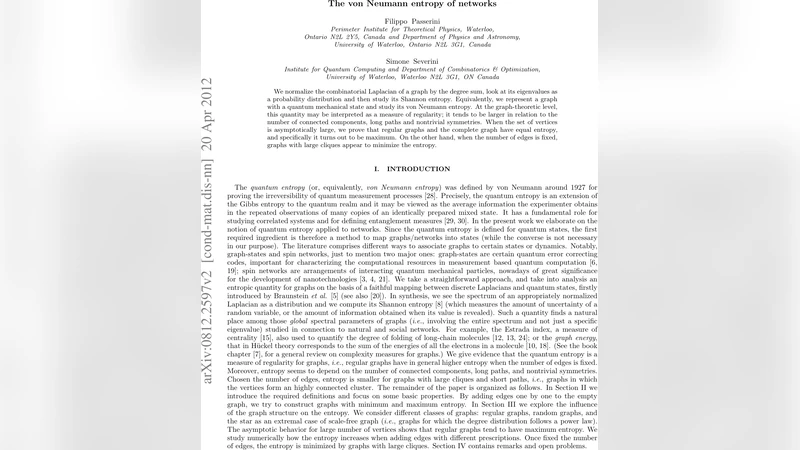
We normalize the combinatorial Laplacian of a graph by the degree sum, look at its eigenvalues as a probability distribution and then study its Shannon entropy. Equivalently, we represent a graph with a quantum mechanical state and study its von Neumann entropy. At the graph-theoretic level, this quantity may be interpreted as a measure of regularity; it tends to be larger in relation to the number of connected components, long paths and nontrivial symmetries. When the set of vertices is asymptotically large, we prove that regular graphs and the complete graph have equal entropy, and specifically it turns out to be maximum. On the other hand, when the number of edges is fixed, graphs with large cliques appear to minimize the entropy.
💡 Research Summary
The paper introduces a novel way to quantify the structural complexity of a network by treating the normalized combinatorial Laplacian of a graph as a quantum‑mechanical density matrix and measuring its von Neumann entropy. Starting from a simple graph (G=(V,E)), the authors define the Laplacian (L = D - A) (where (D) is the degree matrix and (A) the adjacency matrix) and then normalize it by the total degree sum (\mathrm{vol}(G)=\sum_{v\in V} d(v)). The resulting matrix (\rho = L/\mathrm{vol}(G)) is positive semidefinite, has trace one, and its eigenvalues ({\lambda_i}) form a probability distribution. The von Neumann entropy is defined as
\
Comments & Academic Discussion
Loading comments...
Leave a Comment