Anomalies in non-stoichiometric uranium dioxide induced by pseudo-phase transition of point defects
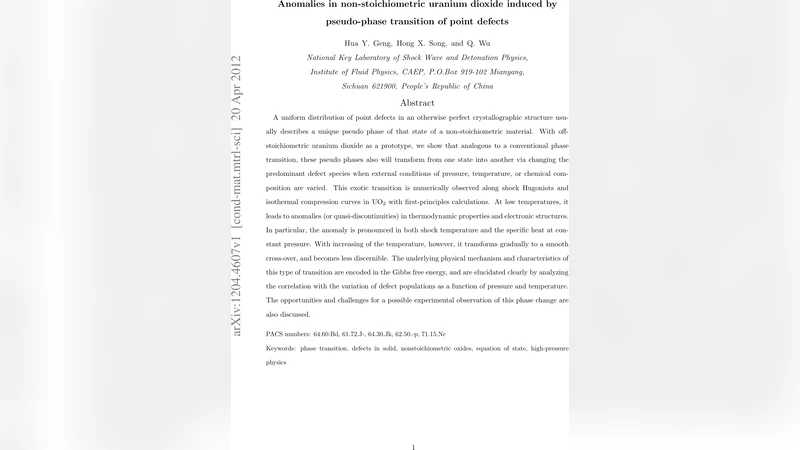
A uniform distribution of point defects in an otherwise perfect crystallographic structure usually describes a unique pseudo phase of that state of a non-stoichiometric material. With off-stoichiometric uranium dioxide as a prototype, we show that analogous to a conventional phase transition, these pseudo phases also will transform from one state into another via changing the predominant defect species when external conditions of pressure, temperature, or chemical composition are varied. This exotic transition is numerically observed along shock Hugoniots and isothermal compression curves in UO2 with first-principles calculations. At low temperatures, it leads to anomalies (or quasi-discontinuities) in thermodynamic properties and electronic structures. In particular, the anomaly is pronounced in both shock temperature and the specific heat at constant pressure. With increasing of the temperature, however, it transforms gradually to a smooth cross-over, and becomes less discernible. The underlying physical mechanism and characteristics of this type of transition are encoded in the Gibbs free energy, and are elucidated clearly by analyzing the correlation with the variation of defect populations as a function of pressure and temperature. The opportunities and challenges for a possible experimental observation of this phase change are also discussed.
💡 Research Summary
The authors investigate a previously unrecognized type of phase‑like transformation that occurs in non‑stoichiometric uranium dioxide (UO₂₊ₓ) when the dominant point‑defect species changes under external stimuli. They term the uniform distribution of a given defect population a “pseudo‑phase” and the abrupt switch from one dominant defect to another a “pseudo‑phase transition.” Using density‑functional theory with a Hubbard‑U correction (DFT+U) together with a statistical‑mechanical treatment of defect thermodynamics, they calculate formation free energies ΔG_i(P,T) for the most relevant defects – oxygen vacancies (V_O), uranium interstitials (U_i), and oxygen interstitials (O_i). The total Gibbs free energy is expressed as
G(P,T) = G₀(P,T) + Σ_i n_i ΔG_i(P,T) + k_B T Σ_i n_i ln n_i,
where n_i denotes the concentration of defect i. Because ΔG_i varies differently with pressure and temperature, the defect that minimizes the free‑energy contribution can switch as P, T, or composition x are varied.
Numerical simulations reveal that at low temperature and moderate to high pressure the oxygen‑vacancy‑dominated pseudo‑phase is stable. Upon further compression, the uranium‑interstitial‑dominated pseudo‑phase becomes energetically favorable, producing a sharp change in the defect population. This transition is manifested on calculated shock‑wave (Hugoniot) curves and on isothermal compression paths. In particular, the shock temperature exhibits a quasi‑discontinuous jump at the transition pressure, and the specific heat at constant pressure (C_p) shows a pronounced peak. These anomalies arise because the rapid redistribution of defects simultaneously alters lattice vibrational spectra and electronic states, producing a latent‑heat‑like contribution without an actual change in crystal symmetry.
When the temperature is raised, thermal excitation smooths the free‑energy differences between defect species. Consequently, the sharp jump in T_Hugoniot and the C_p peak broaden and diminish, turning the transition into a smooth crossover. The authors also analyze the electronic density of states before and after the transition. In the high‑defect‑concentration regime, defect‑induced mid‑gap states appear, slightly narrowing the band gap and increasing electrical conductivity. This suggests that transport measurements (resistivity, thermal conductivity) could serve as indirect probes of the pseudo‑phase transition.
The paper discusses experimental routes to verify the predicted phenomena. High‑pressure diamond‑anvil cell experiments combined with in‑situ X‑ray or neutron diffraction could quantify defect concentrations under compression. Laser‑driven shock experiments can generate Hugoniot data with sufficient resolution to detect the temperature anomaly. However, maintaining a uniform defect distribution and capturing the rapid, possibly reversible, defect re‑population remain significant challenges.
In summary, the work introduces the concept of a defect‑driven pseudo‑phase transition in a non‑stoichiometric oxide. By linking the Gibbs free‑energy landscape to defect populations, the authors show that a change in the dominant point‑defect species can produce observable thermodynamic and electronic anomalies that mimic conventional first‑order phase transitions at low temperature, yet evolve into a continuous crossover at higher temperature. This insight expands the theoretical framework for phase behavior in defective solids and has practical implications for the design and safety assessment of nuclear fuel materials, where defect chemistry under extreme conditions plays a pivotal role.