A Fast and Effective Local Search Algorithm for Optimizing the Placement of Wind Turbines
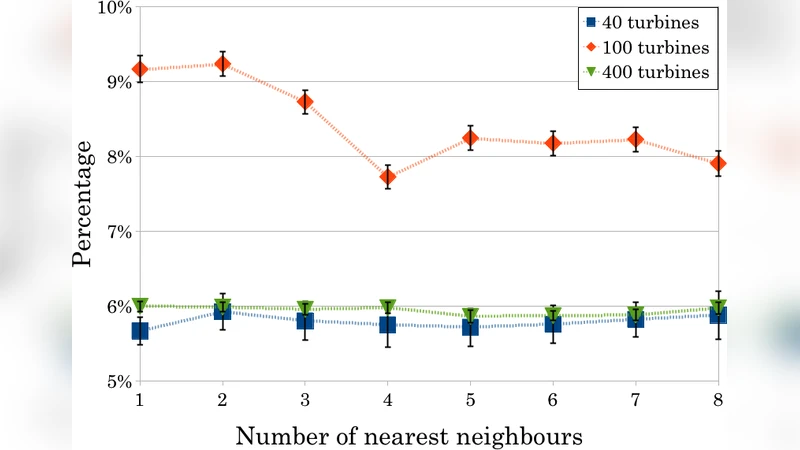
The placement of wind turbines on a given area of land such that the wind farm produces a maximum amount of energy is a challenging optimization problem. In this article, we tackle this problem, taking into account wake effects that are produced by the different turbines on the wind farm. We significantly improve upon existing results for the minimization of wake effects by developing a new problem-specific local search algorithm. One key step in the speed-up of our algorithm is the reduction in computation time needed to assess a given wind farm layout compared to previous approaches. Our new method allows the optimization of large real-world scenarios within a single night on a standard computer, whereas weeks on specialized computing servers were required for previous approaches.
💡 Research Summary
The paper addresses the challenging problem of optimizing wind turbine placement on a given land area while explicitly accounting for wake effects, which cause downstream turbines to experience reduced wind speed and consequently lower power output. Traditional approaches—such as genetic algorithms, particle swarm optimization, simulated annealing, and more recent reinforcement‑learning methods—have demonstrated the ability to find high‑quality layouts, but they suffer from prohibitive computational costs because each candidate layout requires a full O(N²) wake‑loss evaluation across all turbine pairs. This makes large‑scale, real‑world scenarios (thousands of turbines) infeasible on standard hardware, often demanding weeks of processing on dedicated servers.
Problem formulation
The authors model the wind farm as a set of N turbines with coordinates (x_i, y_i) constrained to lie within a predefined polygonal boundary and to respect a minimum inter‑turbine spacing d_min. The wind resource is described by a probability distribution over wind directions θ and speeds v. Using the Jensen (or “top‑hat”) wake model, the wake loss contributed by turbine j to turbine i, W_{ij}(θ, v), is computed as a function of the relative position and the rotor radius. The objective is to maximize the expected total energy production:
E = Σ_i ∫∫ P_i(θ, v)·