Various complexity results for computational mass spectrometry problems
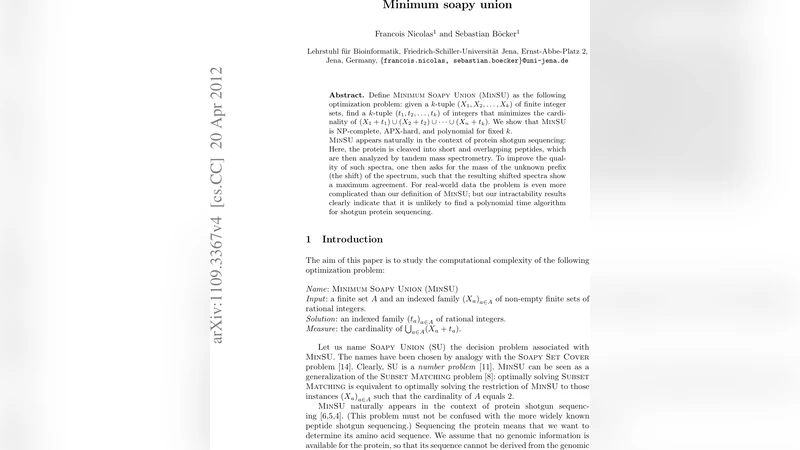
Define Minimum Soapy Union (MinSU) as the following optimization problem: given a $k$-tuple $(X_1, X_2,…, X_k)$ of finite integer sets, find a $k$-tuple $(t_1, t_2,…, t_k)$ of integers that minimizes the cardinality of $(X_1 + t_1) \cup (X_2 + t_2) \cup … \cup (X_n + t_k)$. We show that MinSU is NP-complete, APX-hard, and polynomial for fixed $k$. MinSU appears naturally in the context of protein shotgun sequencing: Here, the protein is cleaved into short and overlapping peptides, which are then analyzed by tandem mass spectrometry. To improve the quality of such spectra, one then asks for the mass of the unknown prefix (the shift) of the spectrum, such that the resulting shifted spectra show a maximum agreement. For real-world data the problem is even more complicated than our definition of MinSU; but our intractability results clearly indicate that it is unlikely to find a polynomial time algorithm for shotgun protein sequencing.
💡 Research Summary
The paper introduces and studies the computational problem called Minimum Soapy Union (MinSU). Given a collection of k finite integer sets (X_1,\dots ,X_k), the task is to choose integer shifts (t_1,\dots ,t_k) so that the cardinality of the union (\bigcup_{i=1}^{k}(X_i+t_i)) is minimized. This formulation arises naturally in shotgun protein sequencing, where overlapping peptide spectra must be aligned by an unknown mass offset (the “shift”) to maximize agreement.
The authors first establish structural properties of optimal solutions. They define the intersection graph of the shifted sets and prove (Lemma 1 and Lemma 2) that any optimal solution must induce a connected intersection graph; otherwise a better solution can be obtained by translating whole components. Using this insight they show that every optimal solution can be represented by a spanning tree (H) on the index set together with an antisymmetric edge‑weight function (\varphi) on (H). The weight on an edge ((a,b)) equals the difference (t_a-t_b) and must belong to the set of differences between elements of the original sets. Consequently, the set of all optimal solutions is exactly the affine lattice ({(t_a+u)_{a\in A}\mid u\in\mathbb Z}) derived from any feasible solution of the tree‑based system.
With this representation the decision version of MinSU (called Soapy Union, SU) is shown to belong to NP (Theorem 1). A nondeterministic algorithm guesses a tree and a compatible weight function (both of polynomial size) and then reconstructs a concrete shift vector in polynomial time, finally checking whether the union size does not exceed the given bound.
The paper then presents a polynomial‑time exact algorithm for the case where the number of sets (k=|A|) is a fixed constant. Since the number of spanning trees on (k) labeled vertices is (k^{k-2}) (Cayley’s formula) and the range of possible edge weights is bounded by the differences of the input elements, one can enumerate all ((H,\varphi)) pairs in time (O(N\cdot k)), where (N) is the total bit‑length of the input. For each pair a solution is computed in linear time, and the best among them is returned (Theorem 2). Thus MinSU is tractable for constant‑size instances.
The core of the hardness results is a reduction from the classic Vertex Cover (VC) problem. The authors construct, for any graph (G=(V,E)), a family of integer sets using specially designed Golomb ruler sets (R_n). Each vertex and edge is encoded as a set that contains shifted copies of (R_n) together with a few “marker” elements. Lemma 4 proves that the (R_n) sets are Golomb rulers with large pairwise distances, which guarantees that overlaps between different encoded sets occur only in controlled ways. By carefully choosing the shift values (-s) or (+n) for edge‑sets, the presence of a vertex in a cover corresponds exactly to the inclusion of a particular element in the union after shifting. This yields a Karp reduction from VC to a restricted version of SU (called Aux) where all integers involved are bounded by a polynomial function of the input size. Consequently, SU is strongly NP‑hard (Theorem 3).
To strengthen the result, the authors consider the APX‑hardness of MinSU. They restrict VC to cubic graphs (each vertex of degree three), a problem known to be APX‑complete and even 100/99‑approximation‑hard. Using the same reduction framework, they show that an approximation algorithm for MinSU with any constant factor (\rho>1) would imply a comparable approximation for cubic Vertex Cover, contradicting known hardness unless P=NP (Theorem 4). Hence MinSU is APX‑hard in the strong sense.
Finally, the paper discusses the implications for real‑world shotgun protein sequencing. While the actual biological problem involves additional complications such as noisy spectra, missing peaks, and multiple charge states, the theoretical results indicate that even the simplified core problem is computationally intractable. Therefore, researchers should not expect a polynomial‑time algorithm that yields near‑optimal alignment of spectra; instead, they must rely on heuristics, fixed‑parameter algorithms (e.g., when the number of spectra is small), or approximation schemes with provably weak guarantees.
In summary, the contributions are: (1) formal definition of MinSU and its decision counterpart SU; (2) proof that SU is in NP via a tree‑based representation; (3) a polynomial‑time exact algorithm for constant‑size instances; (4) strong NP‑completeness and APX‑hardness proofs based on reductions from Vertex Cover using Golomb ruler gadgets; and (5) a clear connection to the practical problem of aligning mass‑spectrometry data, highlighting the inherent computational limits faced by bioinformatics practitioners.
Comments & Academic Discussion
Loading comments...
Leave a Comment