Continuity in Vector Metric Spaces
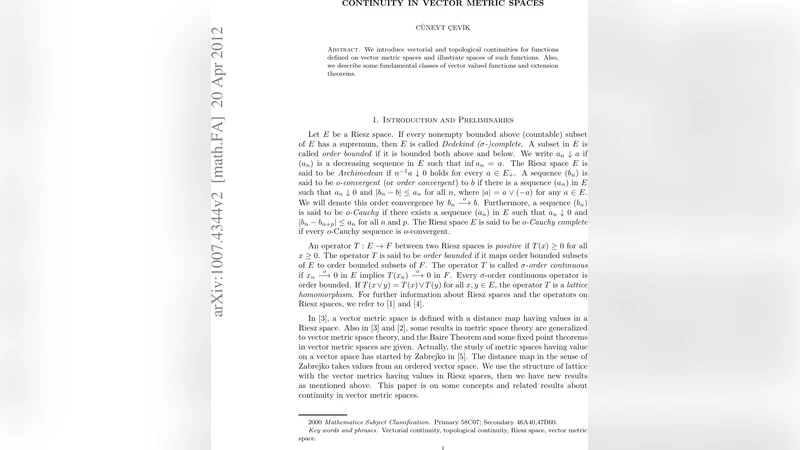
We introduce vectorial and topological continuities for functions defined on vector metric spaces and illustrate spaces of such functions. Also, we describe some fundamental classes of vector valued functions and extension theorems.
💡 Research Summary
The paper introduces a novel framework for continuity in the setting of vector metric spaces, a natural generalization of classical metric spaces where the distance function takes values in an ordered vector space rather than the real line. After defining a vector metric d : X × X → E (with E a partially ordered vector space equipped with a compatible order and, often, a norm), the authors show how the usual topological structure on X is induced by the family of “E‑balls” {y ∈ X | d(x,y) ≺ ε} for ε ∈ E⁺.
Two distinct notions of continuity are then presented. Vectorial continuity extends the ε‑δ definition by replacing real‑valued ε and δ with positive elements of E and using the order relation “≺”. Formally, f : X → Y is vectorially continuous at x₀ if for every ε ∈ E⁺ there exists δ ∈ E⁺ such that d_X(x,x₀) ≺ δ implies d_Y(f(x),f(x₀)) ≺ ε. Topological continuity is the ordinary definition via pre‑images of open sets in the topology τ_d generated by the vector metric. The authors prove that, in general, these concepts are not equivalent; however, when E is a complete lattice (or a complete ordered Banach space) and both X and Y satisfy suitable completeness and order‑regularity conditions, the two notions coincide. In particular, when E = ℝⁿ equipped with the lexicographic order, vectorial continuity is strictly stronger than topological continuity, allowing a multivariate analogue of one‑sided limits.
The paper proceeds to construct function spaces of vectorially continuous maps. Denoting by C_V(X,Y) the set of all vectorially continuous functions from X to Y, a supremum‑type vector metric is defined by
‖f − g‖ = sup_{x∈X} d_Y(f(x),g(x)) ∈ E.
Under the assumption that X is complete with respect to d_X and Y is complete with respect to d_Y, the space (C_V(X,Y),‖·‖) becomes a complete vector metric space itself. The authors examine linear structure, order structure (pointwise order and uniform order), and demonstrate that C_V(X,Y) is closed under uniform limits, thereby extending the classical Banach‑space theory to the ordered‑vector‑metric context.
A major contribution is an extension theorem for vectorially continuous functions. Given a subset A ⊂ X and a vectorially continuous map f : A → Y, the paper establishes necessary and sufficient conditions for the existence of a vectorially continuous extension g : X → Y with g|_A = f. The key conditions are: (i) A must be vectorially closed in X (i.e., its complement can be separated from A by an E‑ball), or at least topologically closed; (ii) Y must be vectorially complete, meaning every Cauchy net with respect to the vector metric converges in Y. Under these hypotheses, a Hahn‑Banach‑type argument is employed to construct an extension that preserves the original vectorial continuity, and, when desired, also preserves norms or order.
The authors then compare their framework with the classical theory. When E = ℝ, vectorial continuity reduces exactly to the standard ε‑δ continuity, and C_V(X,Y) coincides with the usual space C(X,Y). For higher‑dimensional ordered spaces, the new definitions capture phenomena invisible to the scalar metric, such as direction‑dependent convergence and multivariate one‑sided limits.
In the concluding section, potential applications are outlined. The vector metric approach is poised to impact multivariate optimization (where objective functions naturally take values in ordered vector spaces), ordered functional analysis (e.g., spaces of vector‑valued measures), and the development of vector‑valued differential and integral calculus that respects both metric and order structures. The paper suggests that future work could explore vectorial differentiability, integration theory, and the study of nonlinear operators within this enriched setting, thereby opening a broad research avenue at the intersection of metric topology, order theory, and functional analysis.
Comments & Academic Discussion
Loading comments...
Leave a Comment