The Complexity of Approximately Counting Stable Matchings
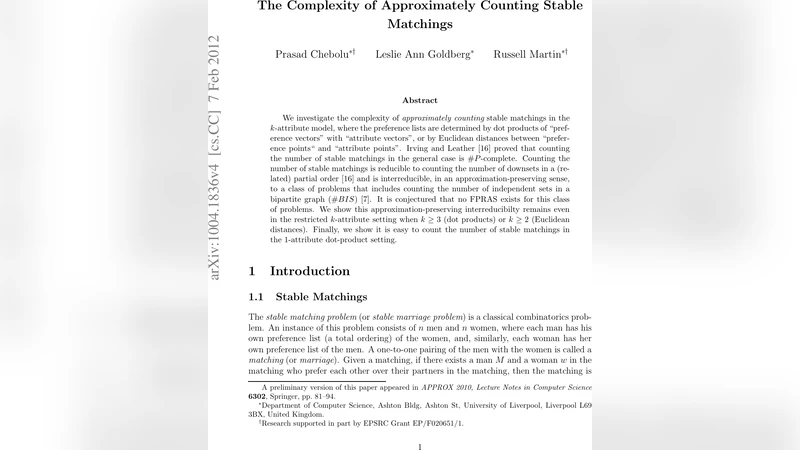
We investigate the complexity of approximately counting stable matchings in the $k$-attribute model, where the preference lists are determined by dot products of “preference vectors” with “attribute vectors”, or by Euclidean distances between “preference points” and “attribute points”. Irving and Leather proved that counting the number of stable matchings in the general case is $#P$-complete. Counting the number of stable matchings is reducible to counting the number of downsets in a (related) partial order and is interreducible, in an approximation-preserving sense, to a class of problems that includes counting the number of independent sets in a bipartite graph ($#BIS$). It is conjectured that no FPRAS exists for this class of problems. We show this approximation-preserving interreducibilty remains even in the restricted $k$-attribute setting when $k \geq 3$ (dot products) or $k \geq 2$ (Euclidean distances). Finally, we show it is easy to count the number of stable matchings in the 1-attribute dot-product setting.
💡 Research Summary
The paper investigates the computational difficulty of approximately counting stable matchings when preferences are generated by geometric models, specifically the k‑attribute model (dot‑product based) and its Euclidean distance variant. In the classical stable marriage problem, each of n men and n women has a strict total order over the opposite sex, and a matching is stable if no man–woman pair would both prefer each other over their current partners. While Gale‑Shapley guarantees the existence of at least one stable matching and provides a polynomial‑time algorithm to find one, counting all stable matchings is known to be #P‑complete (Irving & Leather). This exact counting hardness stems from a reduction to counting down‑sets in a related partial order, a problem also known to be #P‑complete.
Recent work by Dyer et al. placed the counting of down‑sets, and consequently stable matchings, into the complexity class #RHΠ₁, showing that they are AP‑interreducible with the problem #BIS (counting independent sets in a bipartite graph). An AP‑reduction preserves approximation quality: an FPRAS for one problem yields an FPRAS for the other. Since no FPRAS is known for #BIS and it is widely conjectured that none exists, the same conjecture extends to counting stable matchings.
The authors focus on whether this hardness persists in the restricted k‑attribute setting, where each participant i has a k‑dimensional “preference vector” (\hat{i}) and a k‑dimensional “position (or attribute) vector” (\bar{i}). A man M prefers woman w over w′ iff (\hat{M}\cdot\bar{w} > \hat{M}\cdot\bar{w’}). Similarly, the Euclidean variant uses distances: M prefers w over w′ iff (d(\hat{M},\bar{w}) < d(\hat{M},\bar{w’})). For small k not all preference lists can be realized, but the authors show that when k is at least 3 for dot‑product or at least 2 for Euclidean distance, the reduction from #BIS can be embedded into these geometric models.
The core construction maps elements of an arbitrary partial order P (used in the down‑set counting reduction) to men and women with carefully chosen k‑dimensional vectors. The mapping guarantees that the order relation x ≺ y in P is exactly reflected by the corresponding dot‑product (or distance) comparisons, thereby making each down‑set of P correspond to a unique stable matching of the constructed instance. Consequently, counting stable matchings in these k‑attribute (k≥3) or k‑Euclidean (k≥2) instances is AP‑equivalent to #BIS. Hence, unless #BIS admits an FPRAS, no fully polynomial randomized approximation scheme exists for approximately counting stable matchings in these geometric settings.
In contrast, the authors identify a tractable special case: the 1‑attribute dot‑product model. Here each participant’s preference and position vectors are scalars, so preferences are determined solely by the ordering of real numbers. This forces the underlying partial order to be a simple chain, and the set of stable matchings has a highly constrained structure. The paper presents a dynamic‑programming algorithm that enumerates all stable matchings in polynomial time (O(n²)), showing that exact counting is feasible when k = 1.
The paper’s structure is as follows. Section 2 reviews randomized approximation schemes, defines FPRAS, and formalizes AP‑reductions. Section 3 summarizes combinatorial properties of stable matchings, including the Gale‑Shapley algorithm, the lattice of stable matchings, and the correspondence with down‑sets. Sections 4 and 6 contain the detailed AP‑reductions from #BIS to #SM(k‑attribute) (k≥3) and #SM(k‑Euclidean) (k≥2), respectively, describing the vector constructions and proving correctness. Section 5 handles the 1‑attribute case, providing the polynomial‑time counting algorithm. The concluding discussion emphasizes that the hardness of approximate counting persists even under strong geometric restrictions, situating these problems firmly within the #RHΠ₁ completeness class, while also highlighting the sharp threshold at k = 1 where the problem becomes tractable.
Overall, the work bridges combinatorial counting complexity with geometric preference models, demonstrating that modest dimensionality (k≥2 or 3) already yields the full difficulty of #BIS, and that only the degenerate one‑dimensional case admits efficient exact counting. This contributes a nuanced understanding of when stable matching markets are amenable to approximation algorithms and when they inherit inherent computational intractability.
Comments & Academic Discussion
Loading comments...
Leave a Comment