Maximum Cliques in Graphs with Small Intersection Number and Random Intersection Graphs
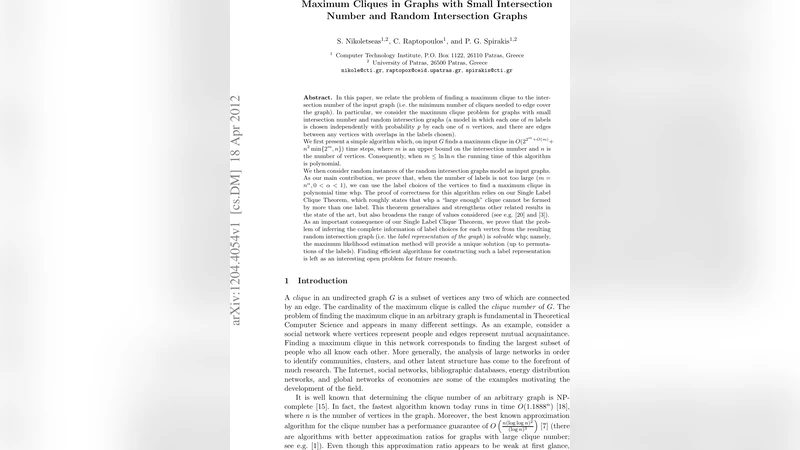
In this paper, we relate the problem of finding a maximum clique to the intersection number of the input graph (i.e. the minimum number of cliques needed to edge cover the graph). In particular, we consider the maximum clique problem for graphs with small intersection number and random intersection graphs (a model in which each one of $m$ labels is chosen independently with probability $p$ by each one of $n$ vertices, and there are edges between any vertices with overlaps in the labels chosen). We first present a simple algorithm which, on input $G$ finds a maximum clique in $O(2^{2^m + O(m)} + n^2 \min{2^m, n})$ time steps, where $m$ is an upper bound on the intersection number and $n$ is the number of vertices. Consequently, when $m \leq \ln{\ln{n}}$ the running time of this algorithm is polynomial. We then consider random instances of the random intersection graphs model as input graphs. As our main contribution, we prove that, when the number of labels is not too large ($m=n^{\alpha}, 0< \alpha <1$), we can use the label choices of the vertices to find a maximum clique in polynomial time whp. The proof of correctness for this algorithm relies on our Single Label Clique Theorem, which roughly states that whp a “large enough” clique cannot be formed by more than one label. This theorem generalizes and strengthens other related results in the state of the art, but also broadens the range of values considered. As an important consequence of our Single Label Clique Theorem, we prove that the problem of inferring the complete information of label choices for each vertex from the resulting random intersection graph (i.e. the \emph{label representation of the graph}) is \emph{solvable} whp. Finding efficient algorithms for constructing such a label representation is left as an interesting open problem for future research.
💡 Research Summary
The paper investigates the maximum‑clique problem from two complementary perspectives: structural graph parameters and probabilistic graph models. First, it introduces the intersection number (IN) of a graph, defined as the smallest number of cliques whose edge‑union covers all edges. If the IN is bounded by m, the authors propose a straightforward exhaustive algorithm that enumerates all 2^m possible label (clique) subsets, constructs the vertex set that shares each subset, and selects the largest such set as a maximum clique. The running time is O(2^{2^m+O(m)} + n²·min{2^m, n}), where n is the number of vertices. Crucially, when m ≤ ln ln n, the term 2^{2^m} becomes polynomial in n, yielding a polynomial‑time exact algorithm for graphs whose intersection number grows doubly‑logarithmically or slower. This result highlights a rare tractable regime for an otherwise NP‑hard problem.
The second part focuses on random intersection graphs (RIGs), a model where each of n vertices independently selects each of m labels with probability p, and an edge is placed between any two vertices sharing at least one label. The authors consider the regime m = n^α with 0 < α < 1, which allows the label set to be polynomially large while keeping each label’s expected degree substantial. Their main technical contribution is the “Single Label Clique Theorem”: with high probability (whp), any clique whose size exceeds a certain threshold (essentially Θ(n·p·m)) is formed by vertices that all share a single common label. In other words, large cliques cannot be the result of the intersection of multiple labels. The proof combines Chernoff bounds, union‑bound arguments, and careful analysis of the overlap structure to show that the probability of two or more labels jointly generating a large clique decays super‑polynomially.
Leveraging this theorem, the paper presents a polynomial‑time algorithm for finding a maximum clique in RIGs when m = n^α. The algorithm simply scans each label, collects the vertices that possess it, and returns the largest such collection; by the theorem this collection is whp the true maximum clique. Moreover, the authors show that the “label representation” of the graph—i.e., the exact assignment of labels to vertices—can be reconstructed from the observed graph with high probability. The reconstruction proceeds by identifying dense subgraphs (candidate cliques) and assigning a unique label to each, exploiting the fact that overlapping large cliques are extremely unlikely.
Finally, the paper outlines open problems: improving the practical efficiency of label‑reconstruction algorithms, extending the deterministic IN‑based algorithm to cases where m slightly exceeds ln ln n, and analyzing extreme regimes of p (very sparse or very dense label selection). Overall, the work bridges combinatorial graph structure (intersection number) and random graph theory (RIGs) to delineate new polynomial‑time solvable instances of the maximum‑clique problem and to demonstrate that hidden label information can be recovered efficiently in realistic random settings.
Comments & Academic Discussion
Loading comments...
Leave a Comment