The algebraic structure of the integrable mixed mKdV/sinh-Gordon model is discussed and \textit{}extended to the AKNS/Lund-Regge model and to its corresponding supersymmetric versions. The integrability of the models is guaranteed from the zero curvature representation and some soliton solutions are discussed.
Deep Dive into A Class of Mixed Integrable Models.
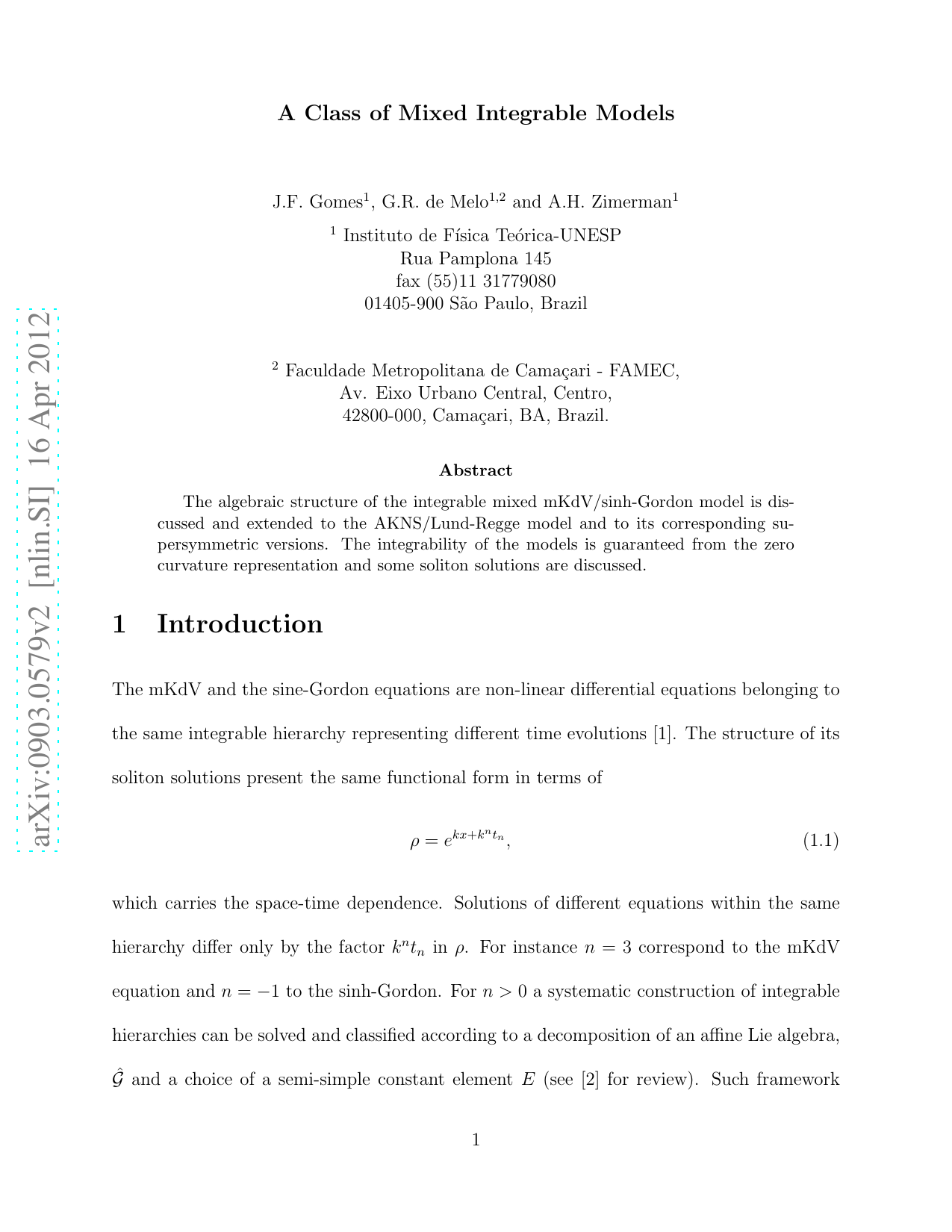
The algebraic structure of the integrable mixed mKdV/sinh-Gordon model is discussed and \textit{}extended to the AKNS/Lund-Regge model and to its corresponding supersymmetric versions. The integrability of the models is guaranteed from the zero curvature representation and some soliton solutions are discussed.
arXiv:0903.0579v2 [nlin.SI] 16 Apr 2012
A Class of Mixed Integrable Models
J.F. Gomes1, G.R. de Melo1,2 and A.H. Zimerman1
1 Instituto de F´ısica Te´orica-UNESP
Rua Pamplona 145
fax (55)11 31779080
01405-900 S˜ao Paulo, Brazil
2 Faculdade Metropolitana de Cama¸cari - FAMEC,
Av. Eixo Urbano Central, Centro,
42800-000, Cama¸cari, BA, Brazil.
Abstract
The algebraic structure of the integrable mixed mKdV/sinh-Gordon model is dis-
cussed and extended to the AKNS/Lund-Regge model and to its corresponding su-
persymmetric versions. The integrability of the models is guaranteed from the zero
curvature representation and some soliton solutions are discussed.
1
Introduction
The mKdV and the sine-Gordon equations are non-linear differential equations belonging to
the same integrable hierarchy representing different time evolutions [1]. The structure of its
soliton solutions present the same functional form in terms of
ρ = ekx+kntn,
(1.1)
which carries the space-time dependence. Solutions of different equations within the same
hierarchy differ only by the factor kntn in ρ. For instance n = 3 correspond to the mKdV
equation and n = −1 to the sinh-Gordon. For n > 0 a systematic construction of integrable
hierarchies can be solved and classified according to a decomposition of an affine Lie algebra,
ˆG and a choice of a semi-simple constant element E (see [2] for review). Such framework
1
was shown to be derived from the Riemann-Hilbert decomposition which later, was shown
to incorporate negative grade isospectral flows n < 0 [3] as well.
The mixed system
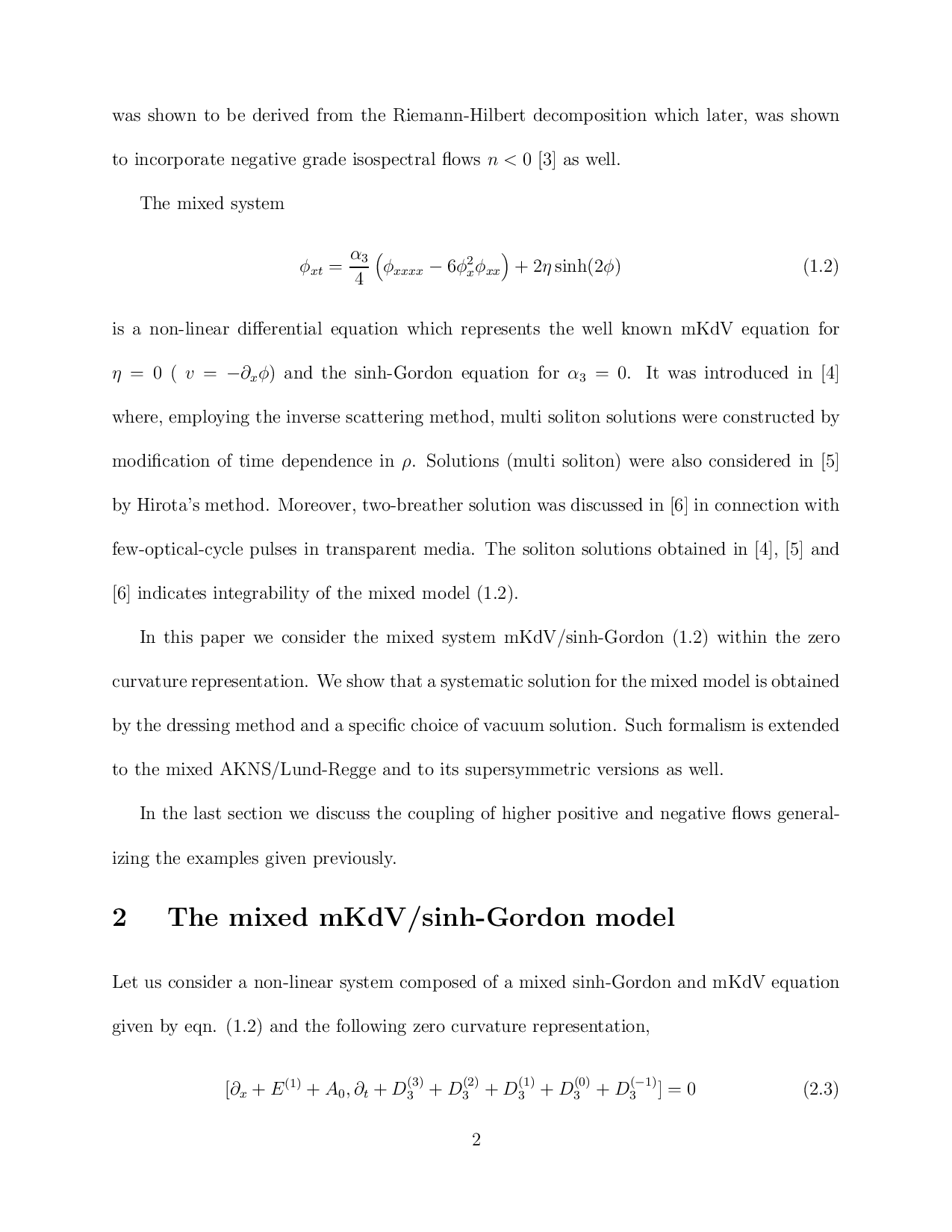
φxt = α3
4
φxxxx −6φ2
xφxx
+ 2η sinh(2φ)
(1.2)
is a non-linear differential equation which represents the well known mKdV equation for
η = 0 ( v = −∂xφ) and the sinh-Gordon equation for α3 = 0. It was introduced in [4]
where, employing the inverse scattering method, multi soliton solutions were constructed by
modification of time dependence in ρ. Solutions (multi soliton) were also considered in [5]
by Hirota’s method. Moreover, two-breather solution was discussed in [6] in connection with
few-optical-cycle pulses in transparent media. The soliton solutions obtained in [4], [5] and
[6] indicates integrability of the mixed model (1.2).
In this paper we consider the mixed system mKdV/sinh-Gordon (1.2) within the zero
curvature representation. We show that a systematic solution for the mixed model is obtained
by the dressing method and a specific choice of vacuum solution. Such formalism is extended
to the mixed AKNS/Lund-Regge and to its supersymmetric versions as well.
In the last section we discuss the coupling of higher positive and negative flows general-
izing the examples given previously.
2
The mixed mKdV/sinh-Gordon model
Let us consider a non-linear system composed of a mixed sinh-Gordon and mKdV equation
given by eqn. (1.2) and the following zero curvature representation,
[∂x + E(1) + A0, ∂t + D(3)
3
+ D(2)
3
+ D(1)
3
+ D(0)
3
+ D(−1)
3
] = 0
(2.3)
2
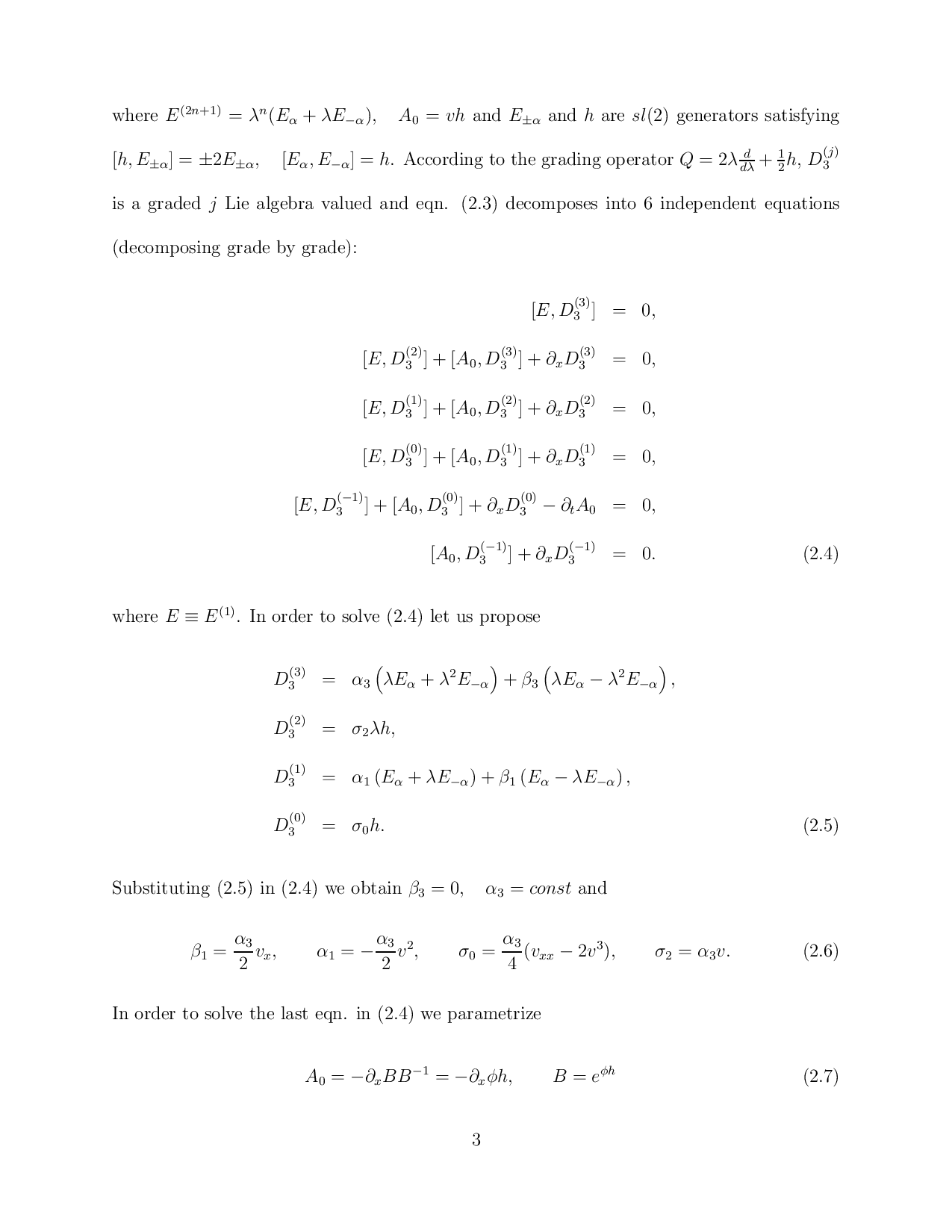
where E(2n+1) = λn(Eα + λE−α),
A0 = vh and E±α and h are sl(2) generators satisfying
[h, E±α] = ±2E±α,
[Eα, E−α] = h. According to the grading operator Q = 2λ d
dλ + 1
2h, D(j)
3
is a graded j Lie algebra valued and eqn. (2.3) decomposes into 6 independent equations
(decomposing grade by grade):
[E, D(3)
3 ]
=
0,
[E, D(2)
3 ] + [A0, D(3)
3 ] + ∂xD(3)
3
=
0,
[E, D(1)
3 ] + [A0, D(2)
3 ] + ∂xD(2)
3
=
0,
[E, D(0)
3 ] + [A0, D(1)
3 ] + ∂xD(1)
3
=
0,
[E, D(−1)
3
] + [A0, D(0)
3 ] + ∂xD(0)
3
−∂tA0
=
0,
[A0, D(−1)
3
] + ∂xD(−1)
3
=
0.
(2.4)
where E ≡E(1). In order to solve (2.4) let us propose
D(3)
3
=
α3
λEα + λ2E−α
+ β3
λEα −λ2E−α
,
D(2)
3
=
σ2λh,
D(1)
3
=
α1 (Eα + λE−α) + β1 (Eα −λE−α) ,
D(0)
3
=
σ0h.
(2.5)
Substituting (2.5) in (2.4) we obtain β3 = 0,
α3 = const and
β1 = α3
2 vx,
α1 = −α3
2 v2,
σ0 = α3
4 (vxx −2v3),
σ2 = α3v.
(2.6)
In order to solve the last eqn. in (2.4) we parametrize
A0 = −∂xBB−1 = −∂xφh,
B = eφh
(2.7)
3
and
D(−1)
3
= ηBE(−1)B−1 = ηλ−1(e2φEα + λe−2φE−α)
(2.8)
The zero grade projection in (2.4) yields the time evolution equation (1.2). Notice that in
order to solve the last eqn. (2.5) we have introduced the sinh-Gordon variable φ in (2.7) and
in (2.8) such that v = −∂xφ.
Let us now recall some basic aspects of the dressing method which provides systematic
construction of soliton solutions. The zero curvature representation implies in a pure gauge
configuration. In particular, the vacuum is obtained by setting φvac = 0 or vvac = 0 which,
when in (2.3) implies,
∂xT0T −1
0
= E(1),
∂tT0T −1
0
= α3E(3) + ηE(−1)
(2.9)
and after integration
T0 = exp
t(α3E(3) + ηE(−1))
exp
xE(1)
,
E(2n+1) = λn(Eα + λE−α).
(2.10)
If we identify v = −∂xφ eqn. (1.2) represents a coupling of mKdV and sinh-Gordon equations
and becomes a pure mKdV when η = 0 and pure sinh-Gordon when α3 = 0.
Tracing
back those two limits from (2.6) and (2.8) it becomes clear that the sinh-Gordon limit
(η = 0) in (1.2) is responsible for the vanishing of D(−1)
3
. On the other hand, α3 = 0 implies
D(j)
3
= 0, j = 0, · · · 3. Inspired by the
…(Full text truncated)…
This content is AI-processed based on ArXiv data.