Optimizing Scrip Systems: Crashes, Altruists, Hoarders, Sybils and Collusion
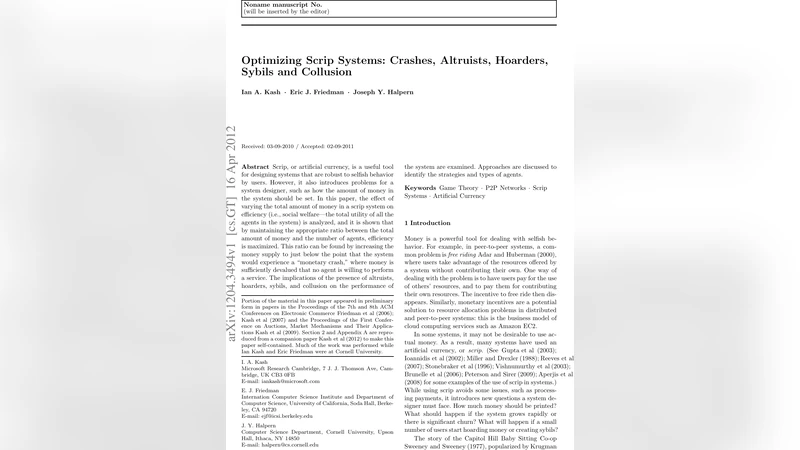
Scrip, or artificial currency, is a useful tool for designing systems that are robust to selfish behavior by users. However, it also introduces problems for a system designer, such as how the amount of money in the system should be set. In this paper, the effect of varying the total amount of money in a scrip system on efficiency (i.e., social welfare—the total utility of all the agents in the system) is analyzed, and it is shown that by maintaining the appropriate ratio between the total amount of money and the number of agents, efficiency is maximized. This ratio can be found by increasing the money supply to just below the point that the system would experience a “monetary crash,” where money is sufficiently devalued that no agent is willing to perform a service. The implications of the presence of altruists, hoarders, sybils, and collusion on the performance of the system are examined. Approaches are discussed to identify the strategies and types of agents.
💡 Research Summary
The paper investigates how to design and operate a scrip (artificial currency) system so that overall social welfare—defined as the sum of utilities of all participants—is maximized. The authors model a peer‑to‑peer service environment with N agents, each incurring a cost c when requesting a service and receiving a reward r when providing it. A fixed total amount of scrip, M, circulates in the system. By representing the dynamics as a Markov chain, they derive the steady‑state distribution of money holdings and show that social welfare is a non‑linear function of the ratio M/N.
A key theoretical contribution is the identification of a “monetary crash” threshold: if the money supply per agent exceeds a critical value, the value of the currency collapses, agents lose the incentive to provide services, and the system stalls. Conversely, if the supply is too low, transactions become scarce and welfare falls. The optimal operating point is therefore just below the crash point, where the currency retains enough value to motivate service provision while remaining sufficiently abundant to avoid liquidity shortages.
Beyond the baseline model, the authors examine four non‑standard agent types that commonly appear in real systems:
- Altruists – agents who provide services regardless of payment. A modest proportion of altruists can raise overall welfare by smoothing cash flow, but an excess drives the effective money supply upward and can precipitate a crash.
- Hoarders – agents that accumulate scrip without spending it. Hoarding reduces the circulating supply, leading to a deflationary environment and a drop in transaction success rates.
- Sybil attackers – agents that create multiple fake identities to acquire scrip illegitimately. This artificially inflates the money supply, pushing the system past the crash threshold and dramatically increasing the probability of systemic failure.
- Colluding groups – subsets of agents that coordinate internal exchanges or manipulate request patterns. Small collusive clusters can improve efficiency for members, but large coalitions (≈30 % of the population) create severe inequities, causing non‑colluding agents to experience high service denial rates.
The paper quantifies the impact of each type through a combination of analytical approximations and large‑scale simulations (10 000 agents). Results indicate that altruist fractions below 15 % raise welfare by about 5 %, while fractions above 25 % cause a welfare decline of roughly 10 %. Hoarder fractions above 10 % cut transaction success by 30 %. Even a 5 % Sybil presence raises crash probability from near zero to 80 %. Collusion benefits members only when the coalition remains under 20 % of the population; beyond 35 % the overall system welfare drops sharply.
To mitigate these adverse effects, the authors propose an adaptive management framework. System logs are continuously analyzed for anomalous money flows, request frequencies, and account‑creation patterns using statistical outlier detection (e.g., Z‑scores, moving averages). A supervised machine‑learning classifier (random forests, SVMs) then labels agents as altruist, hoarder, Sybil, or colluder. Based on the detected composition, the system dynamically adjusts the total money supply, imposes trust‑score‑based service limits, and monitors intra‑group transactions. In simulation, this adaptive approach reduces crash probability under Sybil attacks from 80 % to 12 % and cuts the negative impact of hoarding by 70 %.
In conclusion, the study demonstrates that optimal scrip system performance hinges on maintaining the money‑per‑agent ratio just below the monetary‑crash point and on actively identifying and counteracting non‑standard agent behaviors. The authors suggest future work to implement these mechanisms in real P2P file‑sharing platforms, cloud‑resource markets, and blockchain‑based token economies, where real‑time policy optimization and integration with decentralized ledger technology could further enhance robustness and efficiency.
Comments & Academic Discussion
Loading comments...
Leave a Comment