A Prehistory of n-Categorical Physics
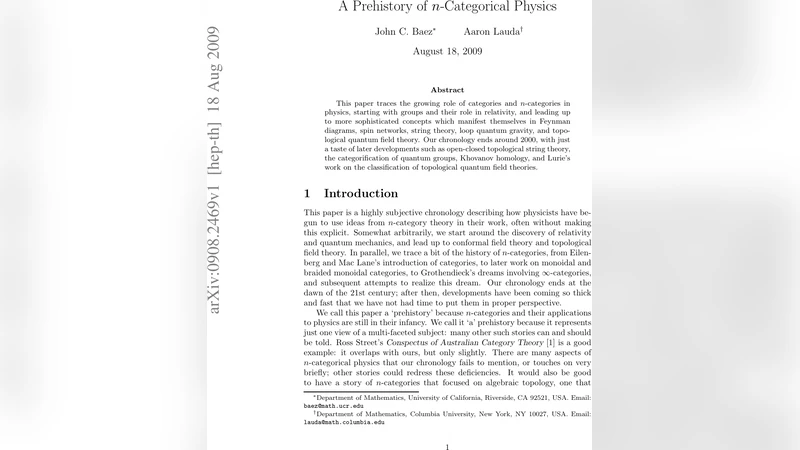
This paper traces the growing role of categories and n-categories in physics, starting with groups and their role in relativity, and leading up to more sophisticated concepts which manifest themselves in Feynman diagrams, spin networks, string theory, loop quantum gravity, and topological quantum field theory. Our chronology ends around 2000, with just a taste of later developments such as open-closed topological string theory, the categorification of quantum groups, Khovanov homology, and Lurie’s work on the classification of topological quantum field theories.
💡 Research Summary
The paper provides a chronological survey of how categorical and higher‑categorical ideas have progressively entered theoretical physics, beginning with the classical role of groups as symmetry objects and culminating in the modern language of n‑categories that underlies many contemporary frameworks. It starts by recalling that the Lorentz and Poincaré groups supplied the mathematical backbone of special and general relativity, and that their representation theory became the first systematic tool for classifying particle states and conserved quantities.
The narrative then moves to the mid‑20th century, when category theory emerged as a unifying language in mathematics and began to influence physics. The authors point out that Penrose diagrams, which encode the composition of linear maps, are essentially visualizations of 1‑category composition, foreshadowing the functorial viewpoint that later became central to quantum field theory. This perspective is deepened by discussing spin networks and loop quantum gravity, where edges carry SU(2) representations and vertices encode tensor‑product couplings. These structures naturally realize a 2‑category: objects are Hilbert spaces, 1‑morphisms are intertwiners, and 2‑morphisms are relations among intertwiners, providing a categorical reinterpretation of the kinematical Hilbert space of quantum geometry.
The paper proceeds to topological quantum field theory (TQFT), emphasizing the Atiyah‑Segal axioms as a functor from the n‑dimensional cobordism category to the category of vector spaces. In this setting, objects are (n‑1)‑manifolds, morphisms are n‑dimensional cobordisms, and higher morphisms appear when one considers bordisms between bordisms, leading directly to the notion of an n‑category. The authors review how Lurie’s cobordism hypothesis extends this idea to fully extended TQFTs, showing that every fully dualizable object in a symmetric monoidal n‑category determines a unique n‑dimensional TQFT.
After establishing the historical arc up to the year 2000, the paper briefly surveys later developments that illustrate the continuing relevance of higher categories. Open‑closed topological string theory requires a 2‑category that simultaneously treats bulk and boundary sectors. The categorification of quantum groups, pioneered by Drinfeld and Jimbo, lifts quantum algebras to monoidal categories, enabling the construction of Khovanov homology—a homological refinement of the Jones polynomial that interprets link diagrams as objects in a 2‑category of complexes. Finally, Lurie’s work on the classification of TQFTs provides a unifying framework that captures all previously mentioned examples as instances of fully extended functorial field theories.
In conclusion, the authors argue that the evolution from groups to 1‑categories, then to 2‑categories and ultimately to n‑categories reflects a deepening understanding of the structural foundations of physics. Each categorical leap has not only clarified existing theories—such as the algebraic structure of Feynman diagrams or the combinatorics of spin networks—but also opened new avenues for research, including higher‑dimensional quantum field theories, categorified invariants, and the pursuit of a fully unified mathematical language for fundamental interactions. The paper suggests that future progress will likely hinge on further integration of higher‑category theory with physical concepts, potentially leading to novel insights into quantum gravity, topological phases of matter, and beyond.
Comments & Academic Discussion
Loading comments...
Leave a Comment