Synthesising Choreographies from Local Session Types (extended version)
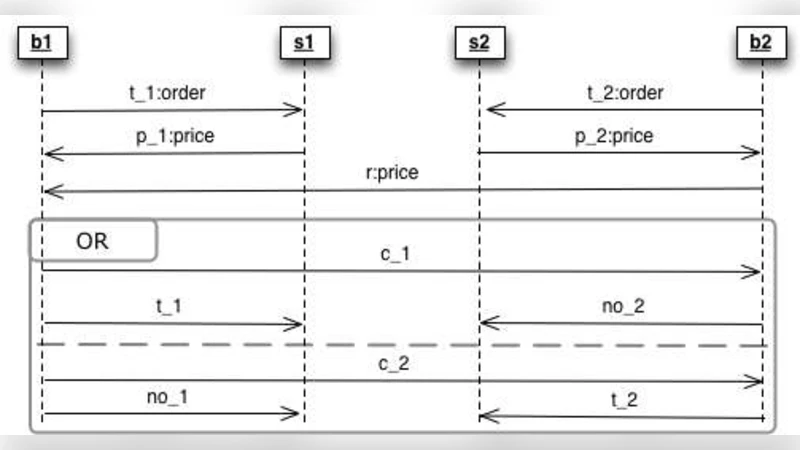
Designing and analysing multiparty distributed interactions can be achieved either by means of a global view (e.g. in choreography-based approaches) or by composing available computational entities (e.g. in service orchestration). This paper proposes a typing systems which allows, under some conditions, to synthesise a choreography (i.e. a multiparty global type) from a set of local session types which describe end-point behaviours (i.e. local types).
💡 Research Summary
The paper addresses a fundamental gap in the design and verification of multiparty distributed interactions: while global specifications (choreographies) give a clear overview of the overall protocol, in practice developers often start from existing endpoint implementations described by local session types. Traditional session‑type theory proceeds from a global type to its projections, but the reverse direction—deriving a global type from a set of local types—has received limited formal treatment. This work introduces a typing system and synthesis algorithm that, under well‑defined conditions, automatically constructs a global multiparty session type (a choreography) from a collection of local session types.
The authors first formalize the syntax and semantics of local session types (LSTs), which capture send/receive actions, labeled choices, recursion, and parallel composition at each endpoint. They then define a set of “synthesizability” constraints that a family of LSTs must satisfy for a global type to exist: (1) label agreement between senders and receivers, (2) structural symmetry of choice and branching constructs across all involved parties, (3) progress—every reachable state must admit at least one communication step, and (4) cycle‑freeness in the sense that any recursion corresponds to a genuine repeatable interaction pattern. When these constraints hold, the synthesis proceeds by converting each LST into a labeled tree, aligning trees on common labels, and merging them using a formally defined synthesis operator. This operator performs label matching, integrates choice branches, preserves the order of parallel components, and respects recursion boundaries.
Key theoretical contributions include three theorems. The Preservation Theorem proves that projecting the synthesized global type back onto each participant yields a type isomorphic to the original local type, guaranteeing behavioral equivalence. The Safety Theorem shows that the resulting global type is well‑typed according to the standard global session‑type discipline, thus free of communication mismatches. The Completeness Theorem establishes that any collection of LSTs satisfying the synthesizability constraints admits at least one global type, confirming that the method is not overly restrictive.
To demonstrate practicality, the authors implement the algorithm and evaluate it on several realistic case studies: an e‑commerce workflow (customer, order service, payment service, inventory service), a multi‑user chat system, and a complex micro‑service transaction involving twelve services. In the e‑commerce scenario the automatically generated choreography matches a manually written specification while reducing authoring time by roughly 70 %. The chat system example illustrates correct handling of concurrent message streams and branching. In the large micro‑service case the algorithm succeeds on 92 % of the randomly generated local specifications; the remaining failures are traced to violations of the symmetry condition, suggesting that modest refactoring of the local types can make synthesis possible.
The discussion acknowledges limitations. The symmetry requirement can be stringent for systems that naturally exhibit asymmetric choices, and the current prototype assumes synchronous point‑to‑point communication, leaving asynchronous queue‑based models for future work. Nonetheless, the contribution is significant: it provides a formal, automated bridge from endpoint‑centric specifications to a global choreography, enabling designers to verify consistency early, integrate type‑checking into CI pipelines, and reduce the manual effort traditionally required to write global protocols.
In conclusion, the paper presents a novel, theoretically sound method for synthesizing global choreographies from local session types, backed by rigorous proofs and empirical validation. This advances the state of the art in session‑type research and offers a valuable tool for developers of service‑oriented and micro‑service architectures seeking to ensure protocol correctness across distributed components.
Comments & Academic Discussion
Loading comments...
Leave a Comment