A regularity lemma and twins in words
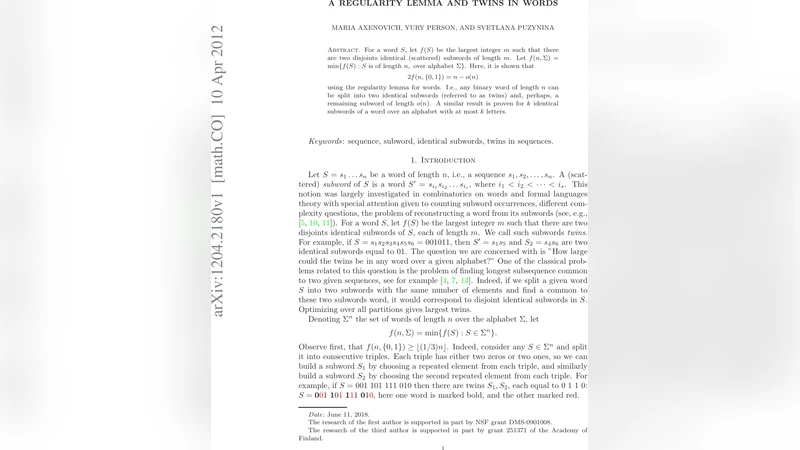
For a word $S$, let $f(S)$ be the largest integer $m$ such that there are two disjoints identical (scattered) subwords of length $m$. Let $f(n, \Sigma) = \min {f(S): S \text{is of length} n, \text{over alphabet} \Sigma }$. Here, it is shown that [2f(n, {0,1}) = n-o(n)] using the regularity lemma for words. I.e., any binary word of length $n$ can be split into two identical subwords (referred to as twins) and, perhaps, a remaining subword of length $o(n)$. A similar result is proven for $k$ identical subwords of a word over an alphabet with at most $k$ letters.
💡 Research Summary
The paper addresses a fundamental combinatorial question about the existence of large identical scattered subwords—called “twins”—within a finite word. For a word $S$, $f(S)$ denotes the maximum length $m$ for which $S$ contains two disjoint identical scattered subwords of length $m$. The authors study the worst‑case value $f(n,\Sigma)=\min{f(S):|S|=n,;S\text{ over alphabet }\Sigma}$ and prove a sharp asymptotic bound for binary alphabets. Their main theorem states that
\
Comments & Academic Discussion
Loading comments...
Leave a Comment