Veech holomorphic families of Riemann surfaces, holomorphic sections, and Diophantine problems
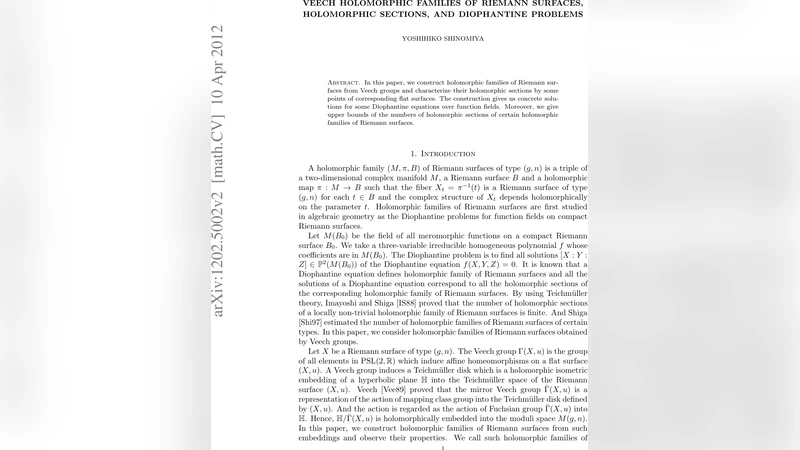
In this paper, we construct holomorphic families of Riemann surfaces from Veech groups and characterize their sections by some points of corresponding flat surfaces. The construction gives us concrete solutions for some Diophantine equations over function fields. Moreover, we give upper bounds of the numbers of holomorphic sections of certain holomorphic families of Riemann surfaces.
💡 Research Summary
The paper investigates a novel bridge between the dynamics of translation surfaces, the theory of Teichmüller curves, and arithmetic geometry over function fields. Starting from a translation surface ((X,q)) – a Riemann surface equipped with a holomorphic quadratic differential whose local charts are given by translations in the complex plane – the authors consider its Veech group (\Gamma\subset\mathrm{SL}(2,\mathbb{R})). The Veech group records all affine diffeomorphisms of ((X,q)) whose derivative lies in (\mathrm{SL}(2,\mathbb{R})); when (\Gamma) is a lattice (i.e., (\mathbb{H}/\Gamma) has finite hyperbolic area) the orbit of ((X,q)) under the (\mathrm{SL}(2,\mathbb{R})) action projects to a Teichmüller curve (M=\mathbb{H}/\Gamma) inside the moduli space (\mathcal{M}_g).
The first major construction is a holomorphic family (\pi:\mathcal{X}\to M). For each point (t\in M) one chooses a matrix (A_t\in\mathrm{SL}(2,\mathbb{R})) representing the class of (t) and defines the fiber (X_t=A_t\cdot X) – the same topological surface equipped with the translated flat structure. Gluing all fibers together yields a complex manifold (\mathcal{X}) together with a holomorphic submersion (\pi). By construction (\pi) is equivariant with respect to the Veech group: the monodromy of the family is precisely the action of (\Gamma) on the flat surface.
The central technical result is a complete description of the holomorphic sections (or “holomorphic sections”) of (\pi). A section (s:M\to\mathcal{X}) chooses, for every (t), a point on the fiber (X_t). The authors prove that every such section is determined by a single point (p) of the original flat surface ((X,q)) that is fixed (or has a finite orbit) under the affine action of (\Gamma). In other words, let
\
Comments & Academic Discussion
Loading comments...
Leave a Comment