Scaling relations between numerical simulations and physical systems they represent
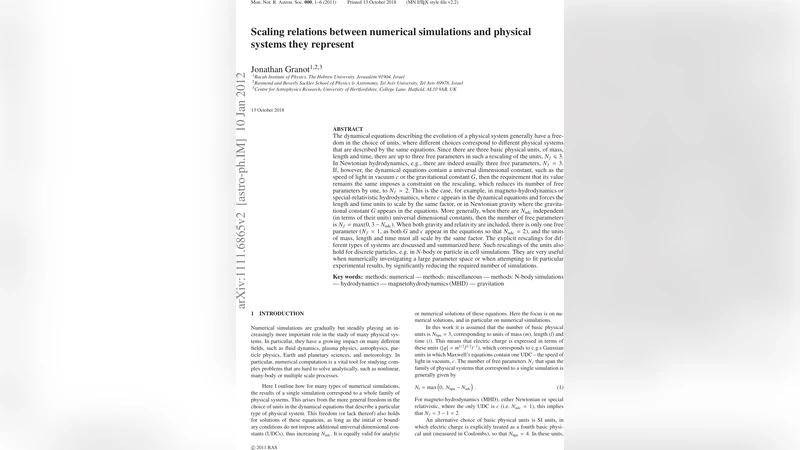
The dynamical equations describing the evolution of a physical system generally have a freedom in the choice of units, where different choices correspond to different physical systems that are described by the same equations. Since there are three basic physical units, of mass, length and time, there are up to three free parameters in such a rescaling of the units, $N_f \leq 3$. In Newtonian hydrodynamics, e.g., there are indeed usually three free parameters, $N_f = 3$. If, however, the dynamical equations contain a universal dimensional constant, such as the speed of light in vacuum $c$ or the gravitational constant $G$, then the requirement that its value remains the same imposes a constraint on the rescaling, which reduces its number of free parameters by one, to $N_f = 2$. This is the case, for example, in magneto-hydrodynamics (MHD) or special relativistic hydrodynamics, where $c$ appears in the dynamical equations and forces the length and time units to scale by the same factor, or in Newtonian gravity where the gravitational constant $G$ appears in the equations. More generally, when there are $N_{udc}$ independent (in terms of their units) universal dimensional constants, then the number of free parameters is $N_f = max(0,3-N_{udc})$. When both gravity and relativity are included, there is only one free parameter ($N_f = 1$, as both $G$ and $c$ appear in the equations so that $N_{udc} = 2$), and the units of mass, length and time must all scale by the same factor. The explicit rescalings for different types of systems are discussed and summarized here. Such rescalings of the units also hold for discrete particles, e.g. in N-body or particle in cell simulations. They are very useful when numerically investigating a large parameter space or when attempting to fit particular experimental results, by significantly reducing the required number of simulations.
💡 Research Summary
The paper investigates the inherent freedom in choosing units when solving the dynamical equations that describe physical systems, and how this freedom translates into a family of physically distinct systems that share a single numerical simulation. Starting from the premise that the basic physical units are mass (m), length (l) and time (t), the author introduces scaling factors ζ (mass), α (length) and η (time). In the absence of any universal dimensional constants (UDCs) the three factors are completely independent, giving three free parameters (N_f = 3).
When a UDC appears in the governing equations, its numerical value must be preserved under any rescaling, which imposes algebraic constraints among ζ, α and η. The paper derives a simple general rule:
N_f = max(0, 3 − N_udc)
where N_udc is the number of independent UDCs (in terms of dimensions). The most common UDCs are the speed of light c (dimensions l t⁻¹) and the gravitational constant G (dimensions m⁻¹ l³ t⁻²).
The author then works out the explicit scaling relations for a variety of simulation types, summarised in Table 1:
-
Newtonian hydrodynamics (no gravity, no c) – No UDCs, so ζ, α, η are all free (N_f = 3). Physical quantities transform as Q′ = ζ^A α^B η^C Q.
-
Special‑relativistic hydrodynamics – c is present, imposing α = η. Two free parameters remain (ζ, α) (N_f = 2). Energy and mass scale with ζ, while space‑time coordinates scale uniformly with α.
-
Newtonian gravity added – G introduces the relation ζ = α³ η⁻². Again two free parameters (α, η) survive (N_f = 2).
-
Both c and G present (relativistic gravity) – Two independent UDCs force ζ = α = η, leaving a single overall scaling factor (N_f = 1).
-
Magnetohydrodynamics (MHD) – c is always present, so α = η (N_f = 2). If gravity is also included, the situation reduces to the previous case with a single free parameter.
-
Particle‑in‑Cell (PIC) simulations – Maxwell’s equations bring in c, giving α = η. If the rest mass and charge of a specific particle species must be kept fixed, additional constraints (q, m) raise N_udc to 3, eliminating all freedom (ζ = α = η = 1).
-
N‑body simulations – With only Newtonian gravity, the same ζ = α³ η⁻² relation applies (N_f = 2). Including relativistic effects adds c, collapsing the scaling to ζ = α = η (N_f = 1).
The paper also discusses cosmological simulations where parameters such as the Hubble constant H₀ or σ₈ may be treated as additional UDCs. Treating H₀ as a fixed constant forces η = 1, which together with G yields ζ = α³, reducing the number of free parameters to one.
A key insight is that a single numerical solution, once expressed in dimensionless “code units”, can be mapped back to an infinite set of physical systems simply by choosing different (ζ, α, η) that satisfy the relevant constraints. This mapping is valid as long as the initial and boundary conditions do not introduce extra dimensional constants. Consequently, researchers can dramatically reduce the number of separate simulations required to explore a large parameter space: by running one simulation and applying the appropriate scaling, one can generate results for many different masses, lengths, times, or even different physical constants.
The author emphasizes the practical utility of this approach for parameter studies, model fitting, and the interpretation of experimental or observational data. By explicitly stating which constants are held fixed and which scaling freedoms are allowed, the methodology provides a clear, mathematically rigorous framework for translating numerical experiments into a broad range of physical contexts, thereby saving computational resources and improving the efficiency of theoretical investigations.
Comments & Academic Discussion
Loading comments...
Leave a Comment