A molecular simulation analysis of producing monatomic carbon chains by stretching ultranarrow graphene nanoribbons
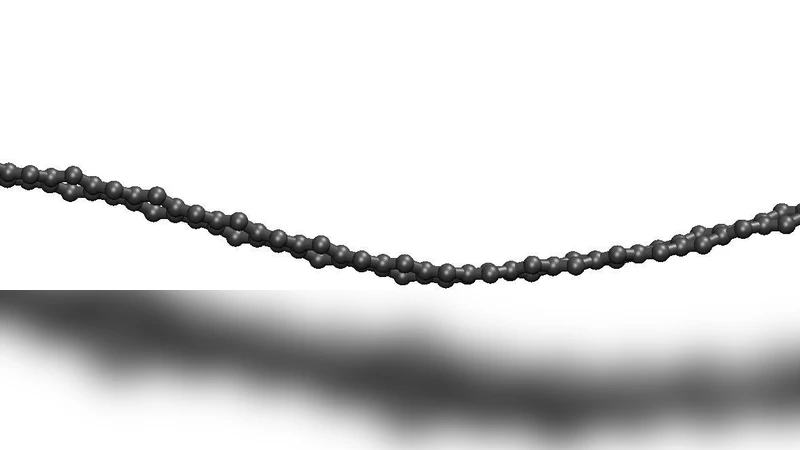
Atomistic simulations were utilized to develop fundamental insights regarding the elongation process starting from ultranarrow graphene nanoribbons (GNRs) and resulting in monatomic carbon chains (MACCs). There are three key findings. First, we demonstrate that complete, elongated, and stable MACCs with fracture strains exceeding 100% can be formed from both ultranarrow armchair and zigzag GNRs. Second, we demonstrate that the deformation processes leading to the MACCs have strong chirality dependence. Specifically, armchair GNRs first form DNA-like chains, then develop into monatomic chains by passing through an intermediate configuration in which monatomic chain sections are separated by two-atom attachments. In contrast, zigzag GNRs form rope-ladder-like chains through a process in which the carbon hexagons are first elongated into rectangles; these rectangles eventually coalesce into monatomic chains through a novel triangle-pentagon deformation structure under further tensile deformation. Finally, we show that the width of GNRs plays an important role in the formation of MACCs, and that the ultranarrow GNRs facilitate the formation of full MACCs. The present work should be of considerable interest due to the experimentally demonstrated feasibility of using narrow GNRs to fabricate novel nanoelectronic components based upon monatomic chains of carbon atoms.
💡 Research Summary
This paper presents a comprehensive atomistic simulation study on the formation of monatomic carbon chains (MACCs) by tensile stretching of ultranarrow graphene nanoribbons (GNRs). Using large‑scale molecular dynamics (MD) with the AIREBO potential, the authors examined both armchair and zigzag GNRs of three different widths (one, two, and three atomic rows) at 300 K under a constant strain rate of 10⁸ s⁻¹. The simulations reveal that when the ribbon width is reduced to a single atomic row, the material can sustain tensile strains exceeding 100 % before fracture, and a continuous, defect‑free MACC emerges.
The deformation pathways are strongly chirality‑dependent. Armchair GNRs initially develop a DNA‑like helical configuration as the hexagonal lattice twists. This is followed by the appearance of short two‑atom “bridge” segments that intermittently separate nascent monatomic sections. As strain increases, these bridges dissolve and the chain collapses into a uniform, single‑atom line. In contrast, zigzag GNRs undergo a distinct mechanism: the hexagons first elongate into rectangular motifs, which then transform into a repeating triangle‑pentagon (Δ‑⊿) pattern. Continued stretching causes the Δ‑⊿ units to merge, yielding a straight monatomic chain. Both mechanisms involve a sequence of bond order changes (from sp² to sp³‑like intermediates and finally to sp) that lower the energetic barrier for chain formation.
Width plays a decisive role. For ribbons one atom thick, the entire lattice participates coherently in the transition, producing a full MACC. When the width increases to two rows, internal atoms experience reduced stress transfer from the edges, leading to prolonged coexistence of bridge or Δ‑⊿ structures and incomplete chain formation. At three rows, the interior region fractures prematurely, and only fragmented monatomic segments survive. This behavior is attributed to the disparity in stress distribution between edge and interior atoms.
The authors discuss the experimental relevance of their findings. Ultrathin GNRs can now be fabricated by bottom‑up chemical synthesis, electron‑beam lithography, or plasma etching, and tensile loading can be applied using atomic force microscopy tips or in‑situ transmission electron microscopy setups. The intermediate DNA‑like and rope‑ladder‑like morphologies identified in the simulations should be observable as characteristic contrast modulations in high‑resolution TEM images, providing a direct validation pathway.
From an application standpoint, MACCs possess exceptional electrical conductance (single‑channel quantum transport) and can carry current densities on the order of 10⁹ A cm⁻², making them attractive for ultra‑compact interconnects, high‑speed switches, and even quantum‑bit elements where atomic precision is essential. The study thus establishes a clear design rule: to reliably produce MACCs, one should employ ultranarrow (single‑row) GNRs and tailor the chirality according to the desired deformation pathway.
In conclusion, the paper demonstrates three key insights: (1) complete, stable MACCs with fracture strains >100 % can be generated from both armchair and zigzag ultranarrow GNRs; (2) the transformation mechanisms are chirality‑specific, involving DNA‑like/two‑atom bridge evolution for armchair ribbons and rectangle‑to‑triangle‑pentagon coalescence for zigzag ribbons; and (3) ribbon width critically governs the success of MACC formation, with the narrowest ribbons being most favorable. The authors suggest future work to incorporate temperature variations, strain‑rate effects, and defect engineering, as well as experimental verification of the predicted structural intermediates and electronic properties.