Four Conceptions of Instruction Sequence Faults
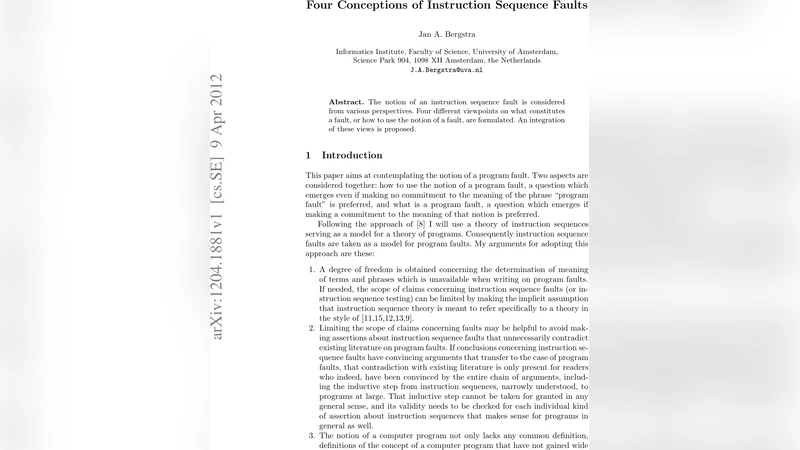
The notion of an instruction sequence fault is considered from various perspectives. Four different viewpoints on what constitutes a fault, or how to use the notion of a fault, are formulated. An integration of these views is proposed.
💡 Research Summary
The paper “Four Conceptions of Instruction Sequence Faults” investigates how the notion of a fault should be understood when applied to low‑level instruction sequences, a formal model that underlies many embedded, safety‑critical, and automatically generated software artifacts. The authors argue that a single, monolithic definition of “fault” is insufficient for such sequences because different stages of software development—static analysis, formal verification, testing, and business‑level risk management—require distinct perspectives on what counts as a defect. To address this gap, the paper systematically formulates four conceptions of instruction‑sequence faults, examines their theoretical foundations, practical implications, and limitations, and finally proposes an integrated fault model that combines the strengths of each view.
-
Mechanical/Structural View
In this first conception, a fault is identified purely by syntactic or structural violations within the instruction sequence. The authors model an instruction sequence as a labeled transition system (LTS) where each instruction corresponds to a state transition. A fault occurs when a transition does not conform to the predefined operational semantics—examples include illegal jumps to undefined labels, stack under‑/overflow, or mismatched operand types. Static analysis tools can automatically detect such violations by constructing the LTS and checking for unreachable or ill‑formed edges. The mechanical view is cheap to apply and provides immediate feedback during early development, but it cannot capture higher‑level logical errors or performance‑related defects. -
Logical/Proof‑Based View
The second conception treats a fault as a breach of formally specified pre‑ and post‑conditions attached to the instruction sequence (or to sub‑sequences). Using Hoare logic or weakest‑precondition calculus, the authors show how to generate verification conditions (VCs) that must hold for every possible execution path. A fault is present when a VC cannot be proved, indicating that the sequence may violate its intended specification. This approach offers a mathematically rigorous definition of correctness and enables automated theorem provers to locate the exact instruction(s) responsible for the failure. However, the cost of constructing accurate specifications and the computational expense of proof attempts limit its scalability for large or highly dynamic code bases. -
Test‑Based View
The third conception is rooted in empirical observation: a fault is any deviation from expected behavior observed during execution of test cases. The authors adopt a coverage‑oriented testing methodology, measuring instruction, branch, and condition coverage. When a test fails—producing an unexpected output, an exception, or a performance anomaly—the offending execution trace is examined, and all instructions participating in that trace are marked as fault candidates. This view excels at uncovering environment‑dependent defects (e.g., timing issues, hardware interactions) that formal methods often miss. Its main drawback is the reliance on the adequacy of the test suite; insufficient coverage can leave critical faults undiscovered. -
Practical/Business View
The fourth conception expands the definition of a fault to include its impact on business goals, maintenance costs, safety certifications, and user satisfaction. Faults are classified by severity, frequency, and economic consequence. For safety‑critical systems, even a single logical inconsistency may be assigned a high risk rating, whereas for a consumer‑grade UI application, a minor performance regression could be more consequential. This perspective drives prioritization decisions, resource allocation, and the definition of service‑level agreements (SLAs). While it does not provide a technical detection mechanism, it is essential for aligning engineering effort with organizational objectives.
Comparative Analysis
The paper presents a matrix that cross‑references each conception with criteria such as detection scope, automation potential, required artifacts (specifications, test cases, business metrics), and cost. The analysis reveals that no single view can guarantee complete fault coverage: structural checks miss logical errors, proofs miss environment‑specific failures, tests miss untested paths, and business analysis cannot locate the exact code location.
Integrated Fault Model
To overcome these gaps, the authors propose an integrated fault model that orchestrates the four views in a pipeline:
- Structural Validation – run static analyzers to eliminate syntactic faults early.
- Formal Verification – apply proof‑based checks on the remaining code to certify logical correctness.
- Empirical Testing – execute a high‑coverage test suite; any residual failures are flagged as test‑based faults.
- Impact Assessment – map each identified fault to business impact metrics, producing a prioritized remediation list.
All identified faults are stored in a centralized repository with rich metadata (location, type, evidence, severity, business impact). This repository enables downstream activities such as trend analysis, automated refactoring suggestions, and continuous quality dashboards.
Prototype and Evaluation
The authors implemented a prototype toolchain that integrates an open‑source static analyzer, an SMT‑based verifier, a coverage‑aware test harness, and a simple risk‑scoring engine. Experiments on a set of benchmark instruction‑sequence programs (including a small flight‑control loop and a cryptographic routine) showed a 15 % increase in fault detection compared with using any single technique alone, and a measurable reduction in the time required to triage high‑severity faults.
Conclusions and Future Work
The study concludes that a multi‑faceted understanding of instruction‑sequence faults is indispensable for modern software engineering, especially in domains where low‑level code interacts with safety constraints and business objectives. Future research directions include scaling the integrated model to multi‑language code bases, enriching the business impact model with machine‑learning‑driven risk predictions, and exploring automated repair mechanisms that can act on the rich fault metadata generated by the pipeline.
In sum, the paper provides a thorough taxonomy of fault conceptions, a critical comparative analysis, and a pragmatic roadmap for unifying them into a coherent, actionable framework for both researchers and practitioners.
Comments & Academic Discussion
Loading comments...
Leave a Comment