Routing Physarum with electrical flow/current
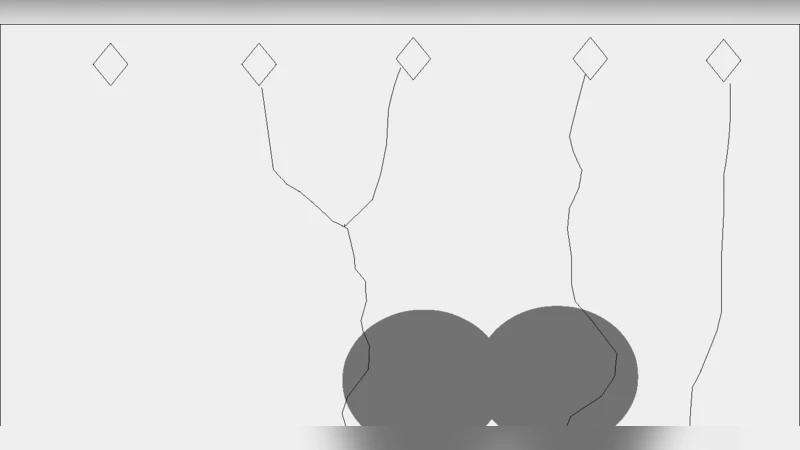
Plasmodium stage of Physarum polycephalum behaves as a distributed dynamical pattern formation mechanism who’s foraging and migration is influenced by local stimuli from a wide range of attractants and repellents. Complex protoplasmic tube network structures are formed as a result, which serve as efficient circuits' by which nutrients are distributed to all parts of the organism. We investigate whether this bottom-up’ circuit routing method may be harnessed in a controllable manner as a possible alternative to conventional template-based circuit design. We interfaced the plasmodium of Physarum polycephalum to the planar surface of the spatially represented computing device, (Mills’ Extended Analog Computer, or EAC), implemented as a sheet of analog computing material whose behaviour is input and read by a regular 5x5 array of electrodes. We presented a pattern of current distribution to the array and found that we were able to select the directional migration of the plasmodium growth front by exploiting plasmodium electro-taxis towards current sinks. We utilised this directional guidance phenomenon to route the plasmodium across its habitat and were able to guide the migration around obstacles represented by repellent current sources. We replicated these findings in a collective particle model of Physarum polycephalum which suggests further methods to orient, route, confine and release the plasmodium using spatial patterns of current sources and sinks. These findings demonstrate proof of concept in the low-level dynamical routing for biologically implemented circuit design.
💡 Research Summary
The paper investigates whether the natural foraging behavior of the slime mold Physarum polycephalum can be harnessed as a bottom‑up method for routing electrical circuits. The authors couple a living plasmodium to the planar surface of an extended analog computer (EAC) that is equipped with a regular 5 × 5 electrode array. By programming spatial patterns of current sources (positive electrodes) and sinks (negative electrodes), they create electric field gradients that the organism follows via electrotaxis.
In the experimental setup, each electrode can be set as a current source or sink, allowing the researchers to generate a controllable distribution of current across the substrate. When a sink is placed at a target location, the plasmodium’s growth front is attracted toward it, while regions that act as current sources act as repellent obstacles. By arranging sources and sinks in a deliberate pattern, the authors guide the slime mold along a predefined path, forcing it to circumvent obstacles and ultimately connect two distant points. The resulting protoplasmic tube network functions as a biological conduit for nutrient transport, analogous to an electrical circuit that distributes current.
The authors also develop a collective particle model that mimics the behavior of Physarum under electric fields. In the model, individual particles experience forces proportional to the local current density and interact with one another to form cohesive streams. Simulations reproduce the experimental observations: particles are drawn toward sinks, avoid sources, and self‑organize into network structures that follow the imposed current pattern. This computational validation suggests that the routing principle can be explored further without the need for live organisms in early design stages.
Key insights from the study include:
- Electrotaxis as a controllable steering mechanism – The slime mold responds rapidly to electric gradients, allowing real‑time redirection of growth.
- Spatial current patterning replaces chemical cues – Unlike traditional attractants (e.g., glucose, light), electric fields can be switched on/off instantly and shaped with high spatial resolution using an electrode matrix.
- Bottom‑up network formation – The organism builds its own protoplasmic tubes, which act as self‑optimizing conductive pathways, potentially reducing the need for explicit layout design.
- Hybrid simulation‑experiment workflow – The particle model provides a fast test‑bed for exploring complex current configurations before committing to biological experiments.
The work demonstrates a proof‑of‑concept for low‑level dynamical routing of a living substrate, opening a pathway toward biologically implemented circuit design. However, practical deployment faces challenges: the growth speed of Physarum is slow, its behavior is sensitive to humidity, temperature, and nutrient availability, and quantitative models linking current density to migration velocity remain coarse. Future research directions suggested by the authors include combining electric fields with chemical gradients to accelerate growth, miniaturizing the electrode grid for higher‑resolution routing, and integrating feedback mechanisms that adjust current patterns in response to the evolving network. If these hurdles can be overcome, slime‑mold‑based routing could complement conventional template‑based design, offering adaptive, self‑healing, and energy‑efficient circuit architectures.
Comments & Academic Discussion
Loading comments...
Leave a Comment