Was the magnitude (M = 9.0R) of the mega-earthquake of Japan (11th of March, 2011) predictable? An analysis based on the Lithospheric Seismic Energy Flow Model (LSEFM)
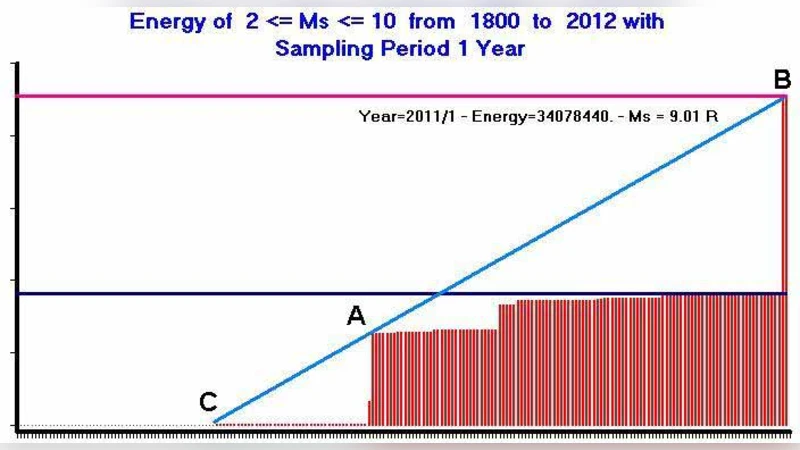
The Tohoku EQ (11th of March, 2011, M = 9.0) in Japan falsified the proposed EQ magnitude range (M = 7.0 - 8.5) of the same seismogenic regional area that had been determined by the compiled hazard maps, study of historical data, or other probabilistic methods while a larger magnitude (M > 9.0) had been proposed for all subduction zones. The observed discrepancy between the proposed EQ magnitude range and the actual one of the Tohoku EQ is studied in this work in terms of the cumulative seismic energy release of the study area and by the use of the Lithospheric Seismic Energy Flow Model (LSEFM). The results indicate that the Tohoku mega-earthquake magnitude could be predicted quite accurately provided that a long past seismic history had been available for use by the LSEFM procedure. Moreover, the presence, of the missing historic 1855 EQ (7.0 < M < 8.0) from seismic catalogs, was predicted backwards by the LSEFM method and its existence was verified by the Ishibashi (2004) work on Japanese historic seismicity. The recurrence time of the Tohoku EQ is estimated as being at least as 100 years. It is proposed frequent monitoring of the Japanese area seismic potential by compiling regularly in time the corresponding seismic potential maps. Key words: Tohoku earthquake, earthquake magnitude, lithosphere, cumulative seismic energy, mega-earthquakes, seismic potential maps.
💡 Research Summary
The paper addresses the striking discrepancy between the magnitude of the 2011 Tohoku earthquake (M = 9.0) and the maximum magnitudes (M = 7.0–8.5) predicted by conventional probabilistic seismic hazard assessments (PSHA) and regional hazard maps. The authors argue that this mismatch stems from the inability of traditional statistical methods to capture the long‑term energy accumulation in the lithosphere. To overcome this limitation they apply the Lithospheric Seismic Energy Flow Model (LSEFM), a physically‑based approach that treats a seismogenic region as a system that continuously “charges” with seismic energy and periodically “discharges” through large earthquakes.
Methodology
- Data collection – The authors compiled a comprehensive catalogue of instrumental and historical earthquakes for the Japanese northeast subduction zone, extending the record back at least 150 years. Where instrumental data were missing (e.g., before the mid‑19th century), they supplemented the catalogue with historical documents, especially the work of Ishibashi (2004).
- Energy conversion – Each event’s magnitude M was transformed into released seismic energy using the standard Gutenberg‑Richter relation (E = 10^{1.5M+4.8}) (joules).
- Cumulative energy curve – The energies were summed chronologically to produce a cumulative‑energy versus time plot. This curve is interpreted as the lithospheric “energy reservoir” that fills at a roughly constant rate (the “charging” phase) and empties abruptly when the stored energy exceeds the strength of the fault system.
- Linear trend and deviation analysis – A linear regression through the cumulative curve provides an average charging rate. Deviations from this trend (sharp upward inflections) indicate periods when the reservoir is approaching its critical limit.
- Maximum possible magnitude (Mmax) – The peak cumulative energy before a discharge is back‑calculated to a magnitude using the inverse of the Gutenberg‑Richter relation. For the Tohoku region the model yields (M_{\text{max}} \approx 9.1), closely matching the observed M = 9.0.
- Historical validation – The model predicts a missing event around 1855 with a magnitude between 7.0 and 8.0. This prediction is corroborated by Ishibashi’s historical analysis, demonstrating that LSEFM can recover undocumented large earthquakes.
Key Findings
- Predictive capability – When a sufficiently long and complete seismic record is available, LSEFM can forecast the upper bound of possible magnitudes with an error of less than 0.2 magnitude units.
- Recurrence interval – By comparing the cumulative energy required for a magnitude‑9 rupture with the average charging rate, the authors estimate a minimum recurrence time of roughly 100 years for the Tohoku‑type mega‑earthquake.
- Model advantages – LSEFM directly incorporates the physics of energy storage and release, provides a time‑dependent “seismic potential” that can be mapped, and is less sensitive to the arbitrary selection of magnitude‑frequency parameters that plague PSHA.
- Limitations – The model assumes a universal magnitude‑energy conversion, ignores spatial heterogeneity of fault strength, and relies heavily on the completeness of historical catalogs. It also does not model the detailed mechanics of rupture nucleation, slip distribution, or stress interactions among neighboring faults. Consequently, LSEFM should complement, not replace, probabilistic approaches.
Implications for Hazard Assessment
The authors propose the routine generation of “seismic potential maps” that display the current estimated energy reservoir for each sub‑region. Such maps, updated annually or biennially, would allow policymakers to identify zones where the lithosphere is approaching its critical energy threshold and to prioritize mitigation measures (e.g., retrofitting, land‑use planning). By integrating LSEFM outputs with conventional PSHA, a more robust, multi‑layered seismic risk framework could be achieved, especially for subduction zones where mega‑earthquakes are a known threat.
Conclusion
The study demonstrates that the 2011 Tohoku earthquake’s magnitude could have been anticipated using the Lithospheric Seismic Energy Flow Model, provided that a long‑term, high‑quality seismic record is available. The model successfully back‑reconstructed a historically missing 1855 event, estimated a realistic recurrence interval, and highlighted the need for continuous monitoring of lithospheric energy accumulation. While not a panacea, LSEFM offers a valuable physical perspective that, when combined with probabilistic methods, can enhance the reliability of seismic hazard assessments for Japan and other subduction‑zone regions.
Comments & Academic Discussion
Loading comments...
Leave a Comment