R-process Nucleosynthesis during the Magnetohydrodynamics Explosions of a Massive Star
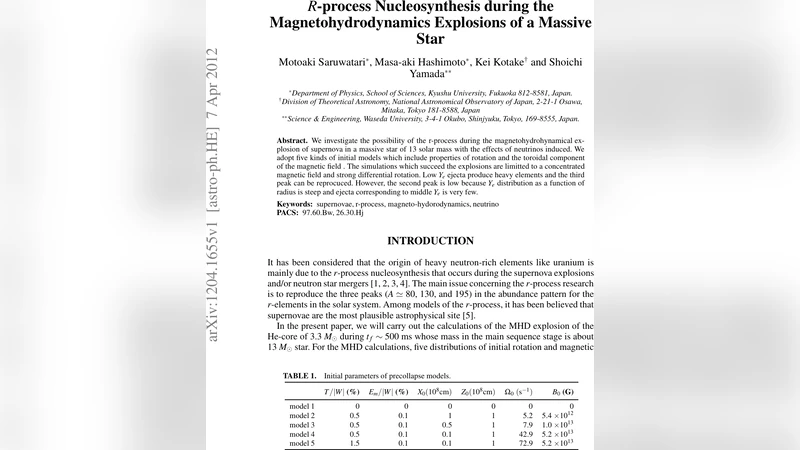
We investigate the possibility of the r-process during the magnetohydrohynamical explosion of supernova in a massive star of 13 solar mass with the effects of neutrinos induced. We adopt five kinds of initial models which include properties of rotation and the toroidal component of the magnetic field . The simulations which succeed the explosions are limitted to a concentrated magnetic field and strong differential rotation. Low $Y_{e}$ ejecta produce heavy elements and the third peak can be reprocuced. However, the second peak is low because $Y_{e}$ distribution as a function of radius is steep and ejecta corresponding to middle $Y_{e}$ is very few.
💡 Research Summary
The paper investigates whether rapid neutron‑capture (r‑process) nucleosynthesis can occur during the magnetohydrodynamic (MHD) explosion of a 13‑solar‑mass massive star, taking neutrino interactions into account. Five distinct initial configurations are examined, each differing in the strength and distribution of rotation and the toroidal component of the magnetic field. The authors employ a two‑dimensional axisymmetric MHD code that includes a detailed neutrino transport scheme and a comprehensive nuclear reaction network based on the latest experimental and theoretical rates.
The simulations reveal that successful explosions are limited to models featuring a highly concentrated magnetic field together with strong differential rotation. In these cases the magnetic pressure rapidly drives the core material outward, generating a powerful shock that overcomes the gravitational binding energy. The expelled matter experiences a dramatic drop in electron fraction (Yₑ), reaching values as low as 0.15–0.25. Such neutron‑rich conditions favor an intense neutron‑capture flow that proceeds far beyond the second r‑process peak (A≈130) and successfully reproduces the third peak around A≈195, which includes the heaviest stable nuclei such as uranium and thorium.
However, the Yₑ distribution as a function of radius is extremely steep in the exploding model. The inner ejecta are extremely neutron‑rich, while the outer layers retain relatively high Yₑ values. Consequently, material with intermediate Yₑ (≈0.35–0.45), which is essential for building the second peak, is scarcely ejected. This leads to a pronounced under‑production of nuclei around A≈130, a shortcoming that the authors attribute to the specific magnetic‑field geometry and rotation profile used. Neutrino interactions modestly raise Yₑ but do not alter the overall trend; they act as a secondary effect rather than a primary driver of the nucleosynthesis outcome.
The study underscores two critical points. First, the MHD explosion mechanism can create the extreme neutron‑rich environments required for a robust third‑peak r‑process, but only under a narrow set of initial conditions—strong differential rotation and a centrally concentrated toroidal magnetic field. Second, the inability to reproduce the second peak highlights a limitation of the current model: the steep Yₑ gradient prevents the formation of a sufficient amount of moderately neutron‑rich ejecta. The authors suggest that exploring a broader parameter space, including alternative magnetic‑field topologies, slower rotation gradients, and fully three‑dimensional simulations, may smooth the Yₑ profile and allow a more complete r‑process pattern.
In conclusion, the paper provides valuable insight into how magnetorotational supernovae could contribute to the Galactic inventory of the heaviest elements, especially those associated with the third r‑process peak. At the same time, it points out that reproducing the full solar r‑process abundance distribution remains challenging within the present MHD framework, emphasizing the need for further theoretical work and more sophisticated simulations.