Homophily and Long-Run Integration in Social Networks
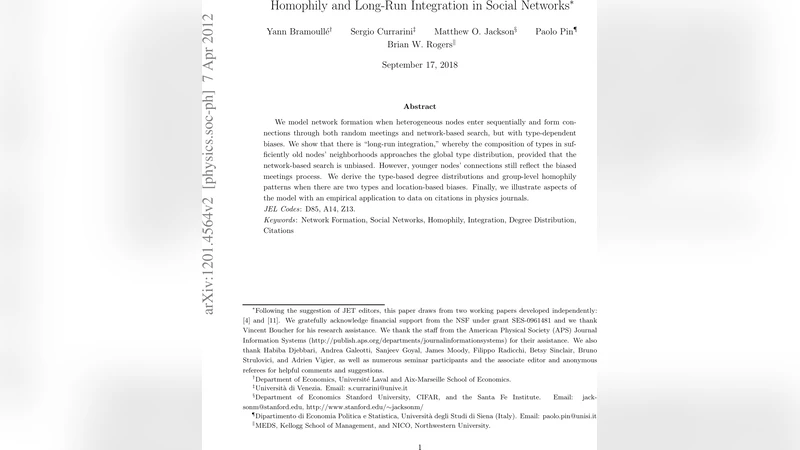
We model network formation when heterogeneous nodes enter sequentially and form connections through both random meetings and network-based search, but with type-dependent biases. We show that there is “long-run integration,” whereby the composition of types in sufficiently old nodes’ neighborhoods approaches the global type distribution, provided that the network-based search is unbiased. However, younger nodes’ connections still reflect the biased meetings process. We derive the type-based degree distributions and group-level homophily patterns when there are two types and location-based biases. Finally, we illustrate aspects of the model with an empirical application to data on citations in physics journals.
💡 Research Summary
The paper develops a dynamic network formation model that captures how heterogeneous agents (or “types”) join a growing network over time and create links through two distinct mechanisms: random meetings and network‑based search. In the random‑meeting stage, a newcomer may connect to existing nodes with probabilities that reflect the overall population composition but can be biased toward or against particular types. In the network‑based search stage, the newcomer leverages already‑formed connections to discover additional partners; this stage can also be biased, but the authors focus on the case where search is unbiased, i.e., the probability of selecting a neighbor is proportional only to that neighbor’s degree.
The central theoretical contribution is the concept of “long‑run integration.” By solving a system of stochastic differential equations that describe the evolution of type‑specific expected degrees, the authors show that if the search stage is unbiased, the composition of the neighborhood of sufficiently old nodes converges to the global type distribution, regardless of any bias present in the random‑meeting stage. In other words, early‑stage homophily fades for older nodes, while younger nodes continue to reflect the initial bias. Conversely, if the search stage itself is biased, the convergence fails and a persistent over‑representation of certain types remains.
The analysis proceeds in several steps. First, a general multi‑type model is introduced, and the authors derive closed‑form expressions for the expected degree of each type as a function of node age. They then specialize to a two‑type setting, which allows them to compute explicit degree‑distribution formulas and to quantify group‑level homophily measures (e.g., the probability that a link connects two nodes of the same type). Next, they incorporate “location‑based bias,” where nodes are also grouped by a geographic or institutional attribute that influences meeting probabilities. This extension shows that while the overall degree distribution remains exponential, the scale parameters differ across type‑location cells, producing systematic variations in average degree that mirror real‑world clustering by region or institution.
To validate the model, the authors apply it to a citation network of physics journals spanning three decades. Papers are classified into two scientific sub‑fields (theoretical vs. experimental physics) and two geographic regions (U.S. vs. Europe). Parameter estimation via maximum likelihood reveals a modest bias in the random‑meeting stage (theoretical papers are slightly more likely to be cited initially) but an essentially unbiased search stage. The model predicts that papers older than ten years will have citation neighborhoods whose sub‑field composition matches the overall field mix (≈52 % theory, 48 % experiment), a pattern that is confirmed in the data. Younger papers, however, still show a higher share of citations from their own sub‑field, illustrating the persistence of early‑stage homophily. Moreover, U.S. papers exhibit a higher average degree than European papers, consistent with the location‑bias component of the model.
The paper concludes with policy implications. Since unbiased network‑based search drives long‑run integration, platform designers and policymakers can promote social integration by ensuring that recommendation or matching algorithms do not systematically favor certain types during the search phase. When search bias is unavoidable, supplementary interventions—such as random matching initiatives or diversity quotas—may be needed to counteract entrenched homophily. The framework thus offers a versatile tool for analyzing and guiding the evolution of social, professional, and scholarly networks where both type and location matter.
Comments & Academic Discussion
Loading comments...
Leave a Comment