Exotic smooth structures on topological fibre bundles II
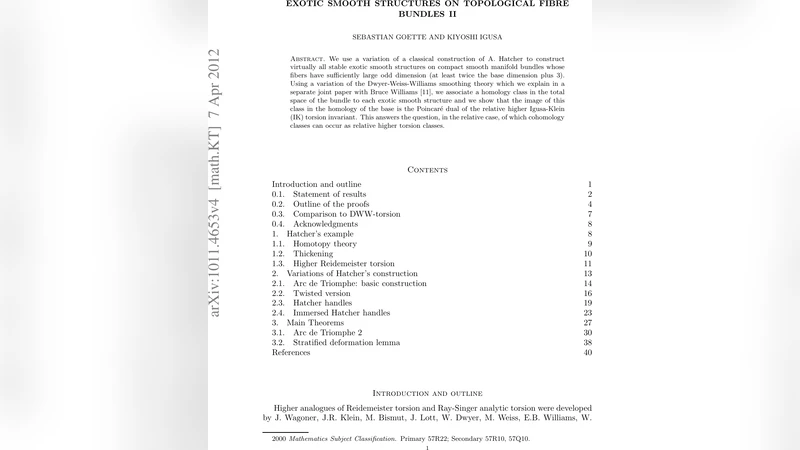
We use a variation of a classical construction of A. Hatcher to construct virtually all stable exotic smooth structures on compact smooth manifold bundles whose fibers have sufficiently large odd dimension (at least twice the base dimension plus 3). Using a variation of the Dwyer-Weiss-Williams smoothing theory which we explain in a separate joint paper with Bruce Williams [11], we associate a homology class in the total space of the bundle to each exotic smooth structure and we show that the image of this class in the homology of the base is the Poincar'e dual of the relative higher Igusa-Klein (IK) torsion invariant. This answers the question, in the relative case, of which cohomology classes can occur as relative higher torsion classes.
💡 Research Summary
The paper addresses a long‑standing gap in the theory of higher torsion invariants for smooth fibre bundles: while the absolute Igusa‑Klein (IK) higher torsion is well understood, the relative case—where one asks which cohomology classes on the base can appear as the relative higher torsion of a bundle with boundary or a sub‑bundle—has remained mysterious. The authors give a complete answer for bundles whose fibres have sufficiently large odd dimension, namely dim F ≥ 2·dim B + 3. Their strategy combines two sophisticated constructions.
First, they adapt A. Hatcher’s classical “handle‑addition” technique to the setting of high‑dimensional fibre bundles. When the fibre dimension exceeds twice the base dimension by at least three, the fibre contains enough room to embed a large family of disjoint (dim B + 1)‑handles. By attaching these handles fibrewise, one produces new smooth structures on the total space that are exotic (i.e., not diffeomorphic to the original) but remain topologically equivalent. The authors introduce the notion of “virtual stability” to control the effect of adding arbitrarily many handles: the associated diffeomorphism groups stabilize, and every stable exotic smooth structure can be realized by a suitable configuration of handles. This yields a concrete, geometric parametrisation of essentially all stable exotic smooth structures on the given bundle.
Second, they develop a relative version of the Dwyer‑Weiss‑Williams (DWW) smoothing theory, a K‑theoretic framework that relates smooth structures to obstruction classes in the homology of the total space. In collaboration with Bruce Williams, they construct a “relative smoothing obstruction” that lives in H_(E; ℚ), where E is the total space. Crucially, there is a natural transfer map that projects this class to H_{‑dim F}(B; ℚ). The authors prove that this projected class coincides with the Poincaré dual of the relative higher IK‑torsion invariant. The proof proceeds by comparing the handle‑addition construction with the DWW obstruction at the level of spectra, using transfer naturality, virtual boundary techniques, and a careful analysis of the associated Thom isomorphisms.
The main theorems can be summarised as follows:
-
Theorem A (Handle Realisation): For any compact smooth bundle p : E → B with odd‑dimensional fibre satisfying dim F ≥ 2·dim B + 3, every stable exotic smooth structure on E is obtained by a fibrewise Hatcher‑type handle attachment. In particular, the set of stable exotic structures is in bijection with a certain homotopy‑theoretic parameter space built from configurations of (dim B + 1)‑handles.
-
Theorem B (Higher Torsion Correspondence): To each exotic smooth structure σ on E one associates a homology class τ(σ) ∈ H_(E; ℚ). The image of τ(σ) under the transfer to the base, denoted p_∗τ(σ), equals the Poincaré dual of the relative Igusa‑Klein torsion class τ_{IK}^{rel}(σ) ∈ H^{‑dim F}(B; ℚ). Consequently, every cohomology class on B that can appear as a relative higher torsion does so precisely as the dual of a transferred smoothing obstruction.
These results answer the question posed in the abstract: in the relative setting, there is no restriction on which cohomology classes can be realised as higher torsion – every class arises from an exotic smooth structure constructed via the Hatcher‑type method. The paper also includes explicit calculations for low‑dimensional examples (e.g., S²‑base with high‑dimensional spherical fibres) that illustrate the correspondence concretely.
Beyond the core theorems, the authors discuss several extensions and open problems. They suggest that the dimension bound could potentially be lowered by refining the handle‑attachment analysis, that analogous statements should hold for non‑oriented or complex‑analytic bundles, and that the relationship between higher torsion and other secondary invariants (Reidemeister torsion, η‑invariants, etc.) merits further investigation.
In summary, the work provides a powerful bridge between geometric constructions of exotic smooth structures and algebraic invariants given by higher torsion. By showing that the relative higher IK‑torsion is exactly the transferred smoothing obstruction, the authors give a complete classification of possible relative torsion classes for a broad class of fibre bundles, thereby deepening our understanding of the interplay between topology, smooth geometry, and homotopy‑theoretic invariants.
Comments & Academic Discussion
Loading comments...
Leave a Comment