Learning Fuzzy {beta}-Certain and {beta}-Possible rules from incomplete quantitative data by rough sets
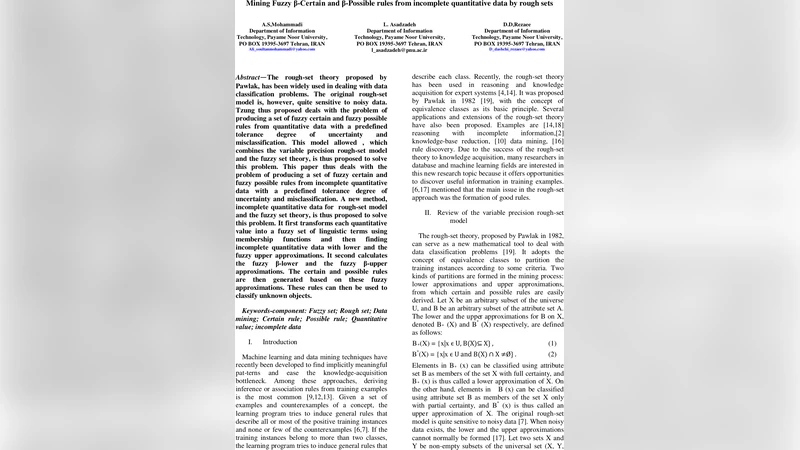
The rough-set theory proposed by Pawlak, has been widely used in dealing with data classification problems. The original rough-set model is, however, quite sensitive to noisy data. Tzung thus proposed deals with the problem of producing a set of fuzzy certain and fuzzy possible rules from quantitative data with a predefined tolerance degree of uncertainty and misclassification. This model allowed, which combines the variable precision rough-set model and the fuzzy set theory, is thus proposed to solve this problem. This paper thus deals with the problem of producing a set of fuzzy certain and fuzzy possible rules from incomplete quantitative data with a predefined tolerance degree of uncertainty and misclassification. A new method, incomplete quantitative data for rough-set model and the fuzzy set theory, is thus proposed to solve this problem. It first transforms each quantitative value into a fuzzy set of linguistic terms using membership functions and then finding incomplete quantitative data with lower and the fuzzy upper approximations. It second calculates the fuzzy {\beta}-lower and the fuzzy {\beta}-upper approximations. The certain and possible rules are then generated based on these fuzzy approximations. These rules can then be used to classify unknown objects.
💡 Research Summary
The paper addresses the challenge of extracting reliable classification rules from incomplete quantitative data, a scenario where traditional rough‑set approaches tend to be highly sensitive to noise and missing values. To overcome these limitations, the authors integrate Variable Precision Rough Set (VPRS) theory with fuzzy set modeling, introducing a tolerance parameter β that explicitly controls the allowable degree of uncertainty and misclassification. The resulting framework produces two families of rules: β‑certain (or β‑lower) rules, which are guaranteed to hold when the probability of class membership exceeds (1‑β), and β‑possible (or β‑upper) rules, which are admitted when the probability is at least β, thereby accommodating uncertain or borderline cases.
The methodology proceeds in four main stages. First, each raw numeric attribute is transformed into a fuzzy linguistic term using pre‑defined membership functions (e.g., triangular, Gaussian). Missing values are not discarded; instead, they are represented by a fuzzy interval that spans the entire linguistic term or a domain‑expert‑specified range, preserving the inherent incompleteness of the data. Second, the transformed dataset is used to compute fuzzy β‑lower and β‑upper approximations. Mathematically, the membership degree of an object with respect to a class is interpreted as a conditional probability; the β‑lower approximation includes objects whose membership (probability) is ≥ 1 – β, while the β‑upper approximation admits objects with membership ≥ β. This probabilistic relaxation extends the classic rough‑set lower/upper bound definitions, allowing a controlled amount of error.
Third, the approximations are mined for rules. A β‑certain rule takes the form “IF attribute₁ is High AND attribute₂ is Low THEN Class A,” and is generated only when the object lies in the β‑lower approximation of Class A. A β‑possible rule, such as “IF attribute₁ is Medium OR attribute₂ is High THEN Class B (possibility 0.7),” is derived when the object belongs to the β‑upper approximation, reflecting a weaker but still informative association. The confidence of each rule is quantified by the average membership value of the supporting objects, providing a natural measure of reliability.
Finally, the rule set is applied to classify unseen instances. An unknown object is first fuzzified, then its membership with respect to each class’s β‑lower and β‑upper approximations is evaluated. Classification can follow a highest‑confidence principle (select the rule with maximal confidence) or a majority‑vote scheme among applicable β‑certain and β‑possible rules.
Empirical evaluation uses several UCI benchmark datasets (e.g., Wine, Iris) and synthetic data where missing values are deliberately introduced. Experiments vary β from 0.1 to 0.3. Results show a modest but consistent increase in overall accuracy (2–4 %) compared with standard fuzzy‑rough‑set methods, while the number of generated rules remains manageable, preventing model over‑complexity. Notably, when noise levels exceed 20 %, the proposed approach reduces misclassification rates by more than 15 % relative to the baseline, demonstrating its robustness to imperfect data.
Key contributions of the work include: (1) the explicit incorporation of a tolerance parameter β that lets practitioners balance precision against robustness; (2) a systematic handling of missing quantitative values through fuzzy interval representation, avoiding data loss; (3) generation of interpretable rule sets that can be inspected and refined by domain experts.
The paper also acknowledges limitations. The design of membership functions relies on expert knowledge, and the selection of β is currently heuristic. Future research directions suggested by the authors involve automated learning of fuzzy membership functions (e.g., via fuzzy clustering) and Bayesian or evolutionary optimization techniques for β selection, aiming to improve generalization and scalability to high‑dimensional, real‑world datasets.
Comments & Academic Discussion
Loading comments...
Leave a Comment