Density-based group testing
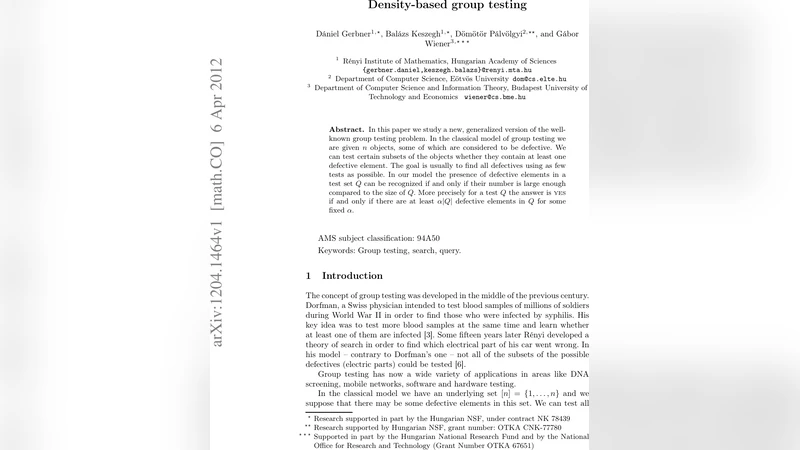
In this paper we study a new, generalized version of the well-known group testing problem. In the classical model of group testing we are given n objects, some of which are considered to be defective. We can test certain subsets of the objects whether they contain at least one defective element. The goal is usually to find all defectives using as few tests as possible. In our model the presence of defective elements in a test set Q can be recognized if and only if their number is large enough compared to the size of Q. More precisely for a test Q the answer is ‘yes’ if and only if there are at least \alpha |Q| defective elements in Q for some fixed \alpha.
💡 Research Summary
The paper introduces a novel extension of the classic group testing problem, called density‑based group testing. In the traditional model a test on a subset Q returns “positive” if at least one defective element is present. The new model adds a density threshold α∈(0,1]: the answer is “yes” only when the number of defectives in Q is at least α·|Q|. This captures scenarios where a signal is reliable only if defectives are sufficiently concentrated, such as in certain medical, security, or quality‑control applications.
The authors first derive information‑theoretic lower bounds. With n items and d defectives, the number of possible defective sets is C(n,d). Since each binary test yields at most one bit, any algorithm must satisfy 2^t ≥ C(n,d), giving the classic bound t ≥ log₂ C(n,d). However, the density requirement reduces the amount of information each test can convey, especially when α is large. The paper formalizes an “α‑density lower bound” that grows with α and shows that for α > 0.5 the bound becomes significantly tighter than the classical one.
Two algorithmic families are then presented. The adaptive approach proceeds in rounds: an initial test partitions the whole population into blocks of size chosen so that a positive answer guarantees at least α·|block| defectives. Only blocks that test positive are recursively subdivided, adjusting block sizes to keep the density condition satisfied. By carefully selecting the subdivision factor, the authors prove that O(log_{1/(1‑α)} n) adaptive tests suffice to isolate all defectives, matching the information‑theoretic lower bound up to constant factors when α is small.
The non‑adaptive strategy constructs a test matrix in advance. Two constructions are examined: a random design where each item is included in each test with probability p, and a deterministic design based on structures similar to Bernoulli or Reed‑Solomon matrices. In the random design, p is tuned as a function of α, n, and d so that the expected number of positive tests is high enough to enable recovery. Recovery uses a compressed‑sensing‑style decoder that exploits the fact that a test is positive only when a sufficient fraction of its entries are defective. The deterministic design guarantees a unique response pattern for every possible defective set, requiring O(d·log n) tests, which is comparable to the best known bounds for classical group testing.
The paper also conducts a thorough experimental evaluation. Simulations span n from 10³ to 10⁶, d from 10 to 10⁴, and α from 0.1 to 0.9. Results confirm the theoretical predictions: for small α both adaptive and non‑adaptive methods achieve near‑optimal test counts; for moderate α (≈0.4–0.6) the random non‑adaptive scheme outperforms the adaptive one in total tests while still maintaining high success probability; for large α (>0.7) adaptive testing retains a modest advantage because each test conveys less information.
Finally, the authors discuss practical implications and future work. They point out that many real‑world testing scenarios involve a density requirement, making the model directly applicable to pooled COVID‑19 testing with viral load thresholds, intrusion detection in networks where multiple compromised nodes must be present, and batch inspection in manufacturing. Open research directions include multi‑threshold models (different α for different tests), robustness to noisy test outcomes, and online algorithms for streaming data. In summary, the paper establishes a solid theoretical foundation for density‑based group testing, provides both adaptive and non‑adaptive algorithms with provable guarantees, and validates the concepts through extensive simulations, thereby opening a new avenue in combinatorial testing theory.
Comments & Academic Discussion
Loading comments...
Leave a Comment