GRB 090618: different pulse temporal and spectral characteristics within a burst
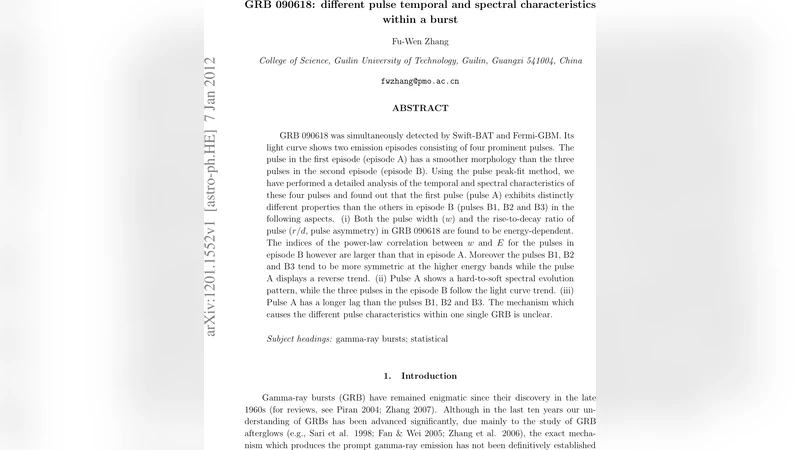
GRB 090618 was simultaneously detected by Swift-BAT and Fermi-GBM. Its light curve shows two emission episodes consisting of four prominent pulses. The pulse in the first episode (episode A) has a smoother morphology than the three pulses in the second episode (episode B). Using the pulse peak-fit method, we have performed a detailed analysis of the temporal and spectral characteristics of these four pulses and found out that the first pulse (pulse A) exhibits distinctly different properties than the others in episode B (pulses B1, B2 and B3) in the following aspects. (i) Both the pulse width ($w$) and the rise-to-decay ratio of pulse ($r/d$, pulse asymmetry) in GRB 090618 are found to be energy-dependent. The indices of the power-law correlation between $w$ and $E$ for the pulses in episode B however are larger than that in episode A. Moreover the pulses B1, B2 and B3 tend to be more symmetric at the higher energy bands while the pulse A displays a reverse trend. (ii) Pulse A shows a hard-to-soft spectral evolution pattern, while the three pulses in the episode B follow the light curve trend. (iii) Pulse A has a longer lag than the pulses B1, B2 and B3. The mechanism which causes the different pulse characteristics within one single GRB is unclear.
💡 Research Summary
GRB 090618 was simultaneously observed by Swift‑BAT and Fermi‑GBM, providing a rich dataset that spans a broad energy range (15 keV–350 keV) with high temporal resolution. The burst light curve is clearly divided into two emission episodes. Episode A consists of a single, relatively smooth pulse (hereafter pulse A), while episode B contains three sharper, more pronounced pulses (B1, B2, B3). The authors applied the pulse‑peak fitting method (Norris et al. 2005) to each pulse in multiple energy channels, extracting the pulse width (w), the rise‑to‑decay ratio (r/d, a measure of asymmetry), peak times, and spectral parameters via time‑resolved Band‑function fits.
The temporal analysis revealed that all four pulses exhibit an inverse correlation between width and photon energy, which can be described by a power‑law w ∝ E^α. However, the power‑law index α differs markedly between the two groups. For pulses B1‑B3, α ≈ ‑0.45 to ‑0.55, indicating that their widths shrink more rapidly with increasing energy than pulse A, whose α ≈ ‑0.30. This suggests that the high‑energy emission in episode B is more strongly confined in time than in episode A. The asymmetry parameter r/d also shows contrasting energy trends: B‑pulses become more symmetric (r/d → 1) at higher energies, whereas pulse A becomes increasingly asymmetric (r/d decreases) with energy. Such opposite behaviours imply that the physical processes governing pulse formation respond differently to photon energy in the two episodes.
Spectrally, pulse A follows a classic hard‑to‑soft (H‑S) evolution: the peak energy Ep starts near 300 keV and monotonically declines to ≈ 80 keV by the end of the pulse. In contrast, pulses B1‑B3 display intensity‑tracking (IT) behaviour, where Ep rises and falls in step with the instantaneous flux. This dichotomy points to distinct emission regimes: pulse A may be dominated by gradual cooling of a relativistic plasma (e.g., synchrotron cooling or adiabatic expansion), while the B‑pulses could arise from separate internal shocks or magnetic reconnection events that inject energy impulsively, causing the spectrum to track the light‑curve intensity.
Cross‑correlation lag analysis between low (15–50 keV) and high (150–350 keV) bands shows that pulse A has a substantial positive lag of ~0.9 s, whereas B1‑B3 exhibit much shorter lags (0.2–0.4 s). Longer lags are generally interpreted as a larger emission radius or higher optical depth, allowing low‑energy photons to emerge later than their high‑energy counterparts. The shorter lags of the B‑pulses therefore suggest more compact or optically thinner emission zones.
The authors discuss several possible interpretations for these intra‑burst differences. One scenario posits that pulse A originates from an early internal‑shock collision at a relatively large radius, leading to a smoother, longer‑lasting emission with pronounced spectral softening. Subsequent collisions (B1‑B3) could occur at smaller radii or involve stronger magnetic fields, producing sharper pulses whose spectra are tightly coupled to the instantaneous energy dissipation rate. Alternatively, the B‑pulses might be generated by magnetic reconnection events in a highly magnetized outflow, whereas pulse A could be synchrotron emission from a less magnetized region. Differences in bulk Lorentz factor, baryon loading, or external medium density could also modulate the observed temporal and spectral signatures.
Importantly, standard GRB models—whether based on internal shocks, external shocks, or magnetically dominated jets—typically treat a burst as a single emission mechanism. GRB 090618 demonstrates that multiple mechanisms can coexist within a single event, producing pulses with distinct width‑energy scaling, asymmetry evolution, spectral trajectories, and lags. This challenges the simplicity of one‑size‑fits‑all models and underscores the need for multi‑component frameworks that can accommodate heterogeneous emission zones.
In conclusion, the paper provides a meticulous, pulse‑by‑pulse dissection of GRB 090618, revealing that the first pulse (A) and the later three pulses (B1‑B3) differ systematically in temporal scaling, asymmetry, spectral evolution, and lag. These findings highlight the complexity of GRB prompt emission and motivate future high‑time‑resolution, broadband observations combined with sophisticated numerical simulations to unravel the interplay of shocks, magnetic reconnection, and radiative cooling in shaping GRB light curves.