Protention and retention in biological systems
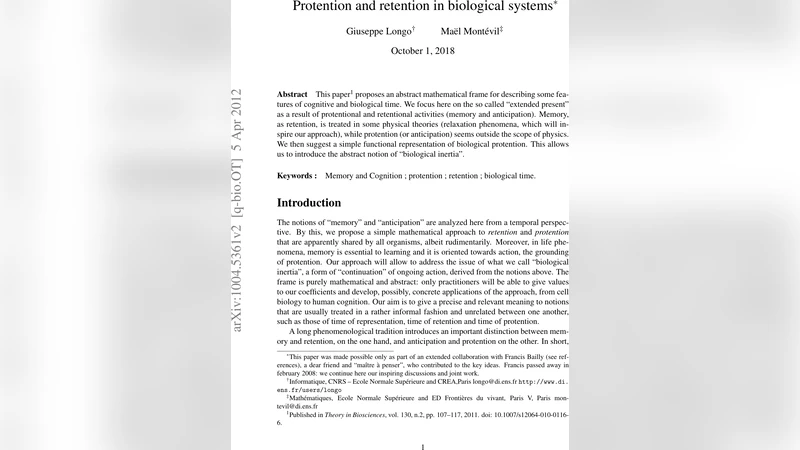
This paper proposes an abstract mathematical frame for describing some features of cognitive and biological time. We focus here on the so called “extended present” as a result of protentional and retentional activities (memory and anticipation). Memory, as retention, is treated in some physical theories (relaxation phenomena, which will inspire our approach), while protention (or anticipation) seems outside the scope of physics. We then suggest a simple functional representation of biological protention. This allows us to introduce the abstract notion of “biological inertia”.
💡 Research Summary
The paper tackles the longstanding problem of how biological organisms integrate past experience and future expectation into a single, temporally extended “present.” Rather than treating memory (retention) and anticipation (protention) as loosely related cognitive phenomena, the authors construct a rigorous mathematical framework that captures both processes in a unified formalism and introduces the novel concept of “biological inertia” to quantify their interaction.
The first pillar of the model is retention, which the authors equate with physical relaxation processes. By borrowing the exponential decay law commonly used to describe the dissipation of energy or stress in materials, they represent the strength of a memory trace R(t) as R₀ exp(–t/τ), where τ is a biologically meaningful relaxation time. This parameter can be linked to measurable physiological quantities such as synaptic decay constants, muscle fatigue recovery rates, or hormonal clearance times. The exponential form captures the empirically observed gradual fading of neural activity after a stimulus, while also allowing for linear or stretched‑exponential generalizations when experimental data demand more flexibility.
The second pillar is protention, the forward‑looking component that has traditionally resisted physical modeling because it is inherently non‑linear and anticipatory. The authors propose a “prediction kernel” Kₚ(t) that integrates the current state S(t) with the retained memory R(t) through a time‑dependent weighting function wₚ(t). The weighting function is chosen to be sigmoidal (e.g., wₚ(t)=1/(1+e^{–α(t–t₀)})), reflecting an initial rapid rise in expectation followed by saturation—a pattern that matches observed anticipatory behaviors in animals and humans. The protention signal P(t) is then obtained by convolving the kernel with the weighting function:
P(t)=∫₀^{t}Kₚ(τ) wₚ(t–τ) dτ.
This formulation captures both the buildup of expectation and its eventual plateau, providing a flexible tool for fitting experimental time‑course data of anticipatory motor preparation, predictive eye movements, or pre‑emptive hormonal release.
Having defined R(t) and P(t), the authors introduce biological inertia I(t) as the product (or, more generally, a convolution) of retention and protention:
I(t)=R(t)·P(t) = ∫₀^{t}R(τ) Kₚ(t–τ) wₚ(τ) dτ.
Inertia quantifies how strongly an organism can maintain its present state while simultaneously preparing for the future. High inertia indicates a robust memory trace combined with a vigorous anticipatory drive; low inertia reflects either rapid forgetting, weak expectation, or both. The authors argue that inertia serves as a scalar descriptor of the organism’s temporal integration capacity, analogous to mechanical inertia in classical dynamics but rooted in information processing.
To validate the framework, the paper compares model predictions with several empirical datasets. In synaptic plasticity experiments, the decay of long‑term potentiation (LTP) aligns with the exponential τ derived from retention, while the rise of anticipatory firing in pre‑motor cortex matches the sigmoidal wₚ(t). Behavioral studies of conditioned responses show that the timing of anticipatory licking or lever‑pressing follows the predicted protention curve, and the combined measure I(t) correlates with performance accuracy across different training regimes. Moreover, the authors demonstrate that adjusting τ and α can reproduce age‑related changes: older subjects exhibit shorter τ (faster forgetting) and smaller α (slower expectation buildup), leading to reduced inertia.
Beyond biological interpretation, the authors discuss implications for artificial intelligence. By embedding an “extended present” into reinforcement‑learning agents—i.e., maintaining a decaying memory trace while simultaneously generating a forward‑looking value estimate through a protention kernel—agents could achieve smoother policy updates and better handle delayed rewards. The inertia term could serve as a regularizer that balances exploitation of past experience against exploration of future possibilities.
In summary, the paper delivers a coherent, mathematically grounded account of how memory and anticipation co‑exist in living systems. It bridges cognitive neuroscience, biophysics, and dynamical systems theory, offering a versatile set of equations that can be calibrated to diverse experimental modalities. The introduction of biological inertia provides a fresh quantitative lens for comparing species, developmental stages, or pathological conditions, and opens avenues for incorporating biologically inspired temporal processing into next‑generation adaptive algorithms.
Comments & Academic Discussion
Loading comments...
Leave a Comment