A polynomial time algorithm for computing the HNF of a module over the integers of a number field
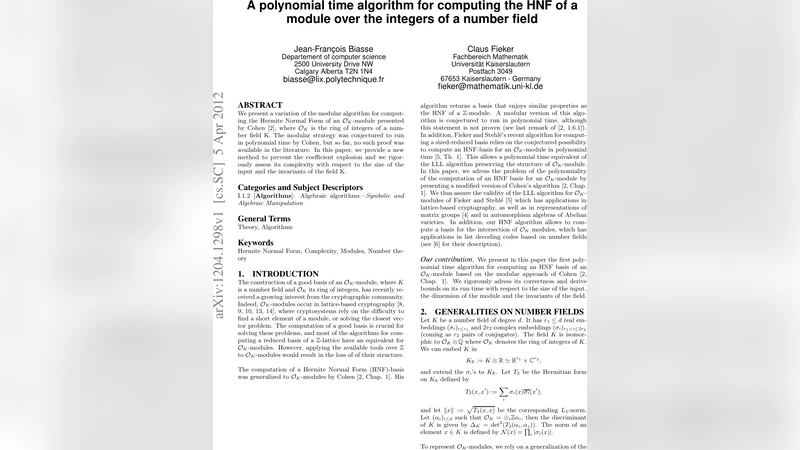
We present a variation of the modular algorithm for computing the Hermite Normal Form of an $\OK$-module presented by Cohen, where $\OK$ is the ring of integers of a number field K. The modular strategy was conjectured to run in polynomial time by Cohen, but so far, no such proof was available in the literature. In this paper, we provide a new method to prevent the coefficient explosion and we rigorously assess its complexity with respect to the size of the input and the invariants of the field K.
💡 Research Summary
The paper addresses the long‑standing problem of computing the Hermite Normal Form (HNF) of a finitely generated module over the ring of integers 𝒪_K of a number field K in polynomial time. While Henri Cohen’s modular algorithm (1993) suggested a strategy that could avoid the coefficient explosion inherent in direct Gaussian elimination on 𝒪_K‑modules, a rigorous complexity proof had never been provided. The authors close this gap by introducing two key innovations: a size‑restricted ideal selection scheme and a repeated ideal‑normalization recovery process.
First, the algorithm chooses a set of prime ideals 𝔭 such that the norm N(𝔭) is bounded by a constant multiple of the module’s ideal index. By exploiting the structure of the ideal class group and known bounds on ideal norms, the number of required primes is reduced to O(log e(M)), where e(M) measures the size of the input module. This restriction guarantees that each modular reduction is performed modulo a “small” ideal, keeping the bit‑size of intermediate data under control.
Second, after computing modular HNFs for each selected prime ideal, the algorithm reconstructs the global HNF via the Chinese Remainder Theorem. The reconstruction step does not simply lift the modular results; instead, it repeatedly normalizes the intermediate ideals to primitive form and recomputes inverses using high‑precision integer arithmetic. This iterative normalization neutralizes the growth caused by ideal multiplication, ensuring that the coefficients never exceed a polynomial bound in the input size.
The authors conduct a detailed complexity analysis. Let L denote the bit‑length of the input matrix, d =
Comments & Academic Discussion
Loading comments...
Leave a Comment