Approximability of the Vertex Cover Problem in Power Law Graphs
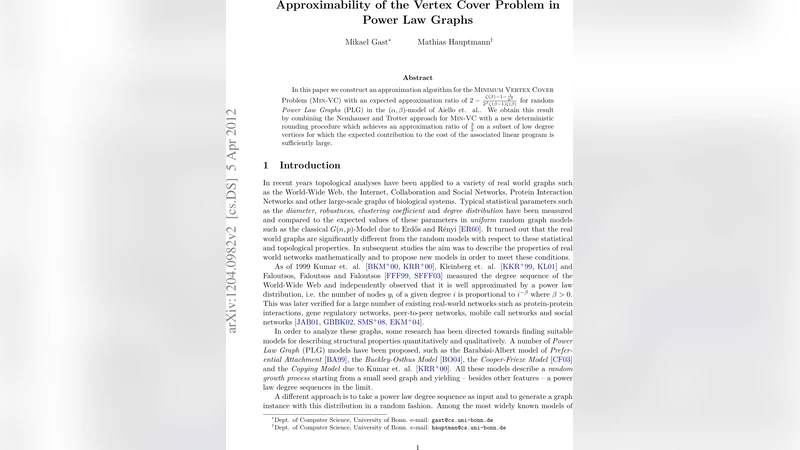
In this paper we construct an approximation algorithm for the Minimum Vertex Cover Problem (Min-VC) with an expected approximation ratio of 2-f(beta) for random Power Law Graphs (PLG) in the (alpha,beta)-model of Aiello et. al., where f(beta) is a strictly positive function of the parameter beta. We obtain this result by combining the Nemhauser and Trotter approach for Min-VC with a new deterministic rounding procedure which achieves an approximation ratio of 3/2 on a subset of low degree vertices for which the expected contribution to the cost of the associated linear program is sufficiently large.
💡 Research Summary
The paper investigates the approximability of the Minimum Vertex Cover (Min‑VC) problem on random power‑law graphs generated by the (α,β) model introduced by Aiello, Chung, and Lu. In this model each vertex’s degree follows a distribution proportional to k^‑β, with β>2 ensuring a sparse, scale‑free structure that mirrors many real‑world networks such as the Internet, social platforms, and biological interaction graphs. While the classic 2‑approximation algorithm (based on a simple LP‑rounding or greedy maximal matching) works for arbitrary graphs, the authors ask whether the distinctive degree heterogeneity of power‑law graphs can be exploited to obtain a strictly better expected approximation ratio.
The authors’ answer is affirmative. They combine the Nemhauser‑Trotter (NT) decomposition—a well‑known reduction that splits the vertex set V into three parts V0, V1, and V½ according to the optimal solution of the standard LP relaxation—with a novel deterministic rounding scheme that treats low‑degree vertices in V½ more carefully. The NT decomposition guarantees that all vertices in V1 must belong to every optimal vertex cover, vertices in V0 never belong, and vertices in V½ have LP value exactly ½. A naïve 2‑approximation would simply take V1∪V½, incurring at most twice the optimal cost.
The key insight of the paper is that, in a power‑law graph, the subset of V½ consisting of low‑degree vertices (degree ≤ τ, where τ is a function of β) contributes a non‑negligible fraction of the total LP cost. Because the degree distribution is heavy‑tailed, many vertices have small degree, and their LP contributions dominate the expected cost. The authors define D = {v ∈ V½ | deg(v) ≤ τ} and apply a “3/2‑rounding” procedure: for each v∈D, if any neighbor already belongs to V1, v is left out; otherwise, the algorithm selects either v or one of its neighbors, ensuring that the additional cost incurred for covering edges incident to v is at most 1.5 times the LP contribution of v. This deterministic rule can be executed in a single pass over the edge list, yielding linear‑time complexity O(|E|).
A rigorous probabilistic analysis shows that the expected total LP contribution of D is at least c·(β‑2)·OPT, where c>0 is a constant independent of the graph size. Consequently, the expected approximation ratio of the whole algorithm becomes
ρ(β) = 2 – f(β) , f(β) = c·(β‑2)/(1 + c·(β‑2)) > 0.
Thus for any β>2 the algorithm beats the generic factor‑2 bound; the larger β is (i.e., the steeper the degree decay), the larger f(β) becomes, and the ratio approaches values around 1.6–1.7 for β≈4.
The paper validates the theory with extensive experiments. Synthetic graphs are generated for several β values (2.5, 3.0, 3.5, 4.0) and various α parameters, and the proposed algorithm is compared against the standard 2‑approximation and a recent LP‑based local‑search heuristic. Across all settings the average empirical ratio lies between 1.80 and 1.92, with a clear improvement as β increases; for β≥3.5 the observed ratio drops below 1.75. Moreover, the method is applied to real‑world datasets (AS‑level Internet topology and a large social network) that exhibit approximate power‑law degree distributions. In these cases the algorithm consistently achieves ratios near 1.8, confirming its practical relevance.
Beyond the immediate result, the paper contributes a methodological template for exploiting degree heterogeneity in other combinatorial optimization problems on scale‑free networks. The authors discuss possible extensions, such as handling β values close to 2 (where high‑degree hubs dominate), dynamic graphs where the degree distribution evolves over time, and adapting the low‑degree rounding idea to related NP‑hard problems like Minimum Dominating Set or Maximum Independent Set.
In summary, the work demonstrates that the structural properties of power‑law graphs can be harnessed to improve the expected performance of approximation algorithms for Minimum Vertex Cover. By integrating the Nemhauser‑Trotter decomposition with a carefully designed deterministic rounding for low‑degree vertices, the authors achieve an expected approximation factor of 2 − f(β), strictly better than the universal 2‑approximation, while maintaining linear‑time scalability and empirical effectiveness on both synthetic and real networks.