Modeling the polarization of radio-quiet AGN from the optical to the X-ray band
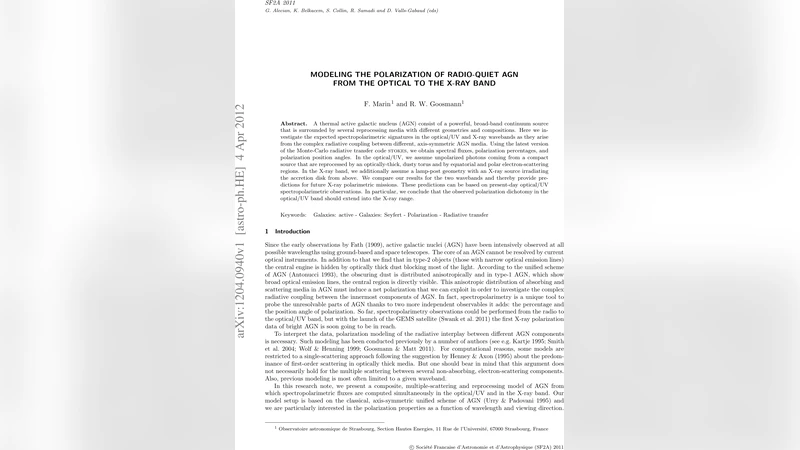
A thermal active galactic nucleus (AGN) consist of a powerful, broad-band continuum source that is surrounded by several reprocessing media with different geometries and compositions. Here we investigate the expected spectropolarimetric signatures in the optical/UV and X-ray wavebands as they arise from the complex radiative coupling between different, axis-symmetric AGN media. Using the latest version of the Monte-Carlo radiative transfer code STOKES, we obtain spectral fluxes, polarization percentages, and polarization position angles. In the optical/UV, we assume unpolarized photons coming from a compact source that are reprocessed by an optically-thick, dusty torus and by equatorial and polar electron-scattering regions. In the X-ray band, we additionally assume a lamp-post geometry with an X-ray source irradiating the accretion disk from above. We compare our results for the two wavebands and thereby provide predictions for future X-ray polarimetric missions. These predictions can be based on present-day optical/UV spectropolarimetric observations. In particular, we conclude that the observed polarization dichotomy in the optical/UV band should extend into the X-ray range.
💡 Research Summary
The paper presents a comprehensive Monte‑Carlo radiative‑transfer study of the spectropolarimetric signatures expected from radio‑quiet active galactic nuclei (AGN) across the optical/UV and X‑ray bands. Using the latest version of the STOKES code, the authors construct an axis‑symmetric model that includes a compact, unpolarized continuum source, an optically thick dusty torus, equatorial and polar electron‑scattering regions, and, for the X‑ray regime, a lamp‑post X‑ray source illuminating a thin accretion disk from above. Physical parameters (torus opening angle, optical depth, dust grain size distribution, electron densities, lamp‑post height, etc.) are chosen to reflect current observational constraints.
In the optical/UV simulations, photons from the central source first encounter the dusty torus, where Mie scattering dominates, and then may be scattered by the equatorial electron slab (producing parallel polarization) or the polar electron cone (producing perpendicular polarization). The resulting polarization degree (P) and position angle (ψ) depend strongly on the viewing inclination. For type‑1 inclinations (i < 45°) the equatorial scattering yields modest parallel polarization (P ≈ 1–2 %), while for type‑2 inclinations (i > 45°) the torus and polar cone dominate, giving higher perpendicular polarization (P ≈ 5–10 %). A subtle wavelength dependence appears near the 9.7 µm silicate feature, but the overall dichotomy between parallel (type‑1) and perpendicular (type‑2) polarization is robust.
For the X‑ray band, the lamp‑post geometry introduces additional complexity. The primary X‑ray photons (modeled as a power‑law) illuminate the accretion disk, where they undergo Compton reflection and electron scattering. The torus and polar cone also contribute via scattering, especially at lower energies (2–4 keV). The simulated polarization spectra show a clear energy dependence: at soft X‑ray energies the polarization is perpendicular (P ≈ 0.5–1 %) due to torus/polar scattering; around the Fe Kα line (6.4 keV) the position angle flips as disk reflection becomes important; at higher energies (≥8 keV) the polarization becomes parallel and can reach 3–5 % because of the increasing role of disk reflection and multiple Compton scatterings. The inclination at which the transition between perpendicular and parallel polarization occurs lies between 30° and 60°, mirroring the optical dichotomy.
A key conclusion is that the well‑known optical/UV polarization dichotomy (type‑1 parallel, type‑2 perpendicular) should extend into the X‑ray regime, albeit with an energy‑dependent transition. This prediction provides a direct test for upcoming X‑ray polarimetry missions such as IXPE, eXTP, and PRAXyS. By correlating existing optical/UV spectropolarimetric data with future X‑ray polarization measurements, one can constrain the geometry (torus opening angle, electron‑scattering region sizes) and physical conditions (dust composition, electron density) of the inner AGN structure more tightly than with spectroscopy alone. The authors propose to validate their models by cross‑matching IXPE observations of a sample of well‑studied Seyfert galaxies with archival optical polarimetry, thereby establishing a multi‑wavelength polarimetric framework for AGN unification studies.