Fast Calculation of Calendar Time-, Age- and Duration Dependent Time at Risk in the Lexis Space
In epidemiology, the person-years method is broadly used to estimate the incidence rates of health related events. This needs determination of time at risk stratified by period, age and sometimes by duration of disease or exposition. The article desc…
Authors: Ralph Brinks
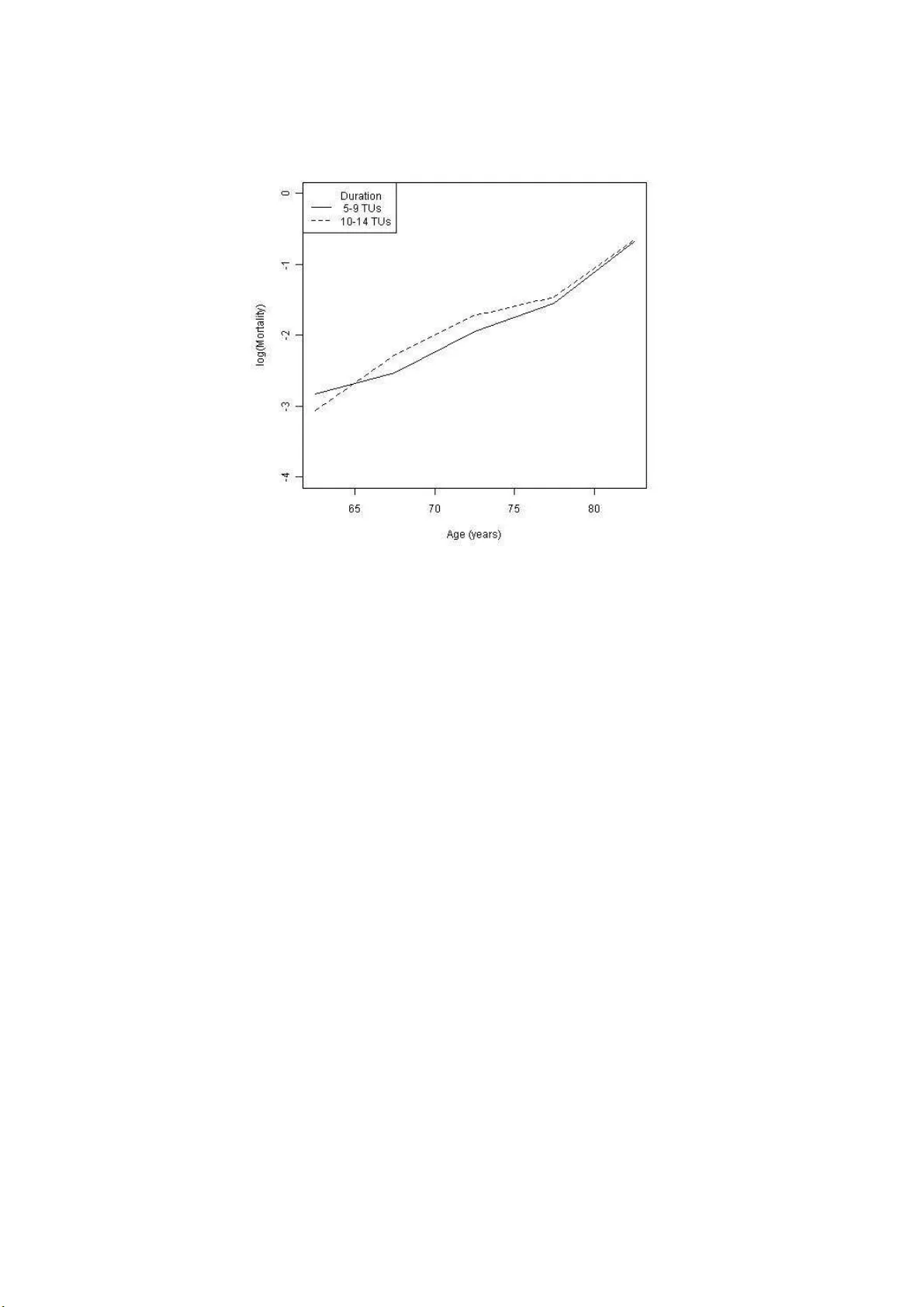
F ast Calculation of Calenda r Time-, Age- and Duration Dep endent Time at Ris k in the Lexis Space Ralph Brinks ∗ Institut e for Biomet ry and Epidem iolog y German Diab et es Center D ¨ usseldorf, Germ an y In epidemiology , the p erson-yea rs metho d is broadly used to estimate the incidence rates of health related ev ents. This needs determination of time at risk stratified b y p erio d , age and sometime s b y duration of disease o r exp osition. The article d escrib es a fast method for calculating the time at risk in t wo - or three-dimensional Lexis diagrams b ased on Siddon’s algorithm. Keywor ds: p erson-y ears method, Lexis diagram, Sidd on’s a lgorithm. 1 Lexis diagram and p erson-y ea rs m etho d In epidemiology , oftentimes relev an t eve n ts or outcomes simulta neously dep end on dif- feren t time scales: age of the su b jects, calendar time and du ration of an ir r ev ers ib le disease. In ev ent history analysis, [5], a useful concept is th e L exis diagr am , whic h is a co-ordinate system with axes calendar time t (abscissa) and age a (ordinate). The calendar t ime dimension sometimes is referred to as p erio d. Eac h sub ject is represented b y a line segmen t from time and age at entry to time and age at exit. Ent ry and exit ma y b e b irth and death, resp ectiv ely , or en try and exit in a epidemiologica l s tudy or trial. There are excellen t and extensiv e in tro ductions ab out the th eory of Lexis d iagrams (see for example [3], [4], [1] and references therein), whic h allo w s to b e sh ort here. When it comes to irreversible diseases, the commonly used t wo-dimensional Lexis diagram with axes in time and age direction may b e generalized to a three-dimensional co-ordinate system with d isease duration d represent ed b y th e app licate (z-a xis). If a su b ject d o es not get the disease during life time, the life line remains in the time-age -plane parallel ∗ rbrinks@ddz.un i-duesseldorf.de 1 to the line b isecting abscissa and ordinate. With other w ord s, the life line for the time without disease p oin ts in the (1 , 1 , 0) direction (where the triple ( t, a, d ) denotes the co-ordinates in time, age and duration d irection, resp ectiv ely). Ho w ev er if at a certain p oin t in time E the disease is diagnosed, the life line c hanges its direction, henceforth p oin ting to (1 , 1 , 1). The situatio n is illustrated in Figure 1 . The life lines of t w o su b jects are sho wn in the three-dimensional Lexis space. At time of b irth (denoted B n , n = 1 , 2) b oth sub jects are d isease-free; b oth life lin es go to the (1 , 1 , 0) dir ection. Th e fi rst su b- ject gets the d isease at E , and henceforth the life line is parallel to (1 , 1 , 1) until death at D 1 . The second sub ject remains without th e disease for th e wh ole life, wh ich ends at D 2 . Figure 1: T h ree-dimensional L exis diagram with t wo life lines. Abscissa, ord inate and applicate repr esen t calendar time t , age a and dur ation d , resp ectiv ely . The life lines start and end at birth B n and d eath D n , n = 1 , 2 . T he fir st sub ject gets the disease at E . Then, th e life line c hanges its dir ection. The s econd sub ject do es n ot get the disease, the corresp ond in g life line r emains in the t - a -plane. In order to measure the frequency of ev en ts in a p opulation, suc h as onset of a c hronic disease, the p erson-y ears metho ds records the num b er of p eople who are affected and the time elapsed b efore the ev en t o ccurs. Th e p erson-y ears incidence rate λ is estimated b y λ = e m , (1) where e is is the num b er of ev ents and m is the n umber of p erson-ye ars at risk [7, p. 250ff]. Calendar time and age often are imp ortan t determinan ts for o ccurr en ce of ev ents and ha v e to b e tak en in to account. This usually is ac hiev ed by dividin g the sub jects’ time sp ent in the stu dy in to calendar time and age groups. Let e ij b e the num b er of ev ents taking place while su b jects are in time and age group ( i, j ) . F urthermore, let m ij 2 b e th e total time at risk sp ent in this group, then Equation (1) b ecomes λ ij = e ij m ij . In the planar Lexis diagram it is clear, h ow the time at r isk m ij can b e obtained. Let the time and age group ( i, j ) b e defined by Cartesian pro du ct S ij := [ t i − 1 , t i ) × [ a j − 1 , a j ). Eac h sub ject whose life line intersects w ith the rectangle S ij con tr ib utes b y its time at risk in S ij . T o b e precise, m ij is the su m of all the sub jects’ times at risk sp en t in S ij : m ij = N X n =1 ℓ ( n ) ij , (2) where ℓ ( n ) ij is the time at risk of sub j ect n, n = 1 , . . . , N , in the rectangle S ij . Again, these ideas can b e generalized to three-dimensional case: Th en, e ij k is the n um b er of even ts taking p lace in the rectangular hexahedron S ij k := [ t i − 1 , t i ) × [ a j − 1 , a j ) × [ d k − 1 , d k ) . F or the times at risk m ij k it h olds m ij k = N X n =1 ℓ ( n ) ij k , (3) where ℓ ( n ) ij k is the time at risk of sub j ect n in volume elemen t S ij k . Giv en a certain study p opulation o f size N , the question a rises ho w the sub jects’ con tr ib utions ℓ ( n ) ij k to the ov erall time at r isk m ij k sp ent in S ij k can b e calculat ed. Since N ma y b e large (up to sev eral thousand), some atten tion sh ould b e paid to computation time. The solution is straigh tforw ard by noti ng that the question is very similar to the problem of f ollo wing a radiological path through a v oxel grid in tomography or ra ytracing in compu ter graph ics. F or b oth fields , tomography and ra ytr acing, there is an ongoing researc h effort to efficie n tly discretize con tinuous lines (radiologi cal paths or rays of ligh t). This article has b een insp ired by the seminal w ork of Sid don, [6]. 2 Intersecting life lines with vo xels in the Lexi s diagram Since the algorithm pr esen ted in this section is motiv ated from the field of computer tomograph y , some of the terminology is u seful. T ypically one of the sets S ij k resulting from a p artition of a r ectangular hexahedron (right cub oid) in to congruent v olume ele- men ts, is called a voxel . The six faces of eac h vo xel are subs ets of t wo adjacen t planes parallel either to t he t - a -plane, a - d -plane or t - d -plane. Hence, th e vo xel space comes along with a set of equid istan t, parallel planes wh ic h are p erp endicular to the abscissa, ordinate or app licate and whic h are defined b y the u nion of all vo xel faces. These planes pla y a cru cial role in the algorithm. 3 In this article all v o xels S ij k are consid er ed to b e cubical, with all edges having the length t r , t r > 0 : S ij k := [ t r · ( i − 1) , t r · i ) × [ t r · ( j − 1) , t r · j ) × [ t r · ( k − 1) , t r · k ) . (4) These vo xels form a grid where the life lines of all sub jects in the study are sorted in to. As a consequence of cubical v oxels, the temp oral r esolution with resp ect to calendar time, age an d dur ation is the same. Ho wev er, generaliza tion to partitions usings rectangular v o xels with height , length and depth b eing different is easily p ossible. The main idea for calculat ing the ℓ ( n ) ij k in the life line L n of sub ject n starting at en try p oint B n := ( t ( n ) 0 , a ( n ) 0 , d ( n ) 0 ), e nding at exit p oin t D n := ( t ( n ) 1 , a ( n ) 1 , d ( n ) 1 ), is the parameterizatio n in th e form L n : B n + α · ( D n − B n ) , α ∈ [0 , 1] . Note, that t ( n ) 1 − t ( n ) 0 = a ( n ) 1 − a ( n ) 0 = d ( n ) 1 − d ( n ) 0 =: ∆ t ( n ) . Using this parameterizatio n, all parameters α ( n ) ∈ [0 , 1] are calculated where an inte rsection with a v o xel face tak es place. Since the v o xels are arranged in a regular grid, in tersecting one of the v o xel faces is equiv alent with intersec ting one of the t - a -, a - d - or t - d -planes formed by the union of all v o xel faces mentioned ab o ve. Hence, we calcula te the inte rsections w ith these planes. Let us start with the a - d -planes (p erp en dicular to the t -axis): all those α ( n ) t where an in tersection with an a - d -plane o ccurs are giv en by α ( n ) t ( u ) = u · t r − ( t ( n ) 0 % t r ) ∆ t ( n ) , u = 1 , . . . , U ( n ) , where % is the m o dulo-op erator and U ( n ) denotes the n um b er of intersected a - d -planes: U ( n ) = j t ( n ) 1 / t r k − j t ( n ) 0 / t r k . Similar formulas hold for those α ( n ) a ( v ) , v = 1 , . . . , V ( n ) , and α ( n ) d ( w ) , w = 1 , . . . , W ( n ) , where L n in tersects the t - d - or t - a -planes, resp ectiv ely . No w define the set A n := { α ( n ) t ( u ) | u = 1 , . . . , U ( n ) } ∪ { α ( n ) a ( v ) | v = 1 , . . . , V ( n ) } (5) ∪ { α ( n ) d ( w ) | w = 1 , . . . , W ( n ) } , whic h con tains those α ( n ) ∈ [0 , 1] where an in tersection o ccurs. No te that th e three sets on the righ t-hand s ide of Eq u ation (5) are not necessarily disjoint . Multiple v alues o ccur if an inte rsection happ ens to b e on an edge or ve rtex of a v o xel. Let A ⋆ n := A n ∪ { 0 , 1 } b e o rdered ascendingly A ⋆ n = { α ( n ) ( p ) | p = 1 , . . . , P ( n ) } with 0 = α ( n ) (1) < · · · < α ( n ) ( P ( n ) ) = 1 . F or calculating the ℓ ( n ) and the asso ciated vo xel indices i, j, k , w e ha ve follo wing algorithm: 1. F or eac h sub ject n , n = 1 , . . . , N , calculate the set A ⋆ n as ab o ve and sort t he elemen ts α ( n ) ( p ) , p = 1 , . . . , P ( n ) , in ascending order. 4 2. F or p = 1 , . . . , P ( n ) set ( i p , j p , k p ) := $ B n + α ( n ) ( p ) · ( D n − B n ) t r % , (6) where th e d ivision is tak en comp onent wise. 3. Then, calculate ℓ ( n ) i p j p k p = α ( n ) ( p + 1) − α ( n ) ( p ) · ∆ t ( n ) , p = 1 , . . . , P ( n ) − 1 . (7) F or eac h vo xel ( i, j, k ) su mming up all the times ℓ ( n ) ij k , n = 1 , . . . , N , b y Equ ation (3) yields the time at risk m ij k in p erio d-, age- and duration class ( i, j, k ) , wh ic h can b e used in th e p erson-years metho d. The idea of calculati ng the intersecti on p oin ts with th e v o xel faces goes b ac k to Rob ert L. Siddon. The a lgorithm prop osed by Siddon has b een dev elop ed for ra ytracing in tomograph y , wh ere several millions of paths ha v e to b e computed to form a radiological image. While the imp lementati on provi ded with this article is not tuned for efficiency , remark able sp eeding up is p ossible [2]. The execution of 500 runs of an R (The R F ound ation for S tatistica l Compu ting) implement ation of the algorithm with th e data of 200 p atien ts (equiv alen t to a total of 10 5 patien ts) on a 2.6 GHz p ersonal computer tak es 92 seconds. The (simulated) patien t data set is describ ed in more detail in the next section. 3 Exa mples An implem ten tatio n of the metho d in this article h as b een tested with sim ulated patien t data. A study p opu lation of 200 sub jects with entry age 55 to 85 b orn b et w een 0 and 15 (TUs) su ffering from a c hronic d isease for 3 to 15 TUs at is the time of en tr y is assumed to h a ve the mortalit y rate m ( a, d ) = exp( − 10 + 0 . 1 · a ) · (1 + 0 . 1 · d ) . Exit from the s tu dy is assu med to b e only du e to death (no censoring). The aim is to unfold the m ortalit y rate from these patien t data. 5 F or setting u p the data set, follo wing cod e has b een used: for(patN r in 1:200){ thisPatI nAge <- runif(1, 55, 80) thisPatB irth <- runif(1, 0, 15) thisPatD uration <- runif(1, 3, 15) F <- fct_F(thi sPatInAge , thisPatDur ation) thisPatD eathAge <- round( which.mi n(runif(1) > F) + t hisPatInA ge + (runif(1) - 0.5), 3) patMatri x[patNr, ] < - c(thisPatBi rth, th isPatInAge , thisPa tDuration , thisPatD eathAge) } F or the simulatio n of the age of death, inv erse transform sampling is used: ( which.min (runif(1) > F) ). Th erefor the cumulati v e distribution f unction F ( t | a 0 , d 0 ) for someone who ente rs the stud y at age a 0 and ha ving got the disease for d 0 TUs is calculate d in the fun ction fct_F : F ( t | a 0 , d 0 ) = 1 − exp − Z t 0 m ( a 0 + τ , d 0 + τ )d τ . If the alorithm is applied to this d ata set with t r = 5 , it is p ossible to estimate the mortalit y rate m ( a, d ) b y the p erson-y ears metho d. T he resu lt is shown in Figure 2. 6 Figure 2: Age- and duration sp ecific mortalit y as estimated by th e p erson-y ears method. 4 Conclusion This article is ab out an extension of the p erson-yea rs wh en p erio d-, age- an d duration- effects o ccur. The metho d to calc ulate the time at risk is based on ra ytracing tec hn iques used in tomograph y and provi des a fast wa y to follo w the individual life lines of sub jects in the L exis diagram. The algorithm is able to treat tw o cases 1. ca lculate the time at risk for n ewly incident cases, and 2. ca lculate the time at risk , where the time elapsed after an ev en t (e.g. duration since onset of a disease) is relev an t. In the first case, the life lines are lo cated in the t - a -plane, in the second the life lines are p oin ting to the (1 , 1 , 1) direction. The later case is imp ortan t, when the duration is a co v ariable. Th is migh t b e the case in late sequalae or mortalit y after h a vin g got a disease. Simila rly , b y interpreting the applicate axis (z-axis) as du ration of exp osur e to a risk factor, th e time at risk dep end ing on p erio d, age and d uration of exp osure can b e calculate d. In large p opulations or register data (log 10 N > 5 , times at risk are usually estimated b y a form u la going b ac k to S v erdrup, [1, Sect. 3.2.]. It is n oted that using the metho d describ ed in this article, estimation is n o longer necessary , b ecause give n ent ry and exit 7 times of the sub jects, c alculation o f times at r isk is p ossible at feasible compu tational exp ense. References [1] Bendix C arstensen. Age-P erio d-Cohort Mo dels for the Lexis Diagram. Statistics in Me dicine , 26(15) :3018– 3045, 2007. [2] Mark Christiaens, Bjorn De S utter, Ko en De Bosschere, Jan V an Camp enhout, and Ignace Lemahieu. A fast, cac he-a w are al gorithm for th e calculation of radiologic al paths exp loiting su b w ord parallelism. In Journal of Systems Ar c hite ctur e, Sp e cial Issue on Par al lel Image Pr o c essing , 1998 . [3] Niels Keiding. Statistical interference in the lexis diagram. Philosophic al T r ansactions of the R oyal So ciety L ondon A , 332:487– 509, 1990 . [4] Niels Keiding. Age-sp ecific incidence and prev alence: a statistical p ersp ectiv e. Jour- nal of the R oyal Statistic al So ciety A , 154:37 1–412 , 199 1. [5] Niels K eiding. Even t h istory analysis an d the cross-section. Statistics in Me dicine , 25(14 ):2343– 2364, 2006. [6] Rob ert L. Siddon. F ast Calculation o f the Exact Radiologic al P ath for a Three- Dimensional C T Arr a y. Me dic al P hysics , 12(2):252– 255, 1985. [7] Mark W o o d w ard. Epidemiolo gy: Study De sign and Data Analysis . T exts in statistical science. Ch apman & Hall/CR C, 2005. 8
Original Paper
Loading high-quality paper...
Comments & Academic Discussion
Loading comments...
Leave a Comment