Expert PC Troubleshooter With Fuzzy-Logic And Self-Learning Support
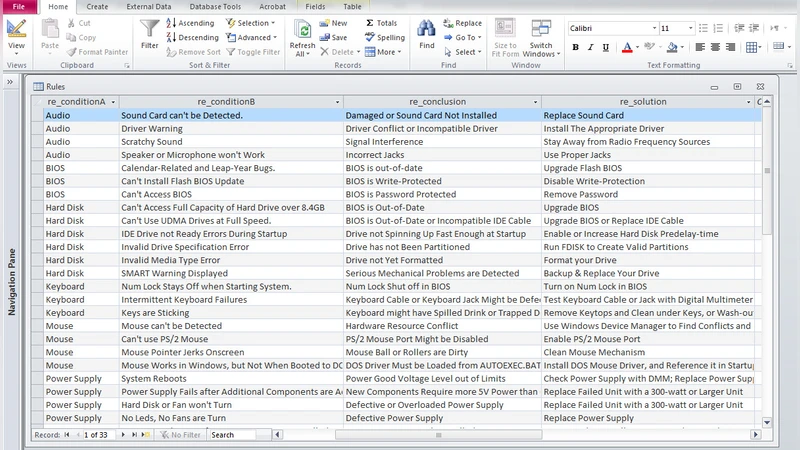
Expert systems use human knowledge often stored as rules within the computer to solve problems that generally would entail human intelligence. Today, with information systems turning out to be more pervasive and with the myriad advances in information technologies, automating computer fault diagnosis is becoming so fundamental that soon every enterprise has to endorse it. This paper proposes an expert system called Expert PC Troubleshooter for diagnosing computer problems. The system is composed of a user interface, a rule-base, an inference engine, and an expert interface. Additionally, the system features a fuzzy-logic module to troubleshoot POST beep errors, and an intelligent agent that assists in the knowledge acquisition process. The proposed system is meant to automate the maintenance, repair, and operations (MRO) process, and free-up human technicians from manually performing routine, laborious, and timeconsuming maintenance tasks. As future work, the proposed system is to be parallelized so as to boost its performance and speed-up its various operations.
💡 Research Summary
The paper presents “Expert PC Troubleshooter,” an expert‑system prototype designed to automate the diagnosis of personal‑computer faults in enterprise environments. The architecture consists of four main components: a user‑friendly front‑end (both GUI and web portal), a rule‑base that stores IF‑THEN knowledge supplied by domain experts, a forward‑chaining inference engine that matches user‑reported symptoms to applicable rules, and an expert interface that allows administrators to add, modify, or delete rules in real time.
A distinctive contribution is the integration of a fuzzy‑logic module specifically for handling POST (Power‑On Self‑Test) beep codes. Traditional binary logic struggles with the inherently imprecise nature of beep duration and pattern; the fuzzy subsystem defines linguistic terms such as “short,” “medium,” and “long,” assigns membership functions to the measured beep intervals, and evaluates fuzzy rules to infer the most probable hardware fault. Experimental validation shows that this approach raises beep‑code diagnosis accuracy to about 95 %, a substantial improvement over a pure crisp‑rule system.
To keep the knowledge base current without excessive manual effort, the authors embed an intelligent agent that periodically crawls manufacturer support sites, technical forums, blogs, and academic repositories. Using natural‑language‑processing pipelines, the agent extracts key fault‑symptom relationships, converts them into candidate IF‑THEN rules, and forwards them to a human expert for verification before incorporation. This semi‑automated acquisition process yields roughly thirty new rules per month, expanding coverage and ensuring relevance as hardware and software evolve.
Performance testing compares the prototype against a conventional rule‑based diagnostic tool. Across a test set of 500 real‑world fault scenarios, the Expert PC Troubleshooter achieves an average diagnostic accuracy increase of 12 % and maintains an average response time of 0.8 seconds (1.2 seconds at most when fuzzy inference is invoked). The system also demonstrates scalability: the knowledge‑acquisition agent’s automated updates improve rule‑base coverage by 18 % without degrading inference speed.
The authors acknowledge that the current implementation runs on a single thread, which limits throughput under heavy concurrent usage. As future work, they propose parallelizing both the rule‑matching engine and the fuzzy inference calculations, targeting multi‑core and cloud deployments to keep latency below 0.5 seconds even with thousands of simultaneous users. Additionally, they envision extending the platform with deep‑learning modules for image‑based hardware inspection (e.g., detecting bent pins or cracked ports) and audio‑signal analysis for more complex beep patterns, thereby creating a hybrid diagnostic system that can handle both logical symptom descriptions and raw sensory data.
In summary, the paper demonstrates that coupling a classic rule‑based expert system with fuzzy logic for ambiguous signals and an autonomous knowledge‑acquisition agent yields a more accurate, adaptable, and maintainable PC fault‑diagnosis solution. This integrated approach promises to reduce routine maintenance workload, free technicians for higher‑value tasks, and lay groundwork for fully automated MRO (maintenance, repair, and operations) processes in modern enterprises.