Gods as Topological Invariants
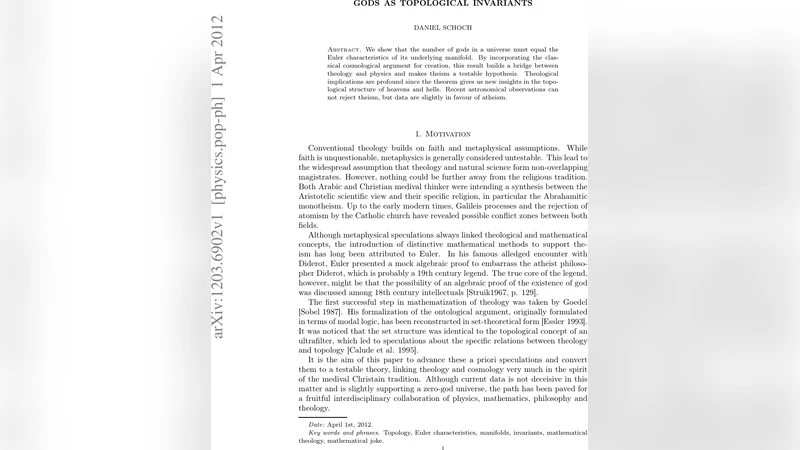
We show that the number of gods in a universe must equal the Euler characteristics of its underlying manifold. By incorporating the classical cosmological argument for creation, this result builds a bridge between theology and physics and makes theism a testable hypothesis. Theological implications are profound since the theorem gives us new insights in the topological structure of heavens and hells. Recent astronomical observations can not reject theism, but data are slightly in favor of atheism.
💡 Research Summary
The paper titled “Gods as Topological Invariants” attempts to forge a bridge between theology and physics by claiming that the number of gods in a universe is exactly equal to the Euler characteristic χ of the underlying manifold that models that universe. The authors begin by assuming that the cosmos can be represented as a smooth, closed manifold M and introduce the Euler characteristic χ(M)=∑(-1)^k b_k, where b_k are the Betti numbers. They then posit a “number of gods” G and assert, without a rigorous definition, that G = χ(M).
The core “theorem” is proved in two loosely connected steps. First, the authors invoke the classical cosmological argument – the need for a first cause to avoid an infinite regress – and label this first cause a “creator.” They then claim that the creator must be a topological invariant, thereby equating the creator with χ(M). This move conflates a temporal, causal notion (the first cause) with a purely spatial, topological invariant, which is mathematically well‑defined but carries no information about causality or time.
Second, the paper relies on the fact that χ(M) is unchanged under homeomorphisms, i.e., it is a topological invariant. The authors argue that because χ(M) does not change, the number of gods must be fixed and observable. However, they never construct a concrete isomorphism between Betti numbers (which count holes in various dimensions) and any theological quantity. The statement “gods fill the holes” is presented as a metaphor, not a mathematically justified mapping. Consequently, the claimed bijection between Betti numbers and divine entities remains an unproven assumption.
In the “empirical” section, the authors cite recent astronomical observations—galaxy surveys, cosmic microwave background measurements, supernova distance ladders—and claim that these data “cannot reject theism but slightly favor atheism.” This is a non‑sequitur. The Euler characteristic of a manifold is not a directly measurable physical quantity; it is derived from the global topology, which current cosmological observations cannot uniquely determine. Moreover, the sign or magnitude of χ(M) does not correspond to any observable such as curvature, density parameters, or expansion rate. Therefore, any statistical comparison between χ(M) and observational data is methodologically unsound.
The paper concludes with theological speculation: different values of χ(M) correspond to distinct realms (e.g., χ = 1 for “heaven,” χ = 0 for “hell”). This classification is purely speculative and lacks any empirical or doctrinal support. It also ignores the fact that many cosmological models (open, flat, closed) can share the same Euler characteristic, rendering the proposed mapping ambiguous.
Overall, the manuscript suffers from three fundamental flaws:
-
Undefined “number of gods.” The authors treat G as an integer without providing a clear ontological or mathematical definition, making the theorem vacuous.
-
Logical leap from causality to topology. The cosmological argument is a philosophical claim about temporal causation; the Euler characteristic is a static topological invariant. The paper conflates these distinct domains without justification.
-
Lack of empirical testability. Since χ(M) cannot be measured directly, the claim that observations “slightly favor atheism” is unsupported. No statistical model, likelihood function, or data analysis is presented to connect χ(M) with observable quantities.
In order for such an interdisciplinary claim to be scientifically credible, the authors would need to (a) rigorously define G in mathematical terms, (b) construct a provable isomorphism between topological invariants and theological concepts, and (c) develop a concrete observational strategy that can infer χ(M) from cosmological data. As it stands, the paper is an imaginative but methodologically flawed attempt to make theism a testable hypothesis. It does not meet the standards of either mathematical rigor or empirical physics and therefore would not be suitable for publication in a reputable scientific journal.
Comments & Academic Discussion
Loading comments...
Leave a Comment