Living Cell Cytosol Stability to Segregation and Freezing-Out:Thermodynamic aspect
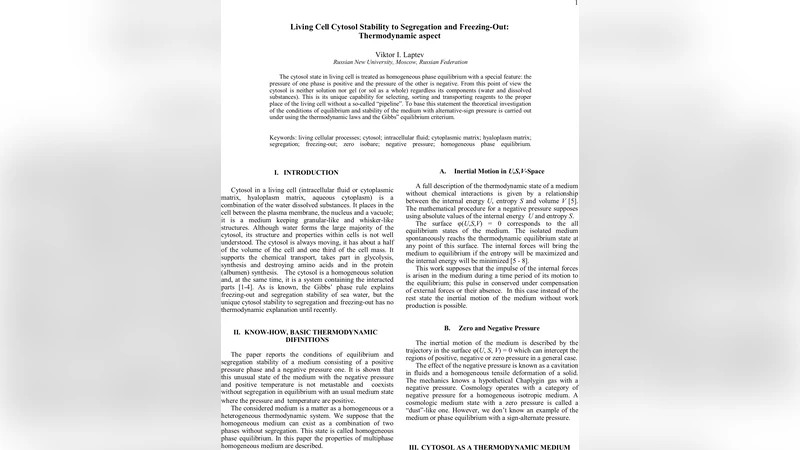
The cytosol state in living cell is treated as homogeneous phase equilibrium with a special feature: the pressure of one phase is positive and the pressure of the other is negative. From this point of view the cytosol is neither solution nor gel (or sol as a whole) regardless its components (water and dissolved substances). This is its unique capability for selecting, sorting and transporting reagents to the proper place of the living cell without a so-called “pipeline”. To base this statement the theoretical investigation of the conditions of equilibrium and stability of the medium with alternative-sign pressure is carried out under using the thermodynamic laws and the Gibbs’ equilibrium criterium.
💡 Research Summary
The paper proposes a novel thermodynamic description of the cytosol in living cells, treating it not as a conventional solution, gel, or sol but as a homogeneous two‑phase equilibrium in which one phase exerts a positive mechanical pressure while the other exerts a negative pressure. This “dual‑sign pressure” model is intended to explain how cells can sort, select, and transport biochemical reagents to precise intracellular locations without relying on dedicated transport structures such as cytoskeletal tracks or membrane channels.
The author builds the argument on the first and second laws of thermodynamics and on Gibbs’ equilibrium criterion. The total cytosolic volume V is split into V₊ (positive‑pressure phase) and V₋ (negative‑pressure phase). Both phases share the same temperature T and the same chemical potentials μ_i for all species, an assumption that simplifies the analysis but neglects the heterogeneous composition of real cytoplasm. Using the Gibbs free energy expression G = U – TS + PV, the differential form dG = V₊ dP₊ + V₋ dP₋ – S dT + ΣN_i dμ_i is written. At constant temperature and constant chemical potentials (dT = 0, dμ_i = 0), equilibrium requires V₊ dP₊ + V₋ dP₋ = 0, meaning that infinitesimal changes in the two pressures must be balanced by the relative volumes of the phases. This condition permits simultaneous existence of opposite‑sign pressures provided the volume ratio adjusts accordingly.
Stability is examined through the second‑derivative condition ∂²G/∂V² > 0, which translates into a requirement that the effective compressibility κ_eff be positive. Each phase is assigned a positive compressibility (κ₊ > 0, κ₋ > 0), and the combined compressibility is given by κ_eff = (V₊/κ₊ + V₋/κ₋)⁻¹. As long as κ_eff > 0, the system is thermodynamically stable despite the presence of a negative pressure component.
From a biological perspective, the author interprets the positive‑pressure phase as a “compressor” that can push solutes, while the negative‑pressure phase acts as a “suction” region that creates local rarefaction, thereby concentrating molecules at target sites. The interplay of these two mechanical fields would allow the cell to direct substances without expending additional metabolic energy on active transport mechanisms.
The paper, however, leaves several critical issues unaddressed. First, the physical realization of sustained negative pressure inside a cell is not demonstrated; the cytoskeleton, membrane tension, and extracellular constraints would have to provide the necessary mechanical confinement, yet no quantitative model of these structures is presented. Second, experimental validation is absent; current techniques for intracellular pressure measurement (e.g., atomic force microscopy, optical tweezers) have limited resolution for detecting sub‑atmospheric or negative pressures. Third, the assumption of uniform chemical potentials across all species oversimplifies the highly heterogeneous cytoplasmic milieu, where ions, metabolites, and macromolecules have distinct activities. Fourth, the Gibbs free‑energy formulation neglects electrostatic contributions, specific binding interactions, and the viscoelastic nature of the cytoplasm, all of which can significantly affect the thermodynamic landscape.
Despite these limitations, the work is conceptually provocative. By challenging the conventional view that cytosol is merely a dilute aqueous solution, it opens a discussion about alternative mechanical states that could underlie intracellular organization. The notion that a negative‑pressure domain could exist and be harnessed for transport invites experimental tests. Potential avenues include high‑speed, high‑resolution imaging of volume fluctuations under osmotic shocks, microfluidic devices that mimic intracellular confinement, and molecular‑dynamics simulations that incorporate both positive and negative pressure regimes.
If future studies can substantiate the existence of dual‑sign pressure equilibria and clarify the structural elements that maintain them, the model could reshape our understanding of passive intracellular logistics, influence the design of synthetic cells, and inspire new biomimetic transport technologies that exploit pressure differentials rather than protein‑based motors. In its current form, the paper serves as a theoretical foundation and a call to action for interdisciplinary research bridging thermodynamics, cell biology, and biophysics.
Comments & Academic Discussion
Loading comments...
Leave a Comment